Trump lands in China to meet Xi: these are the hottest topics
The Chinese and US presidents will address a series of key issues at a time when the two countries are vying for hegemony

-
CAT -
CAST
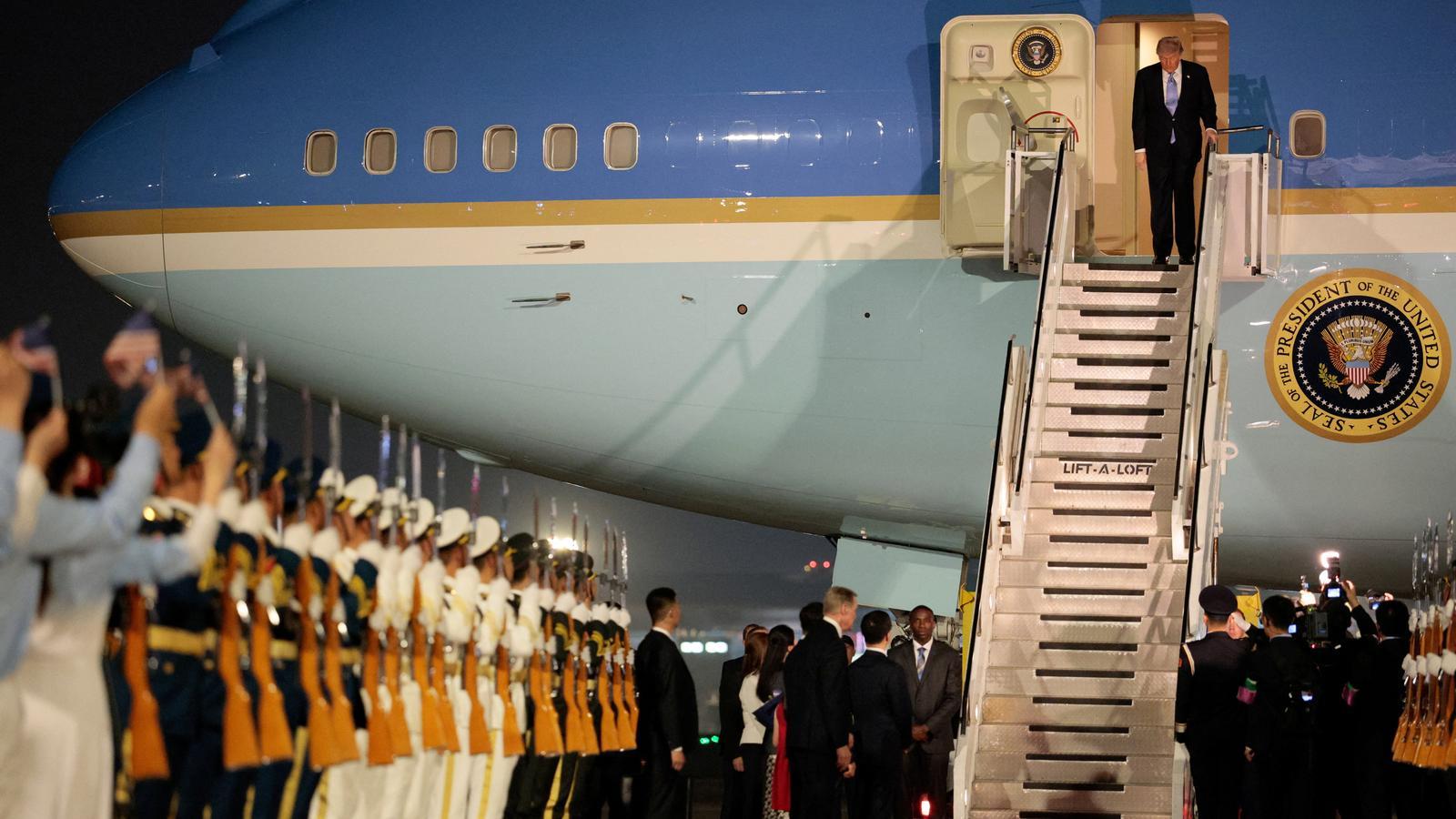
BeijingDonald Trump has landed in Beijing accompanied by a large business entourage and with the message that he wants China to open its large market to American companies. He was received at the foot of the runway by Chinese Vice President Han Zheng, and a small welcome ceremony with 300 children waving flags and a military band. Trump arrived in Beijing at 8 p.m. local time on Wednesday. The official agenda begins on Thursday and includes a reception ceremony, a bilateral meeting with Xi Jinping, a state banquet, and a visit to the Temple of Heaven, one of the emblematic monuments of the capital. On Friday, the two leaders will meet again for a working breakfast before concluding the visit.

It is the second official trip of the North American president to the Asian giant, he visited Beijing in 2017, during his first term. Now Trump is faced with a more competitive and assertive China that rivals the United States. Beijing also faces a more radicalized Trump, who has disrupted the world in just one year of his second term in the White House. Both leaders have an agenda full of key issues. We review them below.
Wars

Donald Trump will seek the complicity of Xi Jinping to persuade Iran to reach a peace agreement and re-establish maritime traffic in the Strait of Hormuz. The United States points out that China is Iran's main trading partner and buys 80% of its oil, so without Beijing's support, the ayatollahs' regime could not survive.
So far, China has limited itself to acting as an observer and demanding an end to the war, which it has called "illegal," and the resumption of maritime traffic. This is its official position, and it remains to be seen if it can take any steps beyond urging negotiations. China is one of the main victims of the crisis, as 45% of the oil and gas it buys circulates through the strait. Furthermore, the joint operation by the United States and Israel against Iran has destabilized its policy in the Middle East. China had been forging alliances and investing in infrastructure in the Gulf monarchies for years, which have now been affected by the crisis.
For the moment, its position with Iran is the same as it has maintained with Ukraine. Despite pressure from the European Union, China has not condemned the invasion, has limited itself to calling for a ceasefire, and has maintained its alliance with Russia. The conflict with Gaza has followed the same policy: despite defending the Palestinians and demanding the creation of a state, it has not cut off relations with Israel.
Tariffs

Trump's visit was designed to stabilize trade relations between the two powers, who are experiencing a delicate trade truce. In 2025, China responded to Donald Trump's tax hikes with the same recipe. The two countries engaged in a tariff escalation that reached unviable tariffs of 145%, which forced them to negotiate a truce. Last October, the two leaders agreed in the South Korean city of Busan to extend the truce for one year. It is now that the foundations of a new agreement should be laid, which will involve maintaining tariffs at a reasonable level and eliminating port barriers to imports.
The United States wants to reduce its trade deficit with China, which in 2025 rose to 202 billion dollars and which, despite pressure, is not decreasing. On the negotiation table is China's commitment to increase purchases of North American agricultural products by Beijing, such as soybeans. Also, the purchase of Boeing aircraft for the commercial fleet of Chinese airlines.
Taiwan

The weakness of Trump's position and his ambiguous stance on Taiwan present an opportunity for China to increase its pressure. Xi Jinping wants Trump to halt arms sales to the island, which the United States Congress approved late last year. Washington is treaty-bound to assist in Taiwan's defense, but Donald Trump has shown less enthusiasm than his predecessor, Joe Biden, in fulfilling this commitment. For Xi, it will be important to secure a clear declaration of support for the "one China" policy and he would wish for Trump to go further and reject supporting Taiwan's independence. From Taipei, there are fears that the island will be used as a bargaining chip to reach trade agreements or support to end the war in Iran.
Artificial intelligence and cybersecurity

The United States are strong competitors in the field of artificial intelligence and robotics. It will be important for China to get Washington to lift restrictions on access to next-generation chips and advanced semiconductors.
Although the two countries mutually accuse each other of cyberattacks, collaboration is on the negotiating table. They are aware of the need to establish security protocols to develop AI, and it is possible they will discuss designing guidelines, even if they are not binding. So far, the only agreement that Xi and Biden managed to sign in 2024 was a basic one to prevent AI products from controlling nuclear weapons.
Rare earths

Rare earth elements have been Beijing's great negotiating tool. These minerals are necessary for sectors such as defense, aeronautics, automotive, clean energy, or semiconductors. Beijing dominates 90% of the rare earth processing market and 70% of its extraction. The decision to restrict access to imports of these materials has been its great card to pressure the United States to lower tariffs. A pressure measure that it has also used with the European Union.

