Von der Leyen swears love to the man of the moment in Europe
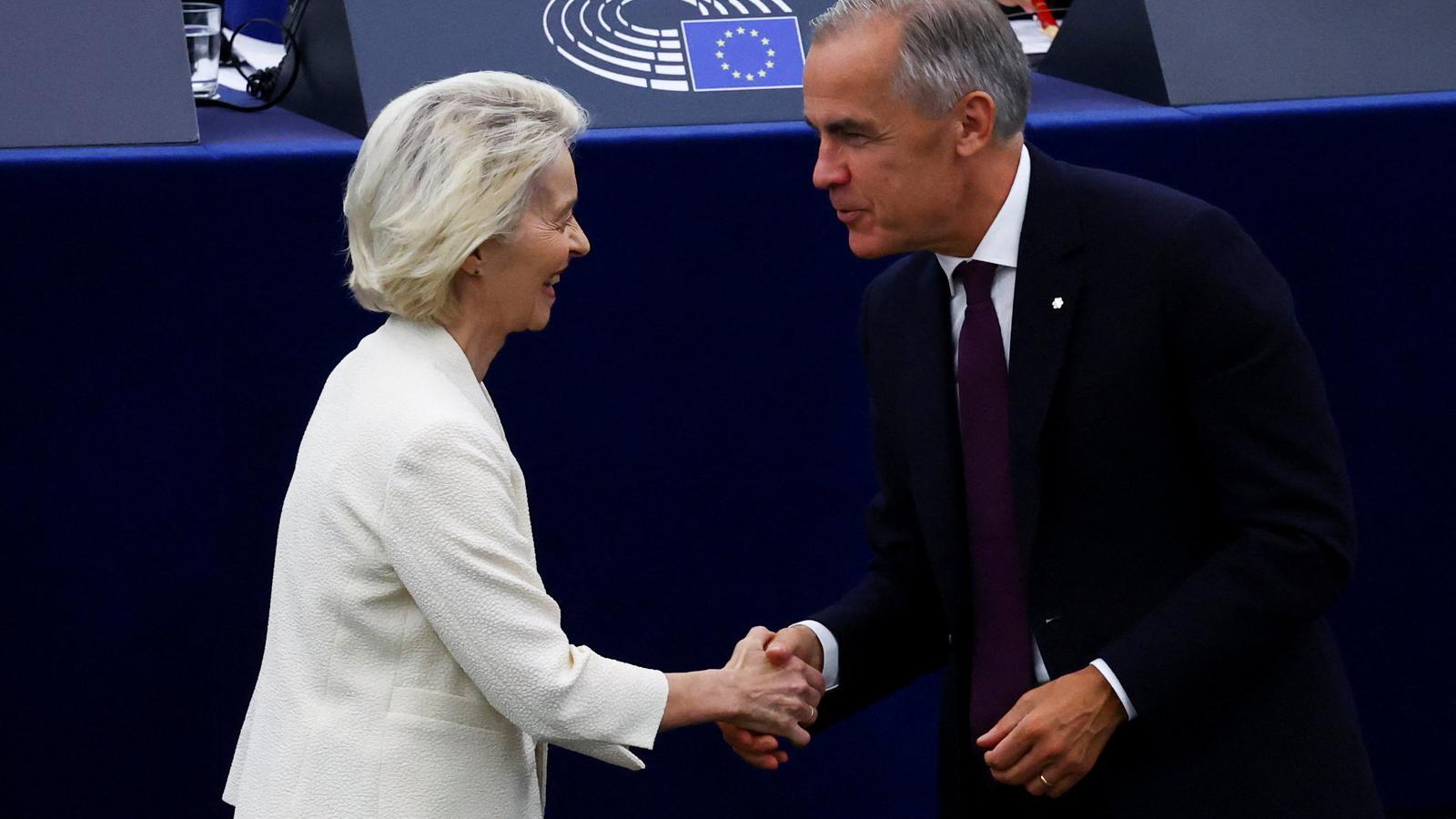

StrasbourgThese are extraordinary times in Europe, and that is why the German Von der Leyen began her speech by quoting the Englishman Charles Dickens: "It was the best of times, it was the worst of times". The writer from Portsmouth, who would now have to show his passport to travel to his beloved Paris, thus defined Europe in the time of sharpened guillotines in France. Von der Leyen updated Dickens's thought before the European Parliament in Strasbourg: "The European Union is stronger than ever, and the European Union may seem more precarious than ever". The paradox is the literary figure that works best in times of despair, of urgency.In the hemicycle, listening to the speech on the state of the Union by the German woman, there was an extraordinary presence, that of another non-EU citizen: Mark Carney, former Governor of the Bank of England and of Canada, now treated as a guru in many European chancelleries thanks to a brilliant speech at the last Davos forum. That day, Carney said some things that community leaders had not dared to utter: he declared the old international order dead; he called on middle powers to unite and take a step forward to stop depending on the big ones; he hinted that it was necessary to stand up to Trump; and he left a monumental phrase: "If you are not at the table, you are on the menu".

The love affair with Mark Carney is, by far, the best news for a European Union lacking good news. It is blindingly obvious that the love is purely self-interested: the Canadian is looking to Europe because he also finds himself immersed in a trade and psychological war with Donald Trump, who threatens to turn Canada into his 51st state. And Europe, even if it denies it, is looking to Ottawa to stand together against Washington. But a reflection often made in the corridors of European institutions is true: Canada has a more European mentality than most Europeans. The President of Finland, Alexander Stubb, went all in this summer: "Wouldn't it be great if Canada were the 28th state of the European Union instead of being the 51st state of the United States?".
These are extraordinary times in Europe, and in the world, and a large part of the EU's path to survival in this landscape of predators involves forging alliances with actors who share at least a similar vision of the global context. We must bring people onto the boomer ship, full of holes, of multilateralism. The announcement of a security alliance with Canada, the United Kingdom, Norway, and Ukraine sails in this direction. As do trade agreements with India, Mexico, or Mercosur. And probably also a possible, albeit risky, major expansion of the community club, with Kyiv – one of the best armies in the world – at the forefront, and the Balkans – territory that flirts with Beijing and Moscow – at the tail end.
The leaders in Brussels, however, must engrave a motto on their foreheads: do not confuse alliance with dependence. The Carney doctrine is urgent today because of the great strategic blunder in the history of the European Union: having delegated to third parties the basic pillars of a power such as productivity, energy, and, above all, security. We know the result all too well: the hihi-haha ended the day Putin invaded Ukraine, Xi Jinping remained Xi Jinping, and Trump conquered and reconquered the White House. Canada is a beautiful country now, but the ballot boxes could mean that, in time, the boreal forests could turn into dangerous forests if a Trump-like figure comes to power in Ottawa.
"Only Europe can provide true sovereignty to Europeans", said Von der Leyen this Wednesday at the beginning of her speech to mark the start of the political term. Certainly, the theory has long been clear: strategic autonomy, an independent Europe.
Putting it into practice is the great problem for the Twenty-Seven, who need time, decisive decisions and, above all, cohesion so that part of the European Commission president's speech this Wednesday stops sounding like a Dickensian Christmas carol.
