Living in Taiwan normally despite the threat of a Chinese invasion next year
Political tension grows in Taiwan, an island where fewer and fewer young people identify as Chinese

-
CAT -
CAST
Taipei (Taiwan)In the summer of 2025, millions of Taiwanese watched on television as the Chinese army blockaded the island and how this caused panic. Hundreds of people looted supermarkets, the internet stopped working, and a few warplanes crossed the sky over the capital. It was fiction. The series Zero day attack broke audience records while generating a deep debate in Taiwanese society: for the first time, fiction imagined an attack by the People's Republic of China. But the possibility of this attack is not fiction, according to a report recently made public by the United States government, in which they state that they have indications of China's intention to invade Taiwan in 2027.
The possibility of being attacked by one of the largest armies in the world is part of everyday life in Taiwan. "People are exaggerating, I don't think anything will ever happen," says Benoît, a Frenchman who has lived in the country for decades. Just as he says it, some air force fighters fly over the sky of the city of Tainan, in the south. "It's normal, routine exercises," he says.
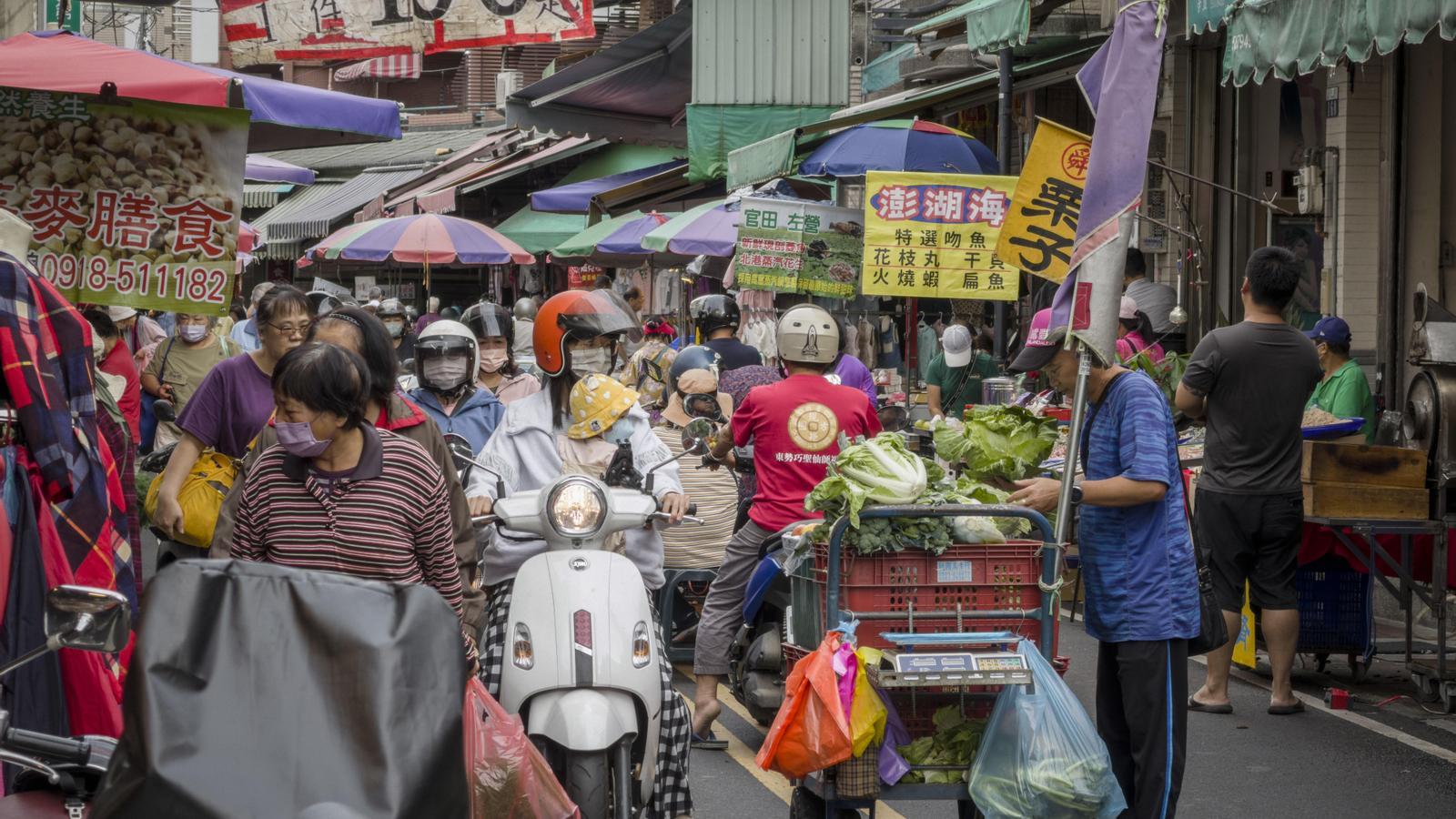
The Taiwanese go about their lives, normalizing what surprises visitors, such as the ubiquitous signs indicating the direction of an air-raid shelter, whether in the Taipei metro, a shopping mall, or a temple. It is normal to see warships in the port and fighter jets flying overhead. Every day, the news reminds us of the exceptionality of this country, where the prime minister does not stop increasing the military budget to defend itself if an attack comes. One day, the news that opens the bulletins is a Chinese drone entering Taiwanese airspace, and the next day, the arrest of a journalist from the CTi News channel accused of working for Beijing's secret services and paying money to former military personnel in exchange for information. Every day, the press normally reports the arrest of someone practicing "unpatriotic activities" on behalf of Beijing.
The threat of invasion by China is not new. Neither is the tension with Beijing. Both countries have already experienced violent armed confrontations in the past, such as the two Taiwan Strait crises of 1954 and 1958, with more than three thousand deaths in combat. In the south of the country, in the city of Kaohsiung, a worker yawns at the exhibition dedicated to the second strait crisis. This museum commemorates the Taiwanese soldiers who, with American support, stood up to much superior Chinese forces. But the museum is empty. No one visits it, and the worker is surprised when the first visitors of the day are foreigners.
For young people, that war is a distant memory. They open businesses, want to visit Europe for holidays, and enjoy a creative cultural life. They spend more time talking about news like that of the American climber Alex Honnold, who climbed the country's tallest building without ropes, than debating a possible war with Beijing. In recent weeks, the most discussed topic on social media was the very high price to see live Korean or Japanese pop groups.
Historically, the United States protects the Taiwanese government, but with the White House opening fronts elsewhere, many Taiwanese fear that Beijing will take advantage of it to attack. "It's hard to imagine a war, but, the way the world is going, who knows," explained Wu Ming-yi, an internationally renowned Taiwanese writer, at a conference. "The most likely scenario is that the day will come when the two governments will agree to reunification without arms, in exchange for guaranteeing a high degree of autonomy for Taiwan," says Benoît, the French citizen. Because, officially, Taiwan is not a country. It could be said that it is a "non-country." "We wonder who we are and what we are. And each person will answer you differently," says Ming-yi.

The only official China
The island of Taiwan is where, in 1949, the nationalist troops of the Kuomintang, led by Chian Kai-shek, took refuge after losing the Chinese Civil War against Mao Zedong's communists. Since then, both states have claimed to be the only official China. The People's Republic of China rules on the mainland, while on the island of Taiwan the name of the state is, officially, the Republic of China, an entity that was recognized by the UN as the official Chinese government until 1971. Then Washington decided to approach Beijing, which led to the UN General Assembly recognizing the delegates of the People's Republic, until then excluded from the international organization, as official representatives, and expelling the Taiwanese. When, in those years, the American Secretary of State, Warren Christopher, visited Taipei, thousands of people received him with insults and by throwing eggs at him. They felt betrayed.
For decades, both governments claimed to be China. But the passage of time has turned past wars into a distant memory. When democracy finally arrived in Taiwan in the 80s and 90s –until then the Kuomintang did not allow elections, using the excuse that a state of exception had to be maintained to protect themselves from the enemy–, political life began to change. In recent years, the green coalition led by the Democratic Progressive Party (PDP) has chained together three consecutive terms, gathering many votes among young people. And this party no longer defends that they are China: the PDP considers Taiwan a separate state from China and promotes its own national identity. A study by the Pew Research Center states that 67% of the population considers themselves Taiwanese only and less than 10% consider themselves Chinese. Among those under 25 years old, 83% consider themselves mainly Taiwanese.
"Taiwan is an independent state. A different reality –defends Wu Ming-yi–. Culturally linked to China, but we are an individual reality".
On the other hand, China continues to assert that Taiwan belongs to them and that, if necessary, they will not rule out using weapons to reclaim the island. Furthermore, the Kuomintang has been left in limbo, as the Taiwanese population does not want unification, and after seeing how Beijing does not respect the promised self-government in Hong Kong, few people want a negotiated unification. Cheng Li-wun, leader of the Kuomintang, has defended in recent days approaching the Chinese government to "avoid a war" in a meeting with Xi Jinping, who made it clear that "we will not tolerate separatism" in Taiwan. A symbol of all this is the tomb of Chiang Kai-shek, who rests in a smaller cemetery and in a small tomb: the father of modern Taiwan wrote down his wish to be buried on the mainland when, as he believed, communism collapsed and China was one again. Ironies of fate, if one day, as he wished, he is buried on the mainland, it would have to be thanks to the communist government of Beijing.

Years ago, when the prestigious International Booker Prize shortlisted Wu Ming-Yi's book The stolen bicycle [The Stolen Bicycle], he was described as a "Taiwanese writer". But a few days later, the prize's website changed the definition to "writer from Taiwan, China". Behind this were pressures from Beijing. "I didn't agree with it, it doesn't define me," complained Wu Ming-yi. "Taiwan already has its own personality and we cannot forget our history, but the pressures from Beijing are evident, also in the world of culture," says Ming-Yi now. "The indigenous populations are still here, we cannot forget them," he adds, referring to peoples who today barely make up 5% of the population, but who had lived in Taiwan for centuries until 400 years ago, when Chinese immigrants began to arrive. And these immigrants spoke two languages, Hoklo and Hakka. "Chiang Kai-shek, considering Taiwan to be part of China, imposed Mandarin, but the local population spoke Hoklo especially," explains Ming-yi. In fact, many people call Hoklo "Taiwanese", a language that is also spoken in mainland China, where it has been persecuted. Promoting languages such as Hoklo, Hakka and indigenous languages has helped to strengthen an identity separate from Beijing.
Street problems
In recent years, more and more young people say that their main concern is the economy, low wages, and obstacles to finding housing, which Beijing has taken advantage of to send the message that they do not have these problems and have a strong economy.
Brian Hioe, an analyst from Taipei, wrote: "In Taipei, it is said that to buy an apartment, you have to go 15 years without eating or drinking. Many young people are disappointed with the PDP because the economy is suffering, but the opposition has not taken advantage of this," as seen in the 2024 presidential elections. However, if two years ago Taiwanese considered the economy their main headache, now they are again worried about a possible war, according to a survey by the Institute for National Defense and Security Research from late 2025.
The television producer Cheng Hsin-mei, creator of Zero day attack, explained in an article that there is "an imminent threat of war, we must accept it." In fact, the current president Lai Ching-te has created new civil defense training projects to prepare citizens in case of an attack. "To ensure Taiwan's security, we hope to rely not only on the armed forces but also on the defensive resilience forces throughout our society. In this way, we will be able to achieve peace through strength," said the leader a few months ago. Some actors, by the way, did not want to participate in Zero day attack, because if they did, their doors could be closed to the giant Chinese market. When a music star or an actor triumphs in Taiwan, Beijing allows them to visit China if they sign contracts stating that they will not make political statements contrary to their interests.
Taiwan and China coexist thus, in a fragile balance. "Young people want to live their lives, love and dream. It is impossible not to think about a future war, but people rebel against it by trying to live a normal life," says Hsin-mei. And Taiwan spends its years trapped between the past and the future. The ruling party does not dare to declare independence so as not to offend Beijing. And the majority of the population is fine with this strange statu quo continuing, as a good part of the young people have other priorities. As a character in the series says: "What do I care what happens in Taiwan if I can be with you?"
