A question gains strength: does China have the capacity to influence the wars in Iran and Ukraine?
Beijing receives the Iranian foreign minister, but continues to show a position of equidistance that could harm its image among allies

-
CAT -
CAST
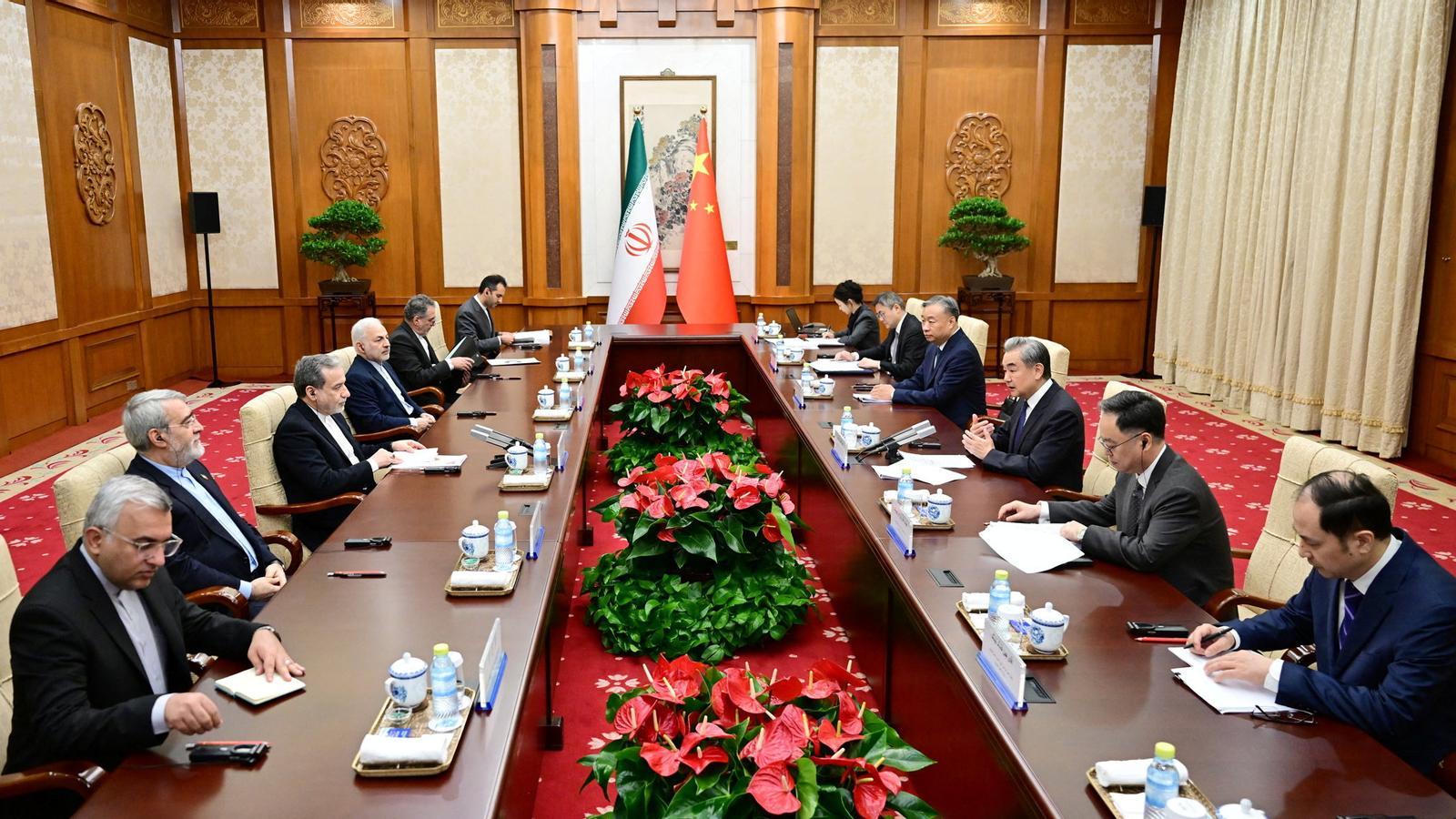
While the Strait of Hormuz remains closed to maritime traffic and Iran and the United States continue to negotiate under the threat of resuming armed attacks, the highest officials of Iranian and Chinese diplomacy have met in Beijing. The Iranian Minister of Foreign Affairs, Abbas Araghchi, traveled to Beijing to meet, this Wednesday, with his counterpart, Wang Yi. It was the first personal meeting since the conflict began. Wang Yi acknowledged the close economic and political ties with Iran and insisted on calling the war "illegitimate". The Chinese diplomat once again called for a comprehensive ceasefire and the reopening of the Strait of Hormuz. He also reiterated China's opposition to sanctions.Wang positioned himself in favor of a solution involving the region's actors. He assured that the Gulf and Middle Eastern countries "should take the reins of their future" and that China supports "the establishment of a regional peace and security framework led by the countries of the region". Since the beginning of the conflict, the Chinese position has been to defend the need to achieve a ceasefire and reopen the Strait of Hormuz to restore world trade. The closure of this route directly affects Chinese interests. China used to buy 80% of Iranian oil, and 45% of the gas and oil imported by the Asian giant circulates through this route.The meeting with the Iranian Foreign Minister comes a week before President Trump's visit to Beijing. A trip scheduled for May 14 and 15, which China has not yet officially confirmed.The war has become the focus of talks that were initially intended to restore trade relations. Donald Trump has requested Xi Jinping's cooperation to reach an agreement with Iran. At the beginning of the week, it was the U.S. Secretary of the Treasury, Scott Bessent, who urged China to influence Iran to reopen Hormuz. And Marco Rubio also joined the pressure in statements to the press from Washington. A whole battery of pressures reminiscent of those deployed by the European Union for China to influence Putin to end the invasion of Ukraine, without success.Beijing's ambiguity
So far, China has limited itself to advocating for diplomatic solutions to conflicts, without getting involved. In the case of Iran, Chinese economic interests are clearer, but it remains to be seen whether China will do anything more than limit itself to statements, as in the case of Ukraine. Unlike the United States, accustomed to using military force, China bases its influence on trade. China has no allies, it has commercial partners. It limits itself to defending its interests under the axiom of not interfering in the internal affairs of its partners. The Asian giant has woven a network of commercial interests and investments to guarantee access to ports and trade routes. Routes and agreements that serve to supply itself with raw materials and to deliver its exports. For example, in these times of energy crisis, China uses its reserves to supply fuel to Southeast Asian countries, highly dependent on the Persian Gulf, and thus strengthen alliances.Officially, it is difficult for China to do anything more than make statements in defense of truces and negotiations. But it is very possible that it is supplying arms to Iran, as the United States has denounced. In the case of Russia, there is no doubt that its economic support helps Putin's regime to survive the sanctions, and there are suspicions that it exports dual-use material, civilian, but which can be used for military purposes.In the process of militarization
But in addition to the lack of will, Beijing also lacks the military capacity to confront the United States. The Chinese army has undergone a radical modernization, but it has not yet reached the level of the North American one. China currently only has 3 aircraft carriers compared to the United States' 11, and only has one military base outside its territory. But perhaps the most important thing is that the Chinese army has no experience; it has not participated in real war missions.Trump's erratic position weakens his figure and also that of the United States as a reliable ally on the international stage. This conjuncture facilitates Xi Jinping positioning himself as a stable leader and defender of international order, but it remains to be seen if China will truly benefit from the situation.In a short time, it has seen how important allies, Venezuela or Iran, for example, have been attacked and destabilized by the United States. And surely the next on the list will be Cuba. China's role as a leader of the Global South could deteriorate if it is perceived that being an ally of the Asian giant does not translate into protection against possible aggressions.
