The world looks to Islamabad: talks between the US and Iran hang by a thread
Pakistan has played a key role in reaching a summit that decides whether the conflict can be contained and redirected

-
CAT -
CAST
LondonThe world watches Islamabad and holds its breath. In a conflict marked by widespread distrust, Pakistan has managed to position itself in a unique and privileged place: that of an interlocutor accepted by all and a key player in avoiding the worst-case scenario. The most visible evidence of the imminent summit between Washington and Tehran, scheduled for this Saturday unless it derails before it begins, is twofold. On the one hand, the fragile ceasefire in effect since Wednesday dawn. On the other, the unprecedented fortification of the country's capital, Islamabad, and Rawalpindi, an adjacent city, which function de facto as a single urban complex.
Since Thursday afternoon, according to local media reports, Nur Khan airbase – between 10 and 15 kilometers from the Serena Hotel, the epicenter of the peace talks – has registered intense activity. Several heavy transport planes from the US Air Force have been landing continuously. And just a few minutes ago, US Vice President J.D. Vance has taken off from Washington for Islamabad. Shortly before boarding the plane, Vance said: "We are eager for negotiations." He added that the US is willing to "extend a hand" if the Iranians act "in good faith." However, he warned that if they "try to deceive" them, the United States will not be receptive.
Pakistan has intensified diplomatic efforts on multiple fronts – China, Egypt, Turkey, and Saudi Arabia – to bring the United States and Iran to the same table. President Donald Trump, however, has added a degree of uncertainty to the summit itself, before Vance's trip was made public. In one of his latest messages, he had accused Tehran of doing a "very poor job" by not allowing maritime transit through the Strait of Hormuz. And in the most recent one, less than an hour ago, he commented: "The Iranians don't seem to realize they don't have much room to maneuver, beyond a short-term extortion of the world by using international waterways. The only reason they are still alive today is to negotiate!"

For his part, the president of the Iranian Parliament, Mohammad Bagher Ghalibaf, published on Thursday on X that Lebanon "forms an inseparable part of the ceasefire". In other words, either Israel stops the aggression, which on Wednesday reached unbearable extremesIn any case, in principle, the American side will be under Vance's baton,
In any case, in principle, the American side will be under the baton of Vance, the man from the Trump administration least inclined to give the green light to the attack at the hand of Israeli Prime Minister Benjamin Netanyahu. Information from Al-Jazeera and the Pakistani newspaper Dawn indicates that Jared Kushner, Trump's son-in-law, and the special envoy and friend of the president, Steve Witkoff, as well as General Brad Cooper, who oversees the military operations of the United States in the region, will most likely accompany him.
On the Iranian side, the delegation will include, according to the same sources, the also mentioned President of Parliament, Mohammad Bagher Ghalibaf, and the Minister of Foreign Affairs, Abbas Araghchi, who has already participated in previous nuclear talks with the Americans. It is likely that he will be joined by the Secretary of the Supreme National Security Council and the Deputy Minister of Foreign Affairs.
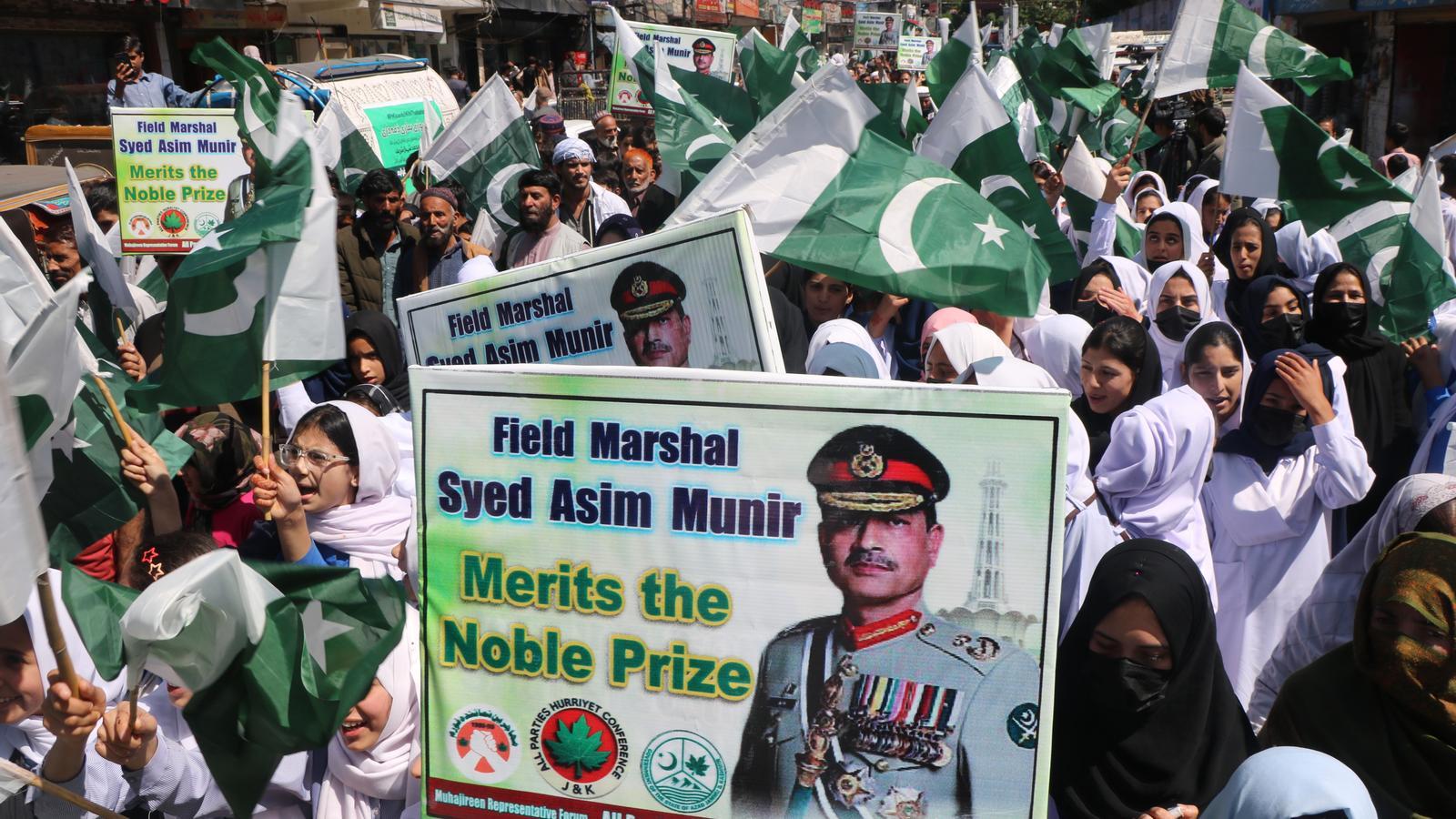
And meanwhile, juggling, Pakistani Prime Minister Shehbaz Sharif will be the host, accompanied by the army chief, Marshal Asim Munir, a friend of Trump, and considered the real strongman of the country. And the Minister of Foreign Affairs, Ishaq Dar.
How did Pakistan get here?
Islamabad's position "is not the result of chance, but of a very specific geopolitical balance," Irene Martínez, a professor at the Institute of Business Administration in Karachi, tells l'ARA. Islamabad maintains direct channels with Washington, but at the same time maintains a "functional relationship with Tehran," fueled by both geographical proximity and sustained contacts between their respective security structures. "There is no other country with this dual operational entry point," points out Martínez.
At stake in Islamabad's talks, above all, is the immediate containment of the conflict and the possibility of opening a broader negotiating path. Very unlikely anything concrete will come out of this weekend. In the best-case scenario, time will continue to be bought. We only need to remember that the agreement between Iran and the P5+1 group, signed on July 14, 2015, in Vienna, which limited Iran's nuclear program in exchange for the lifting of sanctions, was established after more than twenty months of negotiation. Later, during his first term, Donald Trump would disassociate himself. And from that dust comes this mud.
In conversation with l'ARA from Karachi, Irene Martínez assures that Pakistan has opted for a "pragmatic and limited" approach, focused on the security of the Strait of Hormuz, with the aim of achieving tangible results in an area where "global interests are more coincident." This strategy responds to the "window of opportunity" opened by the parties' weariness of the war. But she does not fail to admit "the extreme fragility" of the process, where everything can fall apart at any moment.
From the Pakistani point of view, what is at stake is even more existential. Martínez emphasizes that mediating is "not just a diplomatic option, but a strategic necessity." The country wants to avoid being dragged into a war that could activate military commitments with Saudi Arabia, destabilize its internal front – with a significant Shia community – and compromise its security. The energy crisis due to the strangulation of Hormuz is also another key factor.
For its part, and in statements to Al-Jazeera, retired Rear Admiral Syed Faisal Ali Shah reinforces this idea from a more explicit perspective: Pakistan "is not part of this conflict, but it has direct interests," he recalls. "What happens affects Pakistan and what remains after this war will also have consequences for the country," he states. The conflict directly impacts its security, and also its economy.
At the same time, Pakistan is playing its role as a regional power on the international stage, which on this occasion has been a blow to its historical rival, India. Iran seeks guarantees that "the war will not be imposed on them again in a few months," but will hardly yield on its ballistic missile capability, which it considers essential. This delimits the real scope of negotiations: partial and gradual advances, rather than an immediate structural agreement. In summary, in Islamabad it is decided whether the conflict can be contained and redirected, and Pakistan is risking both its internal and regional stability and its projection as an indispensable diplomatic actor, both in South Asia and in the Middle East.
