The social democrat with an ultra discourse

-
CAT -
CAST
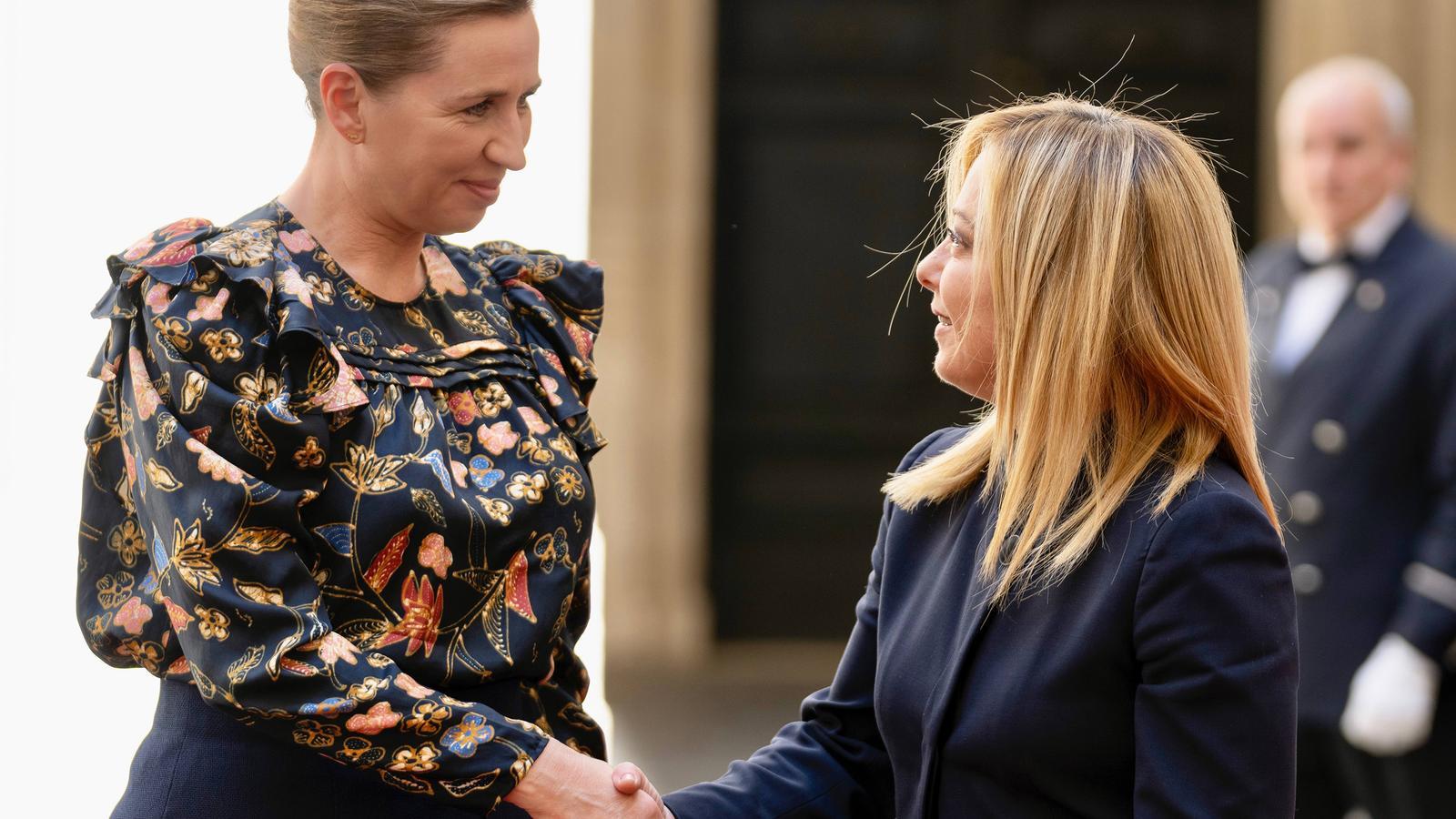
The Danish Prime Minister, Mette Frederiksen, has returned from vacation with a surprising move: a joint statement with her Italian counterpart, Giorgia Meloni, in which both position themselves as the bulwark not only of security in Europe against the "undeniable" dangers of illegal immigration, but also of the traditional Christian values of the Old Continent. Someone unfamiliar with Scandinavian politics might deduce that Denmark's leader is part of an far-right or, at the very least, conservative party. "We are proud of Europe's Christian cultural heritage and we want to protect it. We hope that those who come to our countries and decide to make Europe their home will respect our values and not try to impose a way of life on us that we do not want." A message that could have perfectly come from the mouth of Viktor Orbán, Marine Le Pen, Santiago Abascal, or, indeed, Giorgia Meloni. But it turns out that Mette Frederiksen is a social democrat; one of the few progressive leaders governing in Europe, at least on paper.
But for years, the Danish leader has adopted a hard line against immigration as one of her main political battlehorses and has turned Denmark into one of the most intransigent member states, both with asylum seekers and economic migrants. As early as 2021, during her first term, she set herself the goal of "zero asylum seekers" in Denmark. And that same year, the Danish Parliament approved a controversial law to outsource the processing of applications to countries outside the European Union, specifically, to Rwanda. Thus, a pioneer in a measure that Meloni now champions, following the cooperation agreement with Albania.
This Monday's statement does not represent any change in the Danish leader's stance. It is rather a gesture –laden with demagoguery and opportunism– to take advantage of the crisis in Ceuta to continue reaping political benefits from the anti-immigration discourse: "We do not accept uncontrolled immigration in Europe and have led a strict immigration policy, both in our countries of origin and in Europe". "We are the only two female heads of government in the EU," Meloni and Frederiksen highlight in the statement – even though it is not clear what the value, in this case, of them being women is – and they affirm that they are "united in the desire to protect Europe". They argue that restricting the arrival of migrants and creating return centers in third countries is the "correct" way to do it. "And we believe that millions of Europeans share this conviction," they add. A statement, therefore, that rather than offering new solutions, seeks to emphasize that their stance is the same as that of "millions of Europeans".
Immigration has been a star topic in Danish elections for years, even though migratory pressure in Denmark has nothing to do with that of Southern European countries. Nor can it be compared with the figures of refugees and migrants that its two neighboring countries have traditionally received: Germany, the country that hosted the most refugees in 2015, and Sweden, with the highest figure in relation to its population. Although this has also changed radically over the last decade.
Rise of the traditional far-right party
From the very beginning, Frederiksen has sided with Meloni in calling for Spain's exclusion from the European free circulation area – even though Ceuta is not part of the Schengen area – even though this earned her criticism from members of the government coalition. "Europe must protect its external borders. But we must do so by cooperating. And that is why I do not agree that the Schengen agreement should be suspended," said Magnus Georg Jensen, immigration spokesperson for the Danish Social Liberal Party (Radikale Venstre). The prime minister's move, therefore, could prove dangerous if it fuels internal divisions: Frederiksen has only just started her third government just two months ago, with a coalition more inclined to the left than the previous one.
The crisis in Spain has even led to an urgent debate being called in the Danish Parliament, which has just begun the new political year. It will take place this Wednesday, following pressure from the Danish People's Party (DF, for its Danish acronym), the traditional far-right party in the country that is trying to regain influence after two terms in opposition and with a support in free fall.
Formally, the request for an urgent debate has been submitted by the five right-wing opposition parties, with a broad question for the prime minister and the Minister of Immigration and Integration, Morten Bødskov, also a social democrat. "What can the government say about the consequences for Denmark and Schengen cooperation of the situation in Ceuta, the massive legalization by the Spanish government and the pressure on the EU's external borders; what initiatives will the government take to ensure that the EU's external borders are better protected, and will the government explain how Denmark is prepared to protect our own borders if this becomes necessary?"
The leader of the DF, Morten Messerschmidt, is succeeding in bringing the party back to the media forefront, and just this Monday, the media reported that the party has the highest public support in seven years. With 12.4% of voting intention, the Danish People's Party receives its highest approval rating since April 2019, just before the elections in which Mette Frederiksen first won. In the last elections, held last March, the far-right formation received 9.1% of the votes, while in 2015, at its peak, they had support of over 20%.
And in an attempt to find an explanation for the Danish leader's surprising alliance with Meloni, several analysts point to this rise in the DF's popularity and the classic struggle for hegemony of the anti-immigration discourse.
