The race to enter the EU opens a new fracture in the Balkans
Von der Leyen makes a tour of the region, which demands that its pro-European commitment be translated into real progress

-
CAT -
CAST
BrusselsThe European Union was clear at the start of the Russian invasion of Ukraine that it had to send a political message to Moscow showing that Kyiv is European. The member states agreed in record time to grant Ukraine, and also Moldova, the status of candidate countries to join the community club and open accession negotiations. But this urgent pace, added to the renewed impetus for the accession of Montenegro and Albania, has created a grievance with the rest of the candidates and has opened a rift in the heart of the Balkans.
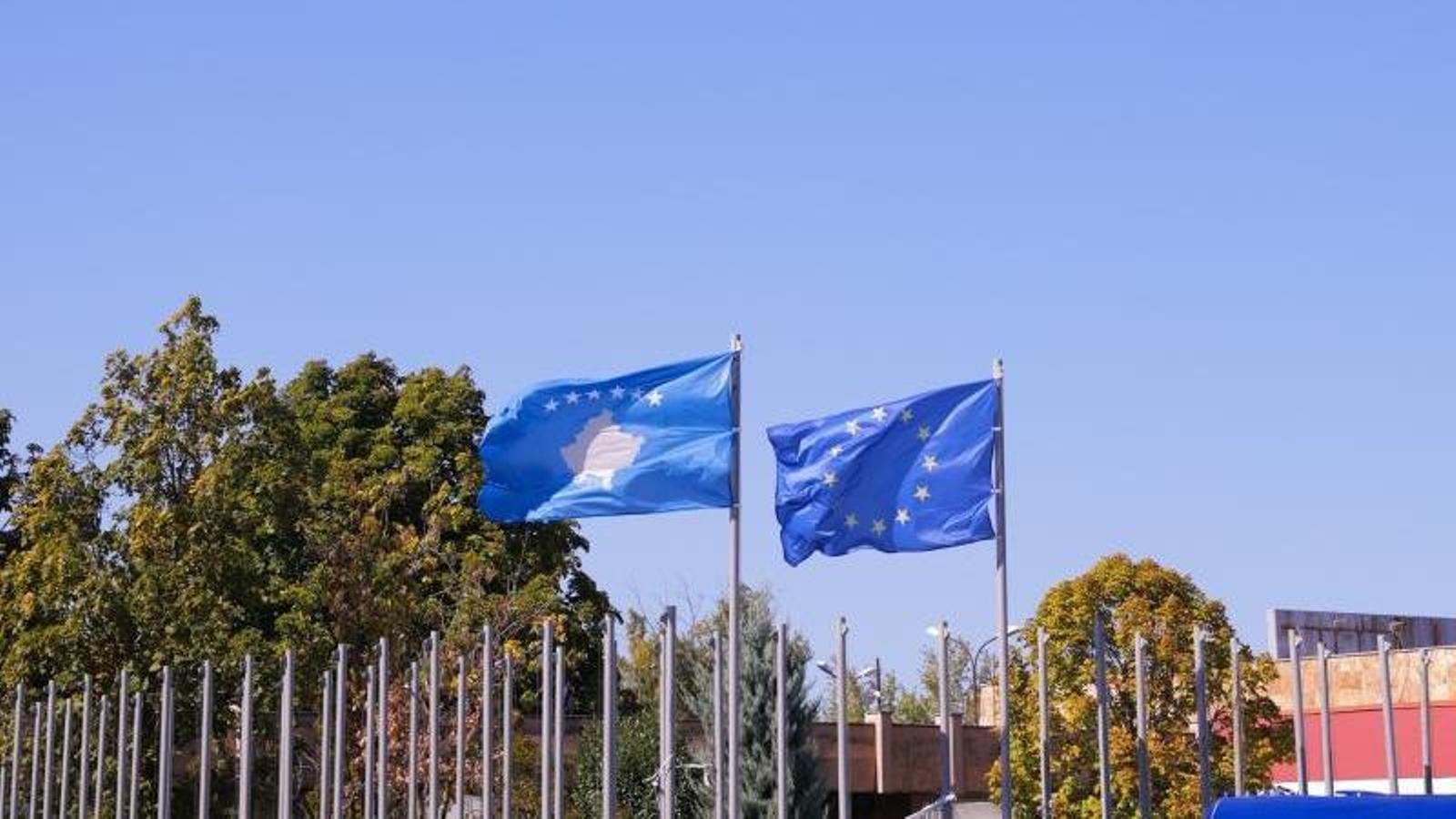
While Brussels presses the accelerator with the four favorite states, countries like North Macedonia, Kosovo, Serbia and Bosnia see how the process to join the community club—which has been going on for more than twenty years—drags on indefinitely. The EU argues that these states are not executing the necessary reforms, but Balkan societies reproach Brussels for applying different yardsticks while euroscepticism grows in the region.
This thorny issue has colored the tour that the President of the European Commission, Ursula von der Leyen, has made through the Balkans this week. The community leader has visited four capitals of a divided region: on one hand, Albania and Montenegro, considered the "star students" in the negotiations; on the other, states like Kosovo or North Macedonia, which demand that their pro-European commitment be translated into real progress. In Serbia and Bosnia, which are also candidates, she did not stop to avoid interfering in the election campaigns currently underway.
The President of the Commission has praised the progress of the candidates—highlighting the leading role of Montenegro, which has carried out 90% of the required reforms—, has confirmed an investment of 6 billion euros in the region and has announced that she will present a specific roadmap of reforms for the most advanced candidate countries—Montenegro, Albania, Ukraine and Moldova—to accelerate their accession to the bloc.
As leaked to the press, the European Commission will propose that these states gradually integrate into the European single market while their accession process is not yet complete. Economic access to the eurozone, however, will be strictly conditioned on these countries adopting EU sanctions and not sharing sensitive technologies with hostile powers. The proposal, which has not yet been made public, points towards a two-speed Europe among the candidates: while some move closer to the club's economic core, others remain trapped in an accession process without a clear date.
In countries less advanced in the negotiations, the conditions imposed by the EU to access the community bloc are perceived as an unattainable horizon and generate deep wear and tear. The case of North Macedonia is paradigmatic. The country, a candidate since 2005, had to change its own constitutional name to satisfy Greece's veto. Despite having met all the Commission's technical requirements, it then encountered a veto from France (which demanded a reform of the accession system) and, later, one from Bulgaria, which demanded bilateral conditions, such as recognizing that the Macedonian language is a dialect of Bulgarian. Currently, despite having formally opened the process in 2022, the country must wait, before opening the negotiating blocks, to modify its Constitution to include the Bulgarian minority. A change that requires the support of two-thirds of its Parliament.
Reluctance
The truth is that both the member states and the European Commission have reservations about the consequences that the entry of new states into the community club could have. On one hand, there is the fear that the entry of new partners could lead to a deadlock in decision-making, as happened with Viktor Orbán's Hungarian government, which used its right to veto in the EU Council to avoid approving aid to Ukraine. In this sense, states like Germany and France have asked to prioritize an internal reform of the mechanisms that require unanimity for any enlargement.
On the other hand, there is the economic concern. The entry of countries with a per capita income much lower than the EU average and with large agricultural sectors (like Ukraine or Moldova) would drastically alter the European budget. According to calculations by the think tank Bruegel, a European Ukraine would receive 85 billion euros annually through the Common Agricultural Policy (CAP). This would drastically reduce the aid received by countries that are currently net recipients of funds (such as Spain, Portugal, Greece, or Poland).
The result of this two-speed accession, however, is that the frustration of some Balkan countries has ended up leading to new alliances. Russia has gained influence in recent years by reaching out to political actors in Serbia and the Republika Srpska of Bosnia, and also through dependence on Russian gas and oil. For its part, China has dedicated itself to financing large infrastructure projects without imposing conditions for political or institutional reforms, and presenting itself as a reliable partner.
