The Malvinas, the Falklands and the infinite match between Argentina and "the English pirates"
The World Cup semi-final coincides with another call from the Casa Rosada to negotiate the return of the archipelago to Buenos Aires

-
CAT -
CAST
LondonHours before England and Norway played on Saturday in Miami in the World Cup quarterfinals, and that Argentina and Switzerland faced each other in Kansas a little later, the Foreign Minister of Javier Milei's government, Pablo Quirno, published a long article in the newspaper La Nación titled "Malvinas: the strength of a just cause". The memory of the 1982 war in which Margaret Thatcher's United Kingdom defeated the Argentine military junta, which wanted to regain sovereignty of the archipelago, remains alive in the imagination of the South American country.
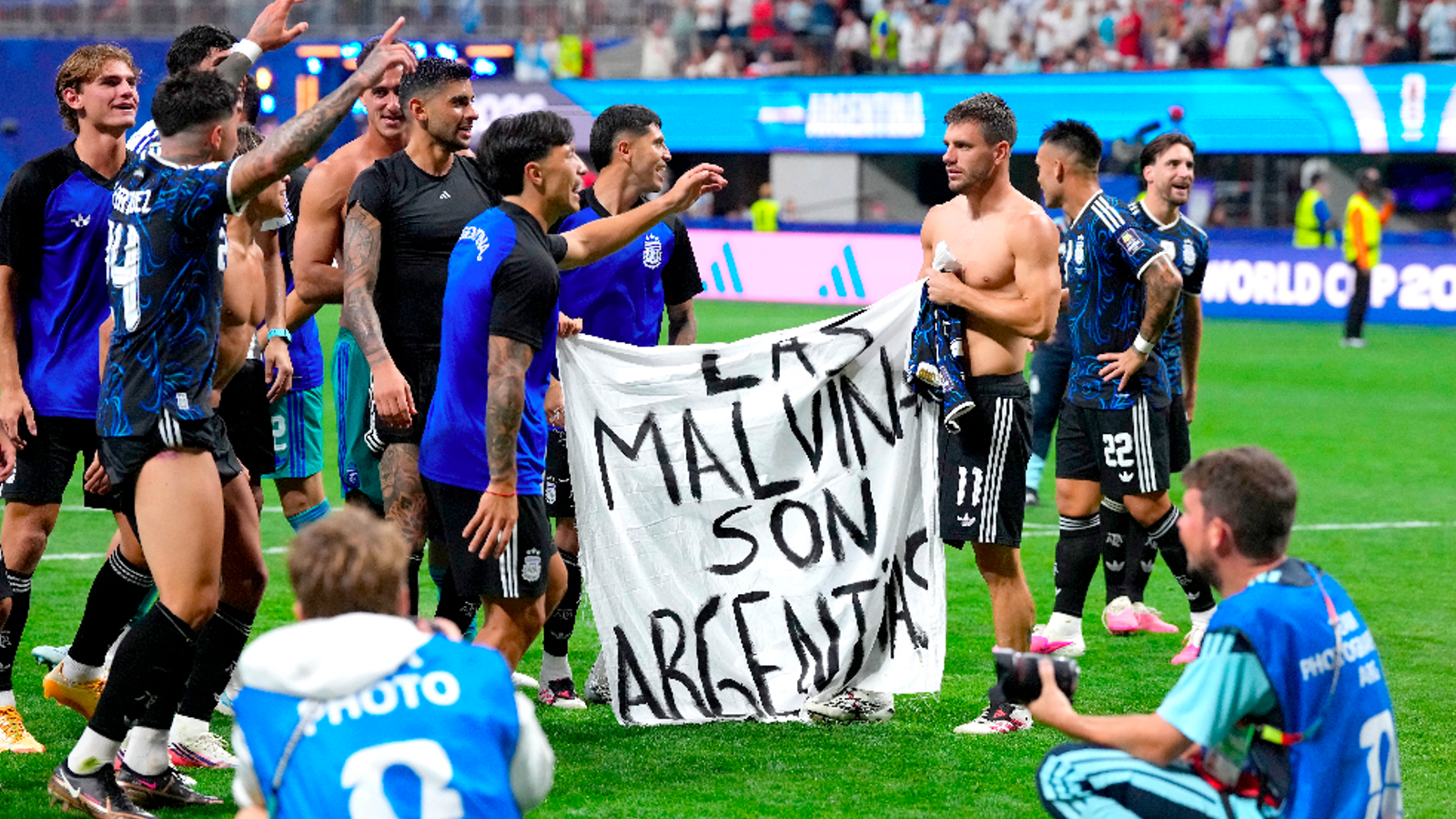
This conflict, which still resonates 44 years later, marked the prelude to this Wednesday's England-Argentina semifinal and also the celebration of the albiceleste after a new agonizing effort to come back from an adverse score in just six minutes. On the grass of Atlanta stadium, Lionel Scaloni's men combined tears of emotion with the vindication of the Malvinas. In the mixed zone, Leandro Paredes was emphatic: "They will always be Argentine".
Quirno's text said nothing that hadn't been heard before in Buenos Aires: that the islands are Argentine, that the British occupation – since 1833 – is illegitimate, and that London should agree to negotiate their return. But the whims of football have meant that those words have resonated with unexpected force. Because the World Cup semi-final bracket certified a new edition of the "infinite match between Argentinians and English, or, as they are still often called in the Río de la Plata, "the English pirates".
That the AFA, the Argentine Football Association, published images of Scaloni's players framing the confrontation as an act of redress "for the Malvinas", as a tribute to Diego Armando Maradona and his Hand of God, and also as recognition for Leo Messi's "last" World Cup has once again shown, paraphrasing Clausewitz, that "football is the art of war by other means".
Especially considering that the World Cups are made to stoke "as much as possible the nationalist spirit: flags, anthems sung with depth, a green field of dispute, unleashed passion… They are metaphors for war", wrote the Argentine political scientist Marcelo Falak this weekendthe Argentine political scientist Marcelo Falak, not precisely a supporter of Milei's anarcho-capitalism, but neither is he a textbook Peronist.
The British press picked up Quirno's words and made the match much more than a game, as did the Argentinians, perhaps more recklessly. In this context, the sensible voice of coach Scaloni tried to temper spirits. In the press conference after the victory against Switzerland, and when asked what he had to say to Argentinians regarding the supposed special significance of the semi-final, the reigning world champion in Qatar commented: "It's a football match, eh? The message is that it's a football match. We're not looking for anything else. We're playing a football match against a great team, which has a great coach, whom I appreciate and admire a lot."
Topics that are true?
It is easy to attribute these readings to the topics of journalism, and perhaps, especially, to sports journalism. But topics always contain doses of truth. He recalled this on Monday on the program Today, from BBC Radio 4, the journalist and writer John Carlin, Barcelonian, British and Argentinian by chance and by choice. "I interviewed Maradona on the pitch of the Azteca stadium while the Argentinian team was training twenty-four hours before the big match [the hand of God match, 1986]. And, being a journalist, I wanted to stir the pot a bit. I asked him: «And what about the war? This will be your act of revenge, your vengeance against the hated "}pirates, to put it that way?” And he replied to me: “No, no, no, no. You journalists are all the same. Always trying to create controversy. It’s just another game. It’s an important game, but we’ll treat the English the same way we treat any other opponent.”
The next day the hand of God arrived. And then the best goal in World Cup history. And a victory that many Argentinians experienced as a symbolic reparation, "as if it were almost more important than winning the war; everyone was talking about the Malvinas".
Before reducing so much rivalry to a simple football legend, it is worth remembering the consequences of the invasion of the archipelago by Leopoldo Galtieri's military junta on April 2, 1982. Throughout the 74 days of conflict, the war claimed the lives of 255 Britons, 649 Argentinians, and three inhabitants of the archipelago. More than 1,600 people were also injured.
National identity
This balance makes it difficult for an England-Argentina to be just a football match. And even more so considering that the belonging of the Malvinas to Argentina is part of the construction of national identity, the opposite of what happens in the United Kingdom, which only remembers, if applicable, the Falklands, when Argentinians claim them or when oil companies see possibilities of extracting crude oil from them.
The new sporting confrontation also came after, last April, a Pentagon memorandum leaked to the British press suggested that the United States was reviewing its position on the sovereignty of the islands as retaliation for London's lack of cooperation following the war with Iran. Javier Milei, one of Donald Trump's closest international allies, insisted at the time that the Malvinas "were, are, and always will be Argentine." The vice president, Victoria Villarruel, went even further, stating that the British who live there should "return to England" someday. In his essay for La Nación, Quirno has cloaked in diplomacy a claim that the Argentine government has never stopped fueling.
Scaloni is the only one who is right when he says it's just a football match. But history never asks permission to rearrange its agents. Chance has willed that an article about the Malvinas coincide with the first semifinal between England and Argentina, although they had previously faced each other in 1998 and 2002.
