Israeli police prevent the Latin Patriarch of Jerusalem from celebrating Palm Sunday Mass for the first time in centuries
The US ambassador and the head of European diplomacy criticize the events, while several leaders consider it an attack on religious freedom
-
CAT -
CAST
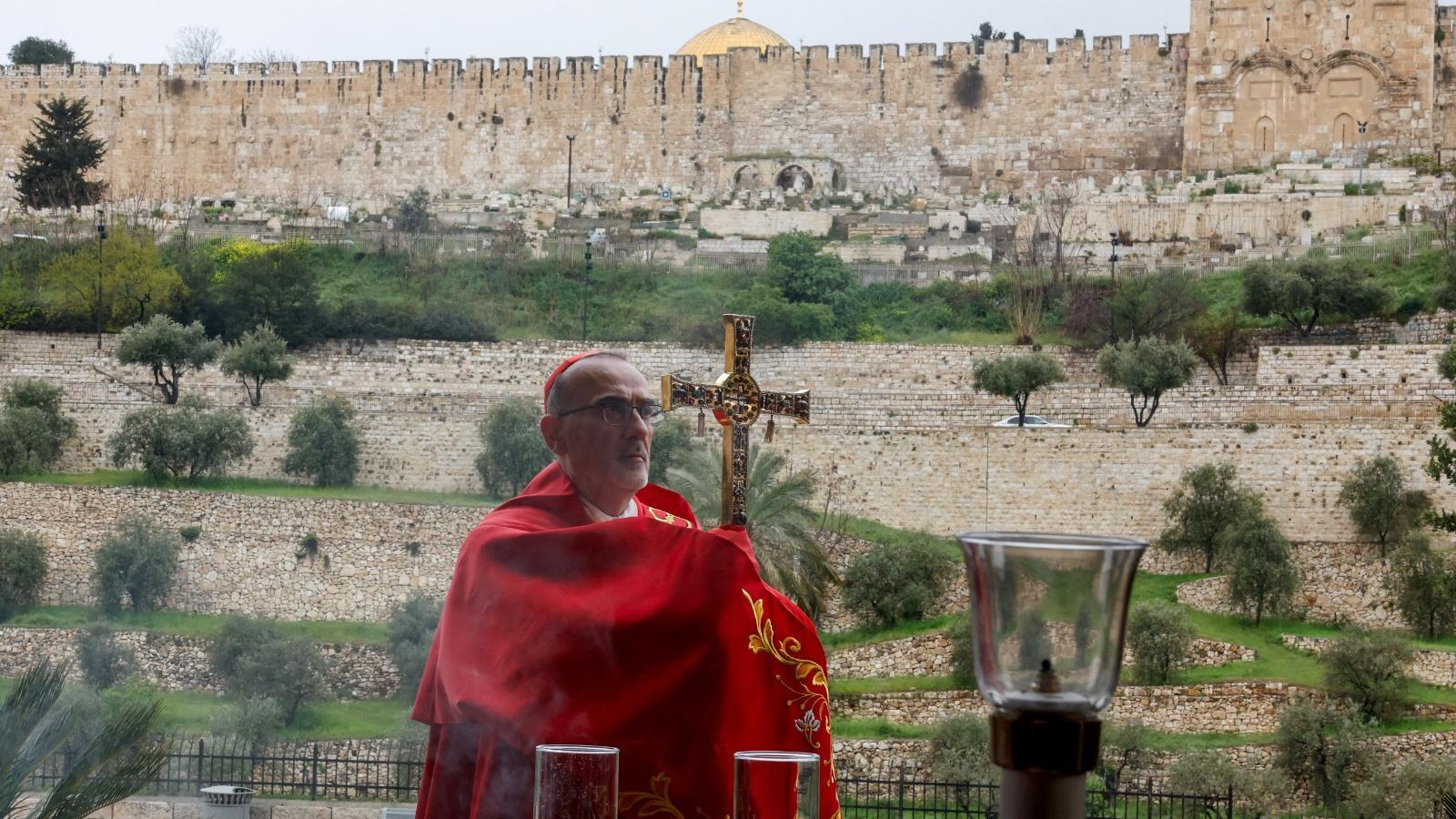
This year's Palm Sunday will be marked as an unusual day in the history of Jerusalem. For the first time in centuries, the Latin Patriarch of Jerusalem, Pierbattista Pizzaballa, the highest representative of the Catholic Church in the Holy Land, has not been able to celebrate Mass in the Basilica of the Holy Sepulchre, because the Israeli police have blocked the entrance to the temple. Holy Week thus begins under exceptional circumstances, without pilgrims, without large processions, and with the image of the Patriarch unable to reach the temple.As reported by the Latin Patriarchate of Jerusalem itself, Israeli agents intercepted the cardinal as he was heading to the Holy Sepulchre with the Franciscan custodian of the Holy Sepulchre, Francesco Ielpo, and forced them to turn back, despite walking “without any sign of procession or ceremonial act”, according to the Patriarchate's statement. Therefore, Mass could not be celebrated. The area has been closed by the police, and Pizzaballa had to limit himself to offering a prayer in the Basilica of Gethsemane.Similarly to what happened during Ramadan, the police ban comes amidst an escalation of the war between the United States, Israel, and Iran, and within the framework of security measures that have kept the main holy sites of the Old City closed, such as the Al-Aqsa Mosque complex, the Western Wall, and the Holy Sepulchre, since March 6. For weeks, Muslim faithful have not been able to access the Al-Aqsa Mosque, nor the Esplanade of the Mosques, nor can they pray outside the walls of the Old City, due to episodes of violence and expulsions by Israeli forces.The Latin Patriarchate has described the measure as “manifestly irrational and very disproportionate” and interprets it as a direct blow to freedom of worship and the sensitivities of millions of faithful worldwide. The Church recalls that it had already complied with all imposed restrictions: public gatherings had been canceled and the traditional Palm Sunday procession from the Mount of Olives to the Old City via the Lion's Gate had been suspended, in view of the Israeli limitation of holding gatherings of fewer than 50 people and provided there is a shelter nearby.Criticism from Italy, Spain, and France
The incident has turned into a diplomatic conflict: the US ambassador to Israel has considered the events an “unfortunate overreaction”, and the head of European diplomacy, Kaja Kallas, has also criticized it. Italian Prime Minister Giorgia Meloni has called it “an offense not only to believers but to any community that recognizes religious freedom.” The Italian Minister of Foreign Affairs, Antonio Tajani, has said that “it is unacceptable that they were prevented from entering,” and added that he has asked the Italian ambassador to Israel to convey Italy’s official protest to his government. The President of the Spanish government, Pedro Sánchez, has also reacted, calling the events “an unjustified attack on religious freedom,” and the French President, Emmanuel Macron, who pointed to a “worrying multiplication of violations of the status of the Holy Places of Jerusalem.”Faced with the avalanche of criticism, Prime Minister Benjamin Netanyahu’s office has assured that it is working on a plan to allow Christian leaders to access and pray at the Church of the Holy Sepulchre in the coming days. According to the Israeli government, and in line with what the police said a few hours earlier, the decision to temporarily restrict access to the holy sites of the Old City of Jerusalem is for strictly security reasons. In a statement published on X, the executive recalls that Iran recently attacked Jerusalem with ballistic missiles, and fragments of one reached a few meters from the Christian temple.“Today, out of special concern for their safety, the Jerusalem police prevented the Latin Patriarch, Cardinal Pizzaballa, from celebrating mass this morning at the Church of the Holy Sepulchre,” says the prime minister’s office. “Again, there was no ill intention, only concern for his safety and that of his entourage.”According to the authorities, their request had not been approved and they had known this since yesterday. “Since the beginning of Operation Roaring Lion, and in accordance with the directives issued by the Home Front Command, all holy sites in the Old City of Jerusalem have been closed to the faithful, especially to those who do not have standard protected spaces, with the aim of safeguarding public safety,” the police said in a statement.The police add that the Old City and the holy sites of Jerusalem “are a complex area that does not allow access for large emergency or rescue vehicles, which significantly hinders response capabilities and poses a real risk to human life in the event of a mass casualty incident.” In some churches, small masses have been held and palms and olive branches have been blessed, but without large crowds, always respecting Israeli regulations. Given the prohibition of usual public events, the faithful will be able to follow the various celebrations online. The Christian Media Center provides access to broadcasts in several languages.
