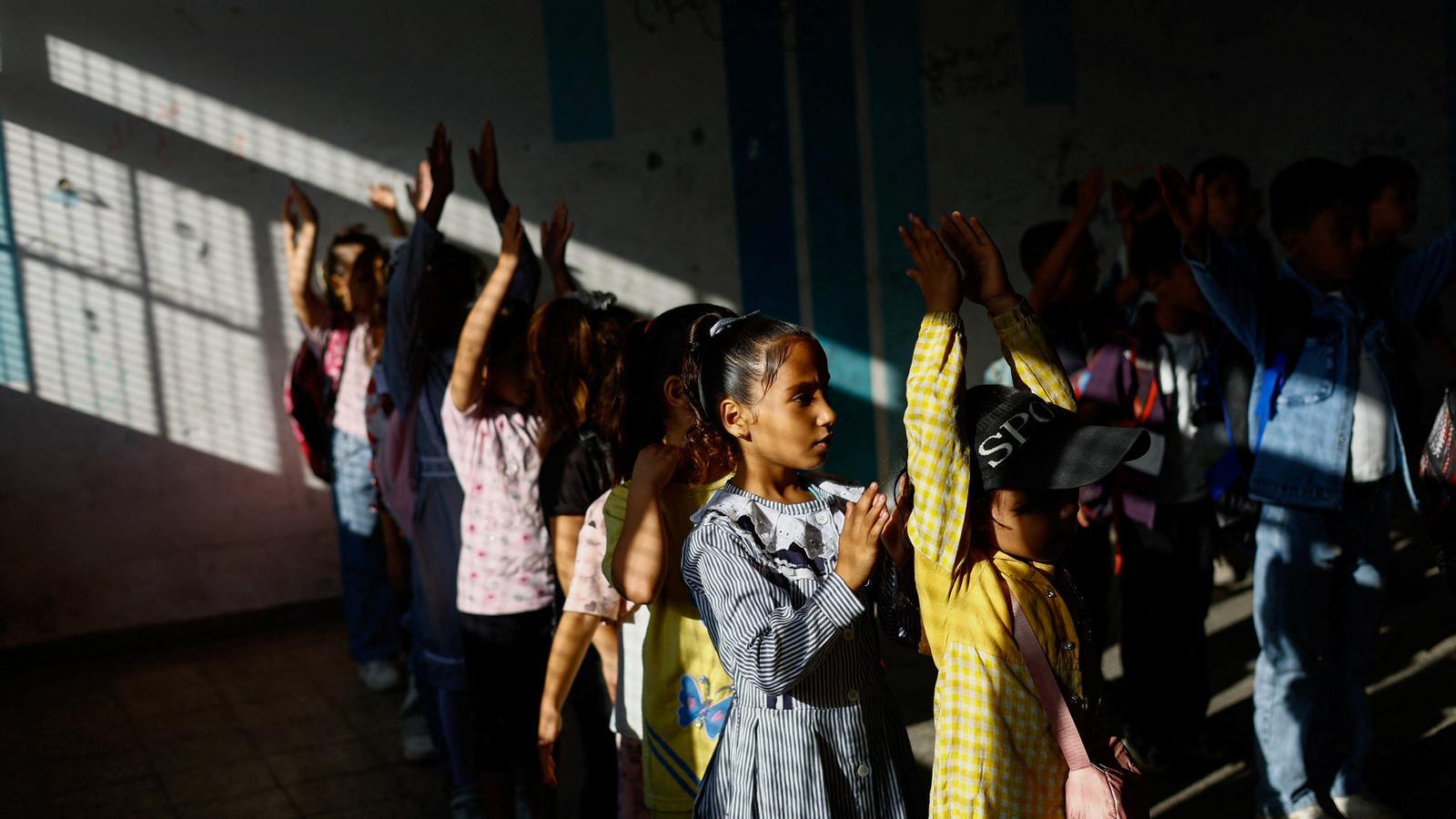
The children of Gaza return to class after three years with practically all the schools damaged
The new school year starts in tents and provisional spaces while thousands of children continue without access to a structured education

-
CAT -
CAST
JerusalemIn Gaza, returning to school does not necessarily mean returning to a school building. For thousands of children, the new term has begun in tents, courtyards, and temporary learning spaces. There are notebooks and blackboards, but also rubble, displacement, and children who are still queuing to get water before classes begin. Amidst all of this, there is a feeling that for three years had been set aside: the possibility that something might once again resemble life as it was before.
“Before the war, all of my grandchildren were enrolled in school, they went to kindergartens and school,” explains Naeem Mohammed Jneid, known as Abu Obaida, to ARA, a father of a family displaced from Jabalia, in the north of the Strip, and now installed in a tent in Gaza City. For the first time in a long time, he says he has “a certain hope”.
In the Strip, the academic year began on September 19, almost three years after face-to-face schooling was interrupted by the war. According to the latest data from the UN Office for the Coordination of Humanitarian Affairs (OCHA), some 495,000 preschool and school-age children are now attending learning spaces supported by the UN and other entities. However, some 200,000 remain without access to any form of conventional education.
In Gaza City, the municipal school has converted a dozen tents into a temporary space to resume face-to-face classes. “One of my grandchildren dreams of being an engineer. He hasn't even been able to study or write normally, but his dream is to be an engineer,” explains Abu Obaida. Another of his grandchildren wants to be a neurologist.

In other parts of the Strip, students study in courtyards, damaged buildings, or facilities built with wooden pallets. Some classes have mattresses instead of desks and chairs, and school supplies remain scarce. Since the start of the war, after the Hamas attacks of October 7, 2023, the lack of school supplies has been a constant, and what little is found is often unaffordable for many families. A notebook that previously cost less than one euro can now reach five euros.
Practically all schools are damaged by the bombings
The void left by the war in education is much greater than what these makeshift classrooms can cover. The United Nations Children's Fund (UNICEF) estimates that about 700,000 minors between the ages of 4 and 17 have spent almost three school years without regular formal face-to-face schooling. Furthermore, in April, the organization estimated that nearly 98% of school buildings in Gaza had suffered damage since the start of the war and that more than 93% required major rehabilitation or complete reconstruction to be able to function again.
“The situation around the schools is very difficult,” describes Mohammed Qomssan, a Civil Defense worker in the Gaza Strip, to this newspaper. “Children are returning to an absolutely devastated environment, with emergency services that have very limited resources and with the risk that there may still be unstable buildings or explosive remnants of war,” he adds. In case of an emergency, he explains, evacuating a school can be extremely complicated because the roads remain severely affected.
Educational disruption, however, cannot be measured only by destroyed buildings. It is also measured by the time that children have stopped learning. A report by the Palestinian Ministry of Education published in May describes this interruption in terms of time: between 2023 and 2026, annual school days have been reduced from 200 to 60, while weekly teaching hours have gone from 30 to 12. In practice, two-thirds of the school year have disappeared from the students' lives.
Even when there is a classroom, children have to study with limited access to electricity, water, sanitation, and protection from the weather. But the biggest challenge is summarized by Qomssan: they are asked to return to class while the conditions surrounding them are still very far from normal. That is why he says that what is happening now is not exactly the return of the educational system that existed before in the Strip, but rather “an emergency attempt to keep education alive until the schools can be rebuilt and teaching can take place under proper conditions.”
The return to school coincides with a reduction in violence compared to the most intense moments of the conflict, following the ceasefire announced in October 2025. But it has not meant the end of insecurity. Attacks have continued and, at the beginning of September, at least two children died in an Israeli attack. According to the Palestinian Ministry of Education, between October 7, 2023, and February 17, 2026, more than 20,000 students from schools, high schools, and universities died, as well as nearly a thousand education workers.

