Surviving without state aid: the civil network supporting the displaced in Lebanon
Volunteers and donations guarantee the survival of hundreds of thousands of people amid the ceasefire with Israel.

-
CAT -
CAST
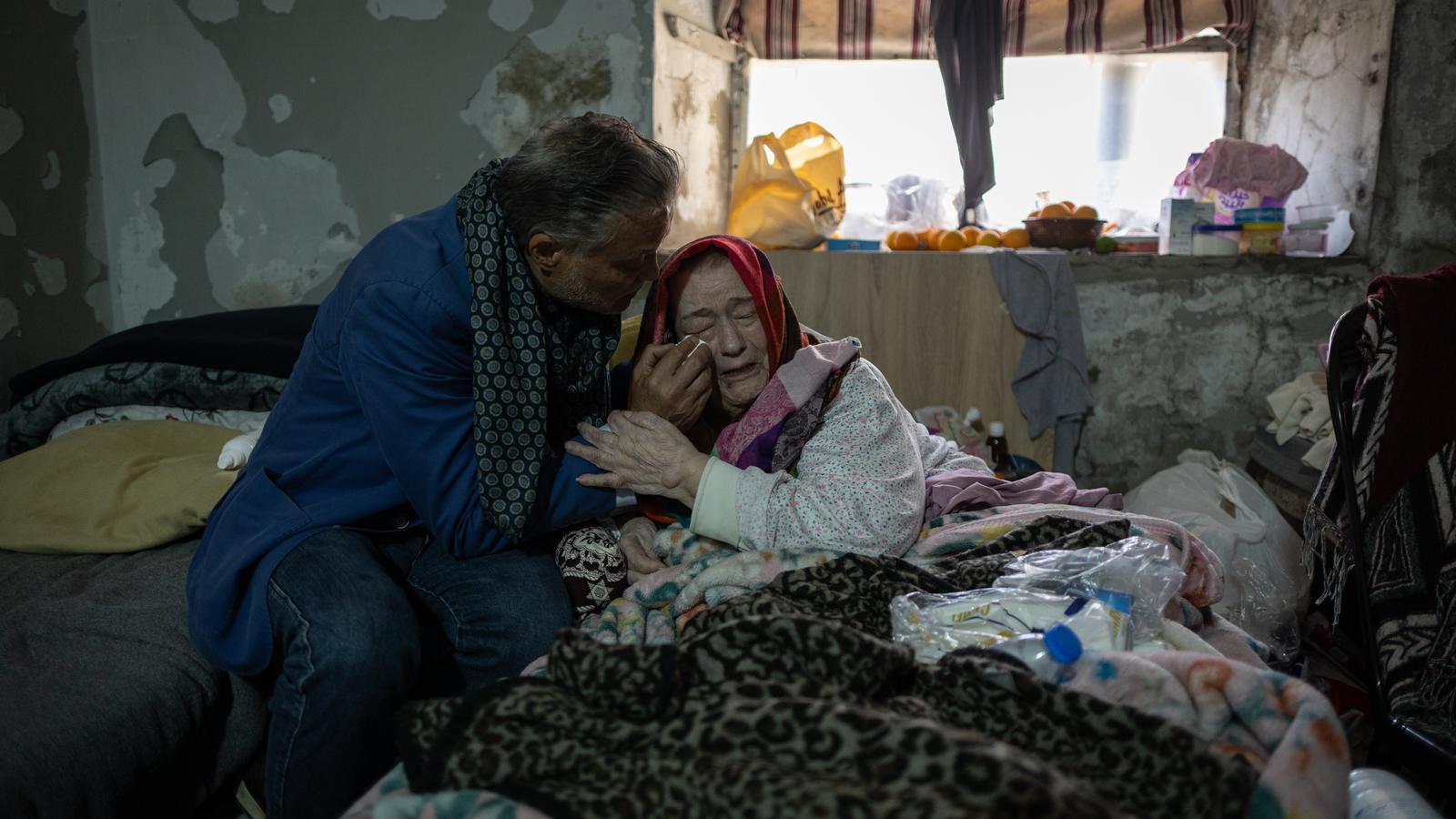
Sidon / BeirutThe old Palace of Justice in Sidon, about 60 kilometers south of Beirut, is once again full of life. But not for the reasons it was built. The old courtrooms, which had been closed for 35 years, have changed function. Where there were once files, judicial hearings, and institutional silence, there are now mattresses lined up against the walls, clothes hung on ropes, and families trying to rebuild a minimal life between cracked walls and roofs that do not fully protect.
In the corridors, a forced coexistence is heard. Children running between columns, pots on portable stoves, hushed conversations so as not to invade the other's limited space. The doors, which once separated cases and proceedings, no longer separate anything. About 400 people who have arrived from southern Lebanon and the suburbs of Beirut have settled here, after losing everything in a matter of days due to Israeli bombings.
Some families have erected divisions of wood and fabric. It is not intimacy, but it is close enough to continue waiting. Among them is the family of Ali Hamdan, director of an institute in the suburbs of Beirut. He recounts a story of loss: his home, in the south of the country, destroyed, and his apartment in the Burj al-Barajneh neighborhood, in the capital, inaccessible. "We lacked nothing, and from one day to the next we found ourselves living in the car. For eight days it was the living room, the kitchen, the bedroom," he recounts. He pauses briefly before adding: "We appreciate the solidarity of people like Hamed, but the government has abandoned us. To them, we are nobody."

The building has been reopened thanks to Hamed Abou Zahr, a Lebanese businessman naturalized Peruvian, who returned to the country to try to organize a reception space. He walks through the rooms with a mixture of urgency and weariness, always attentive to what is missing. “We are not the government. We help as we can because tomorrow anyone can find themselves in this situation,” he explains. But his diagnosis is not optimistic: “This cannot be permanent. Even with the ceasefire, many of these people will not be able to return to their homes. We don't know what will become of them.” The ceasefire in effect since Friday has reduced the intensity of the conflict, but it has not changed the material reality of the displaced. It does not allow them to return home, nor to reopen schools, nor to re-establish basic services. The calm, for the moment, does not allow for return.
Outside of Sidon, the same logic is repeated in different parts of the country. Public schools designated by the state as shelters are overflowing and can only accommodate a portion of the displaced. The rest are scattered in unsuitable spaces, such as parking lots, empty buildings, sidewalks, or the promenade, where tent settlements have been improvised. At the port of Beirut, the old meat market is one of these places. The market, closed for decades, has been reactivated as a shelter on the initiative of lawyer Maria Daou. Today it houses more than a thousand people.
Life in an old market
Between metal structures, industrial walls, and spaces without adequate ventilation, mattresses for sleeping, a dining area, and a basic infirmary have been organized. The needs are absolute: medicine, hygiene, water, electricity. Everything depends on irregular donations and volunteer networks. “We can’t expect much from the government – Daou explains. It has limited resources and the country is going through multiple simultaneous crises. International aid also doesn’t arrive in the necessary quantity. So, this is something we’ve set up among friends and contacts.” But the effort has limits. “We can’t take in more people. We don’t have the capacity.”
In the corridors, Abdu, displaced from Nabatieh, walks with his wife among flickering lights. He talks about electricity outages that last up to 18 hours a day, the absence of basic hygiene, and plagues that are beginning to appear in common areas. The place, he says without dramatizing, has become more of a waiting room than a shelter.
In the Hamra neighborhood of Beirut, solidarity takes another form. It is home to a larger concentration of displaced people from the capital, and there, every local initiative is a key piece of survival. In a private parking lot, a group of volunteers has set up a distribution point for food, clothing, and basic necessities. A small recycling workshop also operates here. Collected glass bottles are transformed into glasses, ashtrays, or small artisanal pieces that are then sold to finance the project itself. It’s a minimal, circular economy, designed to sustain what is, in reality, unsustainable.
Imane Assaf and a group of activists are in charge of the space. In addition to the distribution point, the space functions as a community kitchen. Every day, hot meals are prepared and sent not only to the displaced people who come to the parking lot but also to official centers given the lack of resources. “People come and take what they need. We don’t want to leave anyone behind,” Imane emphasizes. In this daily transit between the informal and the institutional, part of the sustenance for thousands of people is maintained. But this network, driven by volunteering and donations, operates at the limit of its capacity, depending on a solidarity that also wears out over time.
