Oleksandra Matvitxuk: "Putin is not crazy: his logic is historical"
President of the Center for Civil Liberties of Ukraine

-
CAT -
CAST
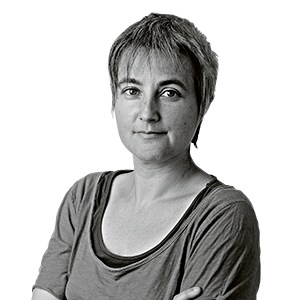
BarcelonaOleksandra Matvitxuk (Kiv, 1983) is a Ukrainian lawyer and one of the most prominent voices in the defense of human rights in Eastern Europe. She leads the Center for Civil Liberties, a key organization in documenting war crimes committed by Russia. Awarded the Nobel Peace Prize in 2022, she has become an international figure in the fight against impunity. She visited Barcelona at the invitation of CIDOB.
How is the war against Iran affecting Ukraine?
— I want to begin by expressing my sincere solidarity with the people of Iran. We, as Ukrainians, know what it means to fight against an entire authoritarian state machine that wants to eliminate you, even physically. I am horrified by the number of peaceful protesters killed by this bloodthirsty regime. And now, with this attack by Israel and the United States, it is a tragedy. Unfortunately, in our less-than-ideal world, there are many wars going on. Some have been going on for decades, and it seems that no one cares. I understand that the war in Iran is diverting attention from Ukraine, but Europe is making a mistake if it forgets about it now.
Because?
— Putin started this large-scale war not just to occupy another part of Ukrainian territory. It's incredibly naive to think he's lost hundreds of thousands of Russian soldiers simply to occupy Avdiivka or Bakhmut, two small Ukrainian towns that most Russians can't even locate on a map. Putin isn't crazy: he started this war to occupy and destroy all of Ukraine and continue his advance. He sees Ukraine as a bridge to Europe. His logic is historical, and he dreams of his legacy: he wants to restore the Russian empire by force. And what's holding Putin back is the resistance of the Ukrainian people. The problem is that leaders base their decisions on the short term because they're trapped in election cycles and only seek immediate results. And for many years, this translated into turning a blind eye to Putin, while Russian human rights defenders warned of the persecution of civil society, the imprisonment of journalists, the murders of activists... But these warnings were ignored, and Europe busied itself building gas pipelines and shaking hands with Putin. And that's why we're in this situation now.
Do you think anything resembling peace can be achieved with Putin?
— Ukrainians dream of peace. War is horrific; it is our people who are dying and our cities that are being destroyed. But we need peace, not jobs. We need peace, not a truce that allows Russia to prepare for the next war. I want to remind you that during this year with Donald Trump in the White House, the number of civilians killed or wounded has increased by 31% compared to the previous year. This speaks volumes about these peace negotiations: the American negotiators are primarily interested in minerals, Russian territorial claims, and geopolitical interests. But they don't talk about the people, the millions of civilians living under Russian occupation, in a gray area where they cannot defend their rights, their freedom, their property, their lives, their children, their families. I know what I'm talking about because we have been documenting war crimes for twelve years: the Russian occupation is not just changing one flag for another; it means enforced disappearances, torture, rape, denial of identity, forced adoption, clandestine detention camps, and mass graves.
Can an agreement end up rewarding aggression?
— This isn't just a war over territory: it's about what the new world order will look like. Because Putin is trying to convince us that a great power with a strong military and nuclear weapons can do whatever it wants. It can invade neighboring countries, it can kill people, erase their identities, sell their children to Russia, and forcibly re-educate Ukrainians as if they were Russian. And we Ukrainians have refused to be ideal victims. And we aren't even when we talk about our partners, like the United States. We don't follow instructions; we have dignity, and we fight so that our children have at least a minimal chance of living without fear of violence. We are not objects. We are not hostages. We are actors in this historical process. And this is probably what explains why Ukrainians, after four years of war, continue to resist such an enormous military threat, while all the international partners were convinced that Putin would occupy Ukraine in three or four days.
Will we see those responsible for war crimes in Ukraine brought to justice?
— Politicians who only think in the short term don't understand the meaning of justice. It's not just important for the past or the future, but above all, for the present. Russian troops have committed horrific crimes in Chechnya, Moldova, Georgia, Mali, Libya, Syria, and other countries. They believe they can do whatever they want. If we initiate decisive legal action, even if only a portion of Russians begin to have doubts, this doubt will reduce the brutality of their actions and save thousands of lives. There is no international tribunal that can try Putin and the Russian political and military leadership, not even the International Criminal Court. That's why we are pushing for the creation of a special tribunal for the crime of aggression, which has been endorsed by the Council of Europe: it's a revolutionary step. In all of human history, there is only one precedent: the Nuremberg trials, after the fall of the Nazi regime. But in the 21st century, we must move forward: we must break with the idea that justice is a privilege of the victors. It is a basic human right. And we cannot wait.
You recently said: "The international security system is broken."
— The system created after World War II has never been reformed, even though the world has changed. Five countries have irrational privileges like the right of veto. It's not fair, but the system is just repeating rituals. The real battle today is about what the new world order will look like. And I want Europe to participate. Trump, Xi Jinping, and Putin are negotiating to divide the world into spheres of influence. We've seen this before, and it didn't end well. A world based on the law of the strongest is fragile. It's a world of wars and violence.
