Measles explodes in the US but Trump declares war on vaccines
The country registers the worst year of contagions since the virus was declared eradicated in the year 2000

-
CAT -
CAST
WashingtonMeasles, a virus that the United States had considered eradicated in 2000, is breaking contagion records in the country. With more than 2,300 people affected – and the count continues to grow – 2026 is already the worst year for contagions in two decades. According to the Centers for Disease Control and Prevention (CDC), between 93% and 94% of individuals who have contracted measles were not vaccinated, or it was not recorded that they were. But who the White House has decided to declare war on is not the disease, but the vaccines.
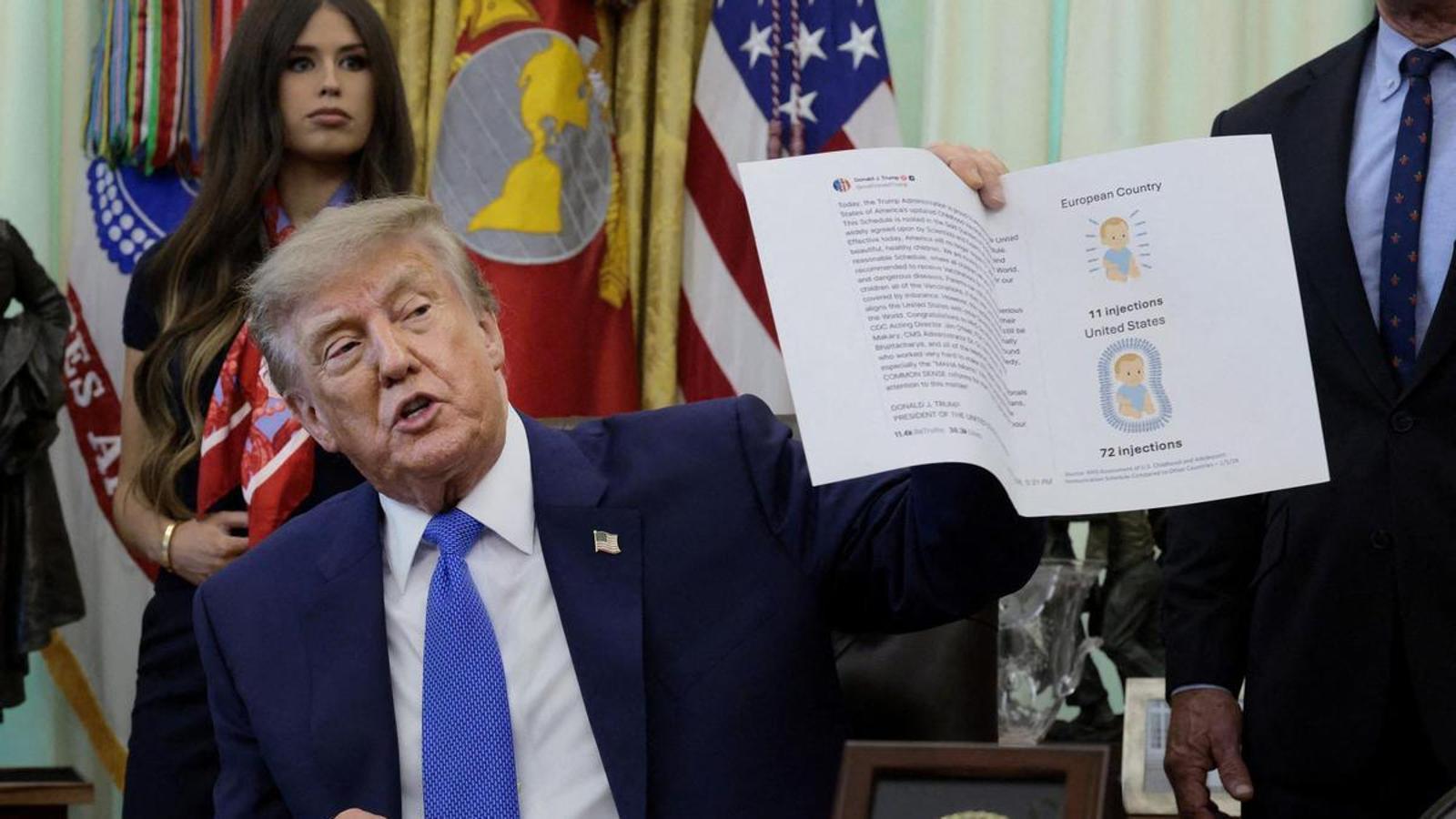
US President Donald Trump signed an executive order on August 10 to reduce recommended vaccines for children and thus make a reality the anti-vaccine agenda of Health Secretary Robert F. Kennedy Jr. Earlier this year, the head of Health already tried to modify childhood vaccination guidelines by reducing the stipulated injections from seventeen to eleven. But a judge blocked the initiative after the American Academy of Pediatrics and other health groups took the case to court.
Trump signed a very similar decree last week, which reduces the complete vaccines for children from seventeen to six and establishes that the combined measles, rubella, and mumps vaccine (known as MMR) should be divided into three different injections. During the signing of the decree, both the president and his Health Secretary insisted on linking the MMR with autism, even though there is no scientific study that proves it. On the contrary, numerous investigations support the safety of the MMR and deny the claims of the magnate, who assures that the combined vaccine is dangerous. "Together, there is a possibility they could be quite lethal," he said.
Recently, the Republican also asked pregnant women not to take paracetamol – known in the US under the brand Tylenol – during gestation, because it could supposedly cause autism in the baby. Another claim that is also not proven by scientific studies.
Most cases are minors
Although the decree is not binding, because those who have the competence to set public health guidelines are the Centers for Disease Control and Prevention (CDC) – and not the White House – the measure only fuels distrust towards vaccines at a particularly delicate moment regarding measles. Between 67% and 74% of cases registered by the CDC during 2026 correspond to minors under 19 years of age, among whom children under five years old represent 20% of the total cases. Last year the US registered three deaths due to measles, two of which were children.Furthermore, the contagion hotspots are concentrated in very specific areas. In South Carolina, the largest outbreak is in Spartanburg County: it began in 2025 and has not been contained since. Of the more than 2,300 cases diagnosed this year, more than 670 are linked to this district. Utah is in a similar situation, with an outbreak that began this year and continues to spread, with 524 cases registered. The CDC has noted that these contagion hotspots occur precisely in communities where the MMR vaccination rate has fallen below the threshold needed to achieve herd immunity.
An exhaustive survey conducted by the Kaiser Family Foundation (KFF) and published in the Washington Post in September 2025 provided more details on this increase in distrust towards vaccines. American parents who chose not to vaccinate their children or to postpone vaccination were accustomed to homeschooling them, were white, very religious, and identified as Republicans, or were under 35 years of age, according to the survey. 9% of respondents admitted that they had not administered the polio or MMR vaccine to their children. In fact, the study concluded that all of this could lead to large outbreaks.
More difficulty vaccinating
Trump's decree not only seeks to discourage childhood vaccination, but also provides for guidelines that make it more difficult for families to vaccinate their children. To begin with, dividing the MMR into three different injections means going to the doctor more times and, consequently, having to pay more, since each visit must be paid for.
Beyond the MMR, six vaccines will move to the category of "object of shared clinical decision-making." This means that, as they will be optional, they could fall outside of health insurance coverage. Specifically, these are the vaccines for hepatitis A, hepatitis B, rotavirus, meningococcal disease, flu, and COVID-19.
Despite the clear anti-vaccine message, Kennedy has repeatedly denied being responsible for the measles outbreak the country is suffering. The Secretary of Health, who last week again insinuated that the MMR vaccine is related to autism, attributes to "global health conditions" and the will of religious communities the fact that more and more people do not want to get vaccinated.

