Lebanon prepares to negotiate with Israel and the US under the bombs
While diplomatic channels are activated, Tel Aviv continues to attack the south of the country and takes the city of Bint Jbeil

-
CAT -
CAST
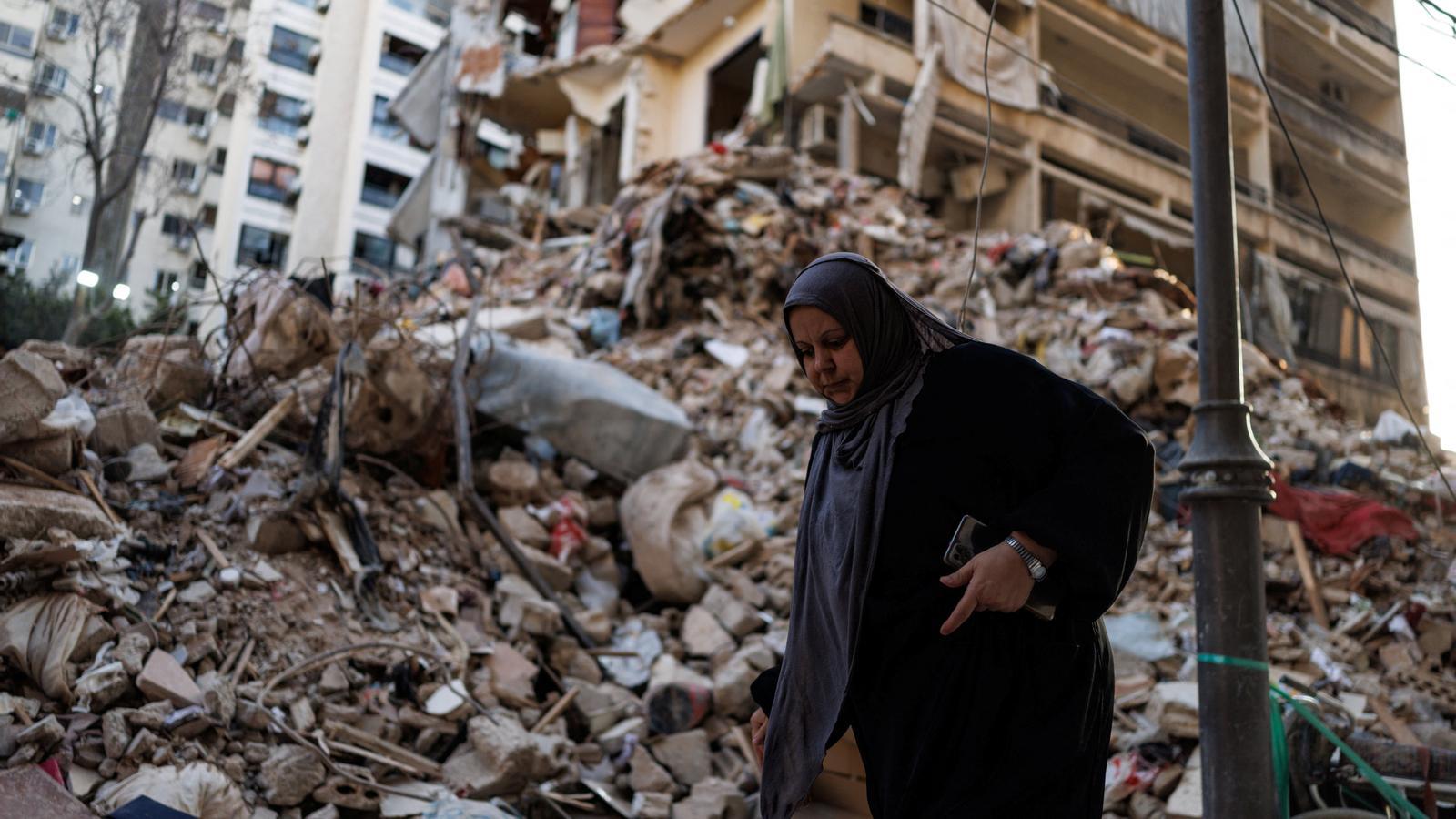
BeirutWhile diplomatic channels are discreetly activated, in southern Lebanon the war continues with an intensity that belies any sign of a truce. The paradox is not new in the Middle East, but it is rarely so evident: talks are beginning, but the front does not stop.
On the ground, this truce does not existOn the ground, this truce does not exist. In the municipality of Bint Jbeil, barely five kilometers from the border, the Israeli army claims to have completed the siege of the city after several days of intense fighting. The offensive marks a significant advance in the ground incursion initiated a few weeks ago. According to Israeli military sources, more than a hundred Hezbollah fighters have died in the last week, in direct confrontations and aerial bombardments.
The Shiite group Hezbollah, however, maintains that the battle remains open. The group's leader, Naim Qassem, asked the Lebanese government this Monday to cancel the meeting with the Israeli ambassador in Washington, calling the talks useless. Furthermore, Hezbollah speaks of "close-range" confrontations and a resistance that continues despite aerial and ground pressure. The city of Bint Jbeil, where the former leader of the movement, Hassan Nasrallah, proclaimed "victory" after the Israeli withdrawal in 2000, is once again becoming a symbol, but also a devastated battlefield.
The violence is not limited to this front. Israeli drones strike vehicles in the south, while artillery bombards towns in Nabatieh (also in the south) and in the Bekaa (in the southeast). Hezbollah responds with rockets and drones against Israeli positions. The exchange is constant, almost mechanical, and leaves little room for diplomacy.
The human cost continues to grow. The official toll exceeds 2,055 deaths, including at least 165 children and dozens of healthcare workers. In recent days, the death of another Lebanese Red Cross paramedic, shot down by a drone during a humanitarian mission, has provoked a strong reaction. The organization denounces a direct attack despite prior coordination with international forces to guarantee their safety. The United Nations Interim Force in Lebanon (UNIFIL) also warns of a worrying deterioration. In a statement this Monday, it accuses the Israeli army of ramming mission vehicles on two occasions and obstructing their freedom of movement, as well as destroying surveillance equipment along the Blue Line. Incidents that, according to the UN, contravene resolution 1701 and hinder its ability to monitor violations on the ground.
Unacceptable demands for Beirut
In this context, the positions of the parties are hardening. Israel, under the leadership of Benjamin Netanyahu, insists that the offensive will continue until the threat from Hezbollah is completely neutralized. The stated objective is twofold: to prevent attacks against northern Israel and to force a change in the balance of power in Lebanon. Among the conditions being put forward are the group's total disarmament, its exclusion from the Lebanese government, and the severance of its ties with Iran. In parallel, a more robust international supervision is proposed, with control of border crossings, mechanisms to prevent arms smuggling, and direct support for the Lebanese army, under US tutelage. All of this is accompanied by a key condition for Israel: maintaining freedom of military action against any threat, even in the event of an agreement.
For Beirut, these demands represent an existential challenge. Hezbollah is not just a militia, but a movement integrated into the country's political and social fabric, within the Shiite community. Its immediate dismantling not only seems unfeasible but could further destabilize an already fragile system.
Nevertheless, the government is trying to gain room for maneuver. The discussion about the state monopoly on weapons reflects both a desire to reaffirm sovereignty and growing pressure from its international partners. Meanwhile, Nabih Berri, a key Hezbollah ally, is reopening channels with the movement to ensure a common position that allows for negotiation without fracturing the internal balance. This balance is precisely one of the major unknowns. The United States insists on the need for a “Shiite guarantee” to ensure compliance with any agreement, aware that without Hezbollah's endorsement, direct or indirect, any compromise risks remaining a dead letter.
Thus, the negotiations that begin today do so under a cloud of distrust. Too many conditions, too many red lines, and above all, a war that does not stop. And for now, in southern Lebanon, war continues to speak louder than diplomacy.

