Israel says it will start negotiations with Lebanon
Beirut's inhabitants, amidst rubble and rescues, live with astonishment the Israeli attacks
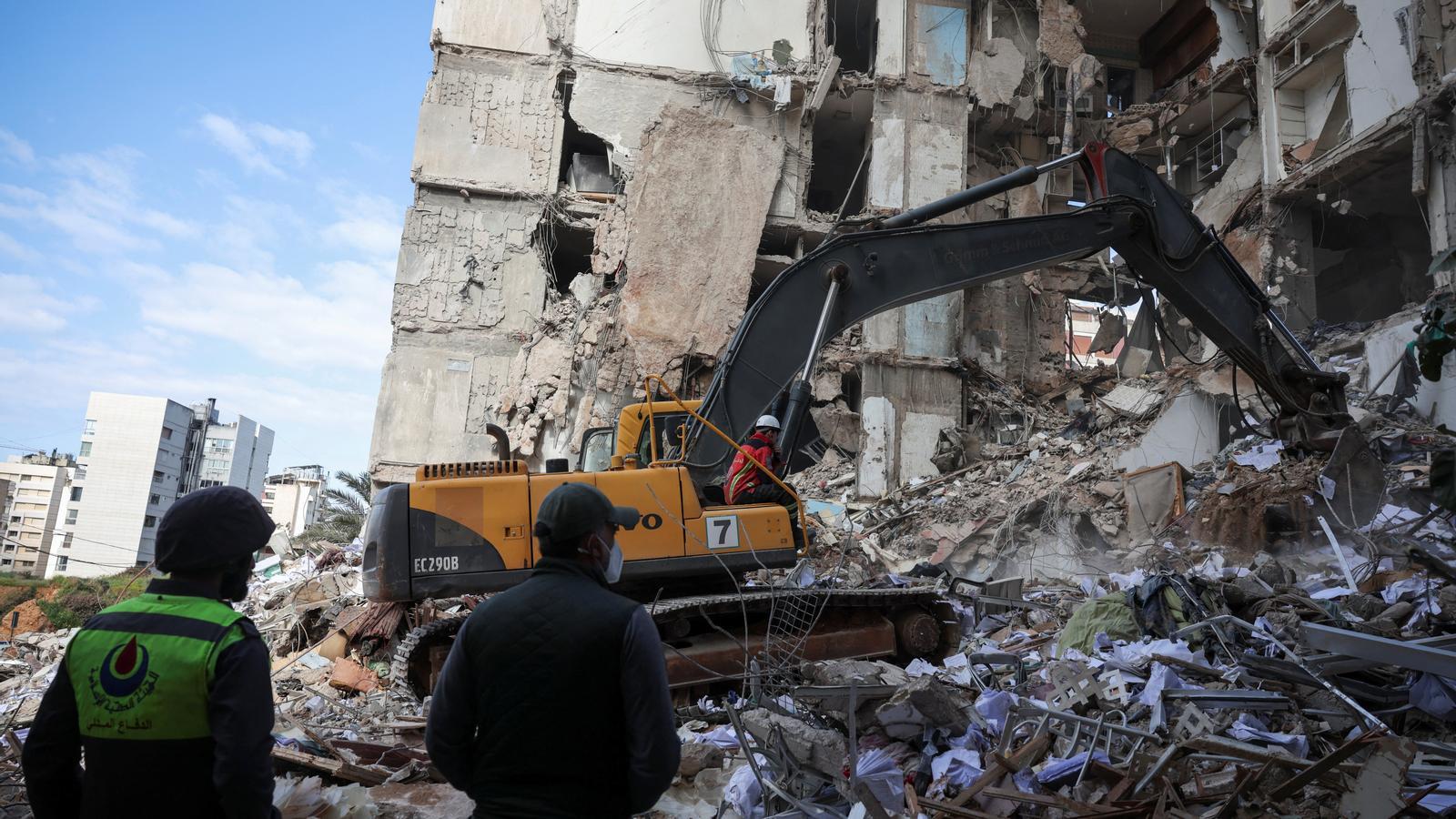

BeirutIn the Ain al-Mreisseh neighborhood, next to the Beirut marina, the silence is only broken by the metallic sound of shovels and the crunch of concrete. Amidst the rubble of a building reduced to dust by Wednesday's bombings, Civil Defense teams continue searching. Four people are still trapped. They could be children. A rescuer points to a specific spot. A few hours ago, a hand was found. Now they are preparing body bags. Barely twenty-four hours have passed since, in less than ten minutes, more than a hundred air attacks hit different points in Lebanon. Beirut, which for months had served as a relative refuge, is no longer one.
In this context, Israeli Prime Minister Benjamin Netanyahu has announced that Israel is willing to open direct negotiations with Lebanon. He says they will focus on the disarmament of Hezbollah and on establishing "peaceful relations" between the two countries. The Israeli leader also maintains that his government “appreciates” the Lebanese Prime Minister's call to demilitarize Beirut. "Given Lebanon's repeated calls to initiate direct negotiations with Israel, yesterday I instructed the Cabinet to put them in motion as soon as possible," Netanyahu stated in a note released by his office. Hours before his announcement, Israeli Defense Minister Israel Katz stated that Hezbollah "longs for a ceasefire" after the intensification of the Israeli offensive in Lebanon.
As Netanyahu's announcement is broadcast, in Ain al-Mreisseh, buildings ripped open reveal rooms suspended in the void. Ripped-out walls, scattered glass, crushed cars. Mohamed, a resident of the building opposite, tries to salvage what remains of his house. He sweeps glass, moves wooden debris. “We were lucky to survive. They are still looking for people. There used to be a pharmacy here… The errand boy, a child who used to bring us medicine, has died.”
"I would never have imagined something like this"
A few meters away, Hasani contemplates his car crushed under concrete blocks. “I was at home when everything collapsed. I felt the explosions… I was scared”. When he came out, the building opposite no longer existed. “There are many dead. Thirteen, fourteen… and more injured”. Isa stops in front of the crater. He has a bookstore in the center. “I pass by here every day. I would never have imagined something like this”. There have been no warnings. “Now all areas are dangerous”.
Just a few meters further on, the promenade offers a misleading image of normality. Some are walking, others are running, but everyone stops to look at the sky. Hussein walks with his two daughters. He arrived from the south at the beginning of the war. “We came to Beirut thinking we would be safe, but there is no safe place anymore”. Lina runs without stopping. Yesterday she was in a café near one of the explosions. “Everything is a matter of luck. Being alive or dead depends on where you are”. Closer to the water, Hassan prepares to dive. “We are talking about civilians. This cannot be justified by saying there was a militant”, he laments.
Further south, in Corniche al-Mazraa, the tone changes. Under the remains of a building that served as a distribution center for aid for the displaced, it is believed that at least five people remain trapped. Rescuers have recovered human remains since the morning. The chances of finding survivors are minimal. Authorities have put the death toll for this Wednesday at 303. The building received dozens of people daily who went there to collect food. Its destruction illustrates the scope of a campaign that has hit civilian infrastructure and densely populated areas in different parts of the country.
To the south, several bridges over the Litani River have been destroyed, hindering traffic and partially isolating some towns. The new evacuation orders are pushing thousands of displaced people towards Beirut, increasing pressure on an already saturated capital.
Internal tensions
In parallel, the political front is being redefined. Following an emergency meeting, Prime Minister Nawaf Salam announced the reinforcement of the army's deployment in Beirut to “extend state control” and “guarantee the monopoly of weapons.” The measure has highlighted tensions within the government itself: ministers linked to Hezbollah opposed the reinforcement of state control. In fact, senior representatives of the group have already stated that they reject direct negotiations with Israel and that the Lebanese government should demand a ceasefire as a prerequisite before taking any further steps. President Joseph Aoun, for his part, insisted that “no one negotiates on behalf of Lebanon” and is trying to include the country in an eventual regional ceasefire.
In this context, Netanyahu's announcement to negotiate with the Lebanese government and disarm Hezbollah introduces a new dimension. But in Beirut, pessimism prevails. Political sources emphasize that there is no formal initiative to turn the capital into a “Hezbollah-free zone,” and that the measures discussed are limited to a security plan to reinforce state presence. The divergence reflects the gap between the two narratives: while Israel frames the offensive as a strategy to weaken Hezbollah and pressure the Lebanese state, the Lebanese government is trying to contain the escalation without opening an internal political front that could further destabilize the country.
In Beirut, meanwhile, the evolution of the conflict seems to depend on two parallel dynamics: the intensity of the bombings and the –still uncertain– capacity of the Lebanese state to strengthen its control in the capital without aggravating its own internal fractures. Between the two, the city tries to hold on.
