Europe's struggle for a seat at the Ukraine negotiations
The dispute over who should represent the continent lays bare the differences over the relationship with the Kremlin

-
CAT -
CAST
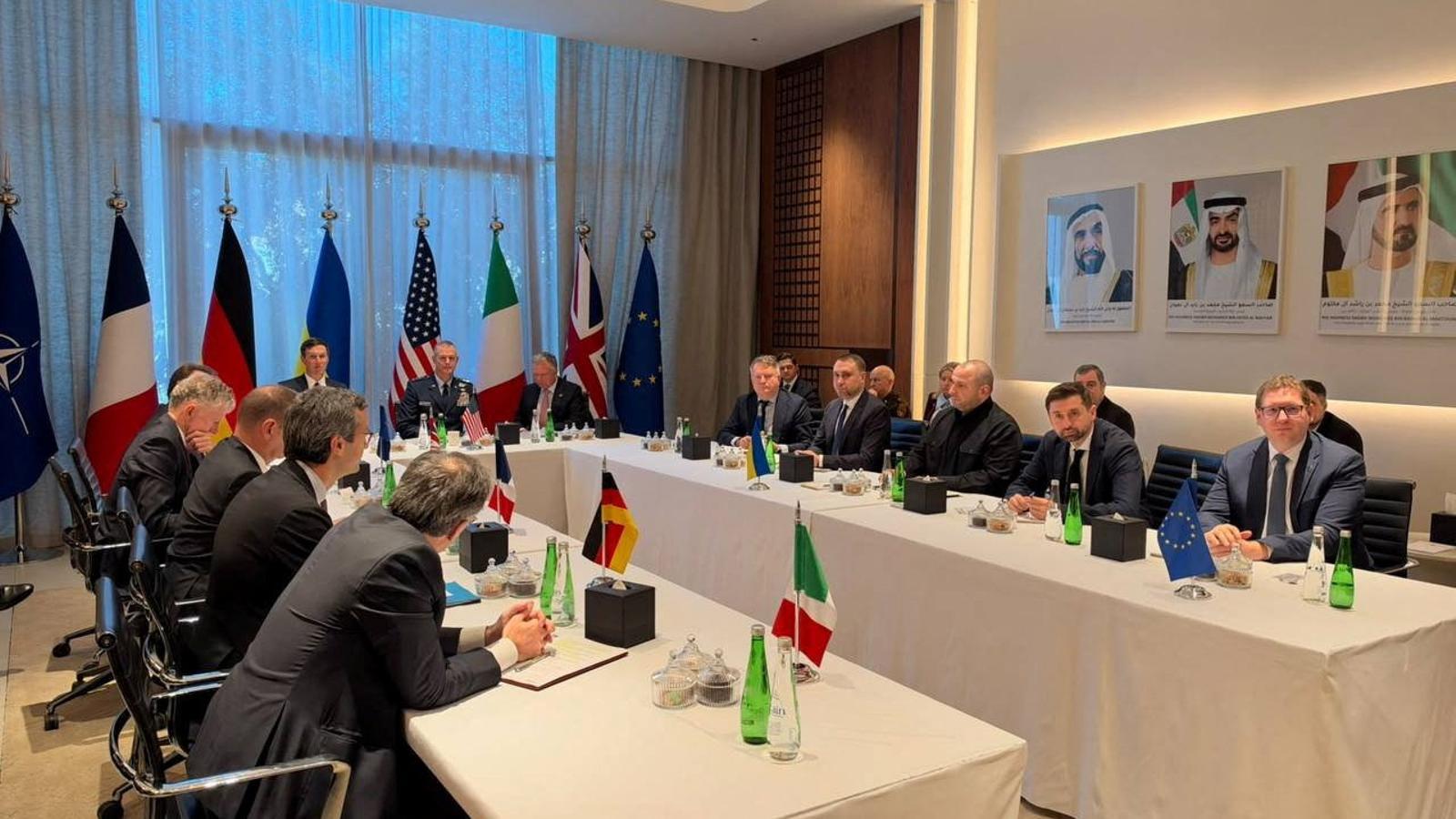
BrusselsTalks have begun in Abu Dhabi regarding the future of Ukraine, and they have done so with a notable absence. Although the delegations from France, Germany, the United Kingdom, Italy, and the European Union have been able to meet with those from Ukraine, the United States, and NATO to coordinate, Europe has no presence at the negotiating table. The Old Continent – which the Kremlin has excluded from this round due to its support for Kyiv – has demanded to have its say, especially regarding security guarantees. But, who should lead these demands?
For now, Europe does not have a consensus political representation. Coordination with Washington and NATO has so far been led by the diplomatic delegations of the so-called E3 (France, Germany, and the United Kingdom), the three main military powers of the continent, and those that – supposedly – should provide the most security infrastructure for Kyiv once peace is agreed upon. But Italy joined this Tuesday's meeting after its prime minister expressed reservations about being left out of the contacts.
Giorgia Meloni sent a letter on Thursday to the President of the European Council, Antonio Costa, in which she requested that the Twenty-seven appoint a single interlocutor with an explicit mandate for the negotiations. In her view, the lack of a consensus figure gives "the impression of a Europe that is moving in different directions". Thus, the conservative leader asked that this issue be addressed at the next EU leaders' summit – which will take place at the end of the week in Dublin – and that a name be agreed upon before the end of the year.
Italy is not the only state that has raised its voice. It has the support of Poland, another great military power that shares a border with Ukraine. Its Foreign Minister, Radoslaw Sikorski, has been direct in warning of the danger that Eastern countries could be left on the sidelines of negotiations that may redefine security relations with Russia: "The last thing we want is for Western Europe to deal with Russia while ignoring Eastern Europeans", he asserted. "You cannot exclude Eastern Europe and Scandinavia from these talks; we are approximately 120 million people", he insisted, listing the EU countries bordering Russia.
The dispute also challenges the community institutions, which claim their own role in European representation. In fact, Sikorski proposed that those in charge of representing the continent in the negotiations should be António Costa; the EU's foreign policy chief, Kaja Kallas, and the Prime Minister of the United Kingdom, Keir Starmer. A position similar to that of Kallas, who showed herself "in agreement with Prime Minister Meloni": "We must not speak with different voices," she defended. Her perspective, however, clashes with that of Berlin or Paris, which consider that, together with the United Kingdom, they are the most natural option, as they gather the main European military capabilities.
Differences in strategy
But the discrepancies go beyond names: the differences in the strategy of the various states are becoming increasingly manifest. The rupture became evident with the phone call that the President of Finland, Alexander Stubb, and the Prime Minister of Norway, Jonas Gahr Store, made two weeks ago to Russian President Vladimir Putin, and which has brought about a new dilemma: does interaction with Russia facilitate negotiations or validate the aggressor?
After the call, which caught some leaders by surprise, Store defended that his strategy intended to return the negotiating initiative to Europe: "We work closely with our European partners to support Ukraine, but the only voice reaching Moscow comes from Washington," he stated.
Despite the validation from Zelensky, who had been consulted beforehand, some eastern countries argued that Europe's role is not to "act as a mediator" or "assume the role of pleasing the dictator," in the words of Estonian Prime Minister Kristen Michal. From a different perspective, but also critical of the initiative, Danish Prime Minister Mette Frederiksen expressed herself, rebuking Stubb and Store for acting on their own: "I don't quite know what they expect to achieve with this," she said, and defended that Europe must remain united.
This crack in diplomatic strategy may emerge again this Tuesday and Wednesday in Copenhagen, where the Ukrainian president will meet with the five Nordic prime ministers. Although the Finnish president will not be there (the prime minister will come in his place), Frederiksen, who will act as host, and Store will coincide there.
