Almost eight years after the collapse of the Morandi bridge, the Genoa motorway viaduct that collapsed on August 14, 2018, causing 43 deaths, Italian justice has sentenced the former CEO of Autostrade per l’Italia (ASPI), Giovanni Castellucci, to 12 years in prison. The prosecution had requested a sentence of 18 years and six months for the person most responsible for the concessionaire in charge of the infrastructure's maintenance, a subsidiary of Atlantia, the highest requested for the 57 defendants.The Genoa Court has also sentenced the former director of the Road Concessions Supervision Unit of the Ministry of Infrastructure and Transport, Mauro Coleta, for whom the prosecution had requested a sentence of ten years, to five years in prison.
The Italian Parliament approves a controversial electoral law that favors Meloni's party and ends parity
The opposition considers that the law is tailor-made for the prime minister for the 2027 general elections

-
CAT -
CAST
RomeThe Italian Parliament gave the green light this Thursday to the electoral law reform project proposed by Prime Minister Giorgia Meloni's government, in the last year of the legislature. The text will now go to the Senate to continue with the parliamentary proceedings before final approval, scheduled for after the summer.
The new electoral law was approved with 217 votes in favour, 152 against, and 2 abstentions, and has opened a rift in the right-wing coalition led by the prime minister after the conservative Forza Italia of Antonio Tajani and the far-right League of Matteo Salvini voted against an amendment on electoral lists promoted by Meloni's party, Brothers of Italy, and on which the government coalition had declared itself favourable.
The amendment in question – one of more than 200 presented – proposed ballots with protected lead candidates and the rest of the candidates subject to the preference of the electors. An initiative that had been accepted without much conviction by Forza Italia and the League. However, once the moment of the vote arrived with the start of parliamentary proceedings on Tuesday, at least thirty deputies from the governing coalition voted against the prime minister's instructions, causing the initiative to fail by a single vote: 188 against and 187 in favour.
The identity of these deputies has not been revealed because the vote was secret, but it has severely shaken the government coalition on the eve of the summer break. "The result shows that the left and the opposition have voted unanimously against. But even within the parliamentary majority, several votes were missing, which invites reflection," lamented Meloni.
70 extra seats for the winner
The objective of the reform, according to its promoters, is to give more stability to future executives by introducing a "governability prize", a mechanism that would award an extra 70 seats in the Chamber of Deputies and 35 in the Senate to the list or coalition that reaches 42% of the votes in the elections. A gift that would allow the winning coalition at the polls to choose the next President of the Republic without reaching an agreement with the rest of the parties – as has always been done – since it would have the majority to choose the successor of the current head of state, Sergio Mattarella, whose mandate expires in 2029. A democratic anomaly that the opposition considers unconstitutional.
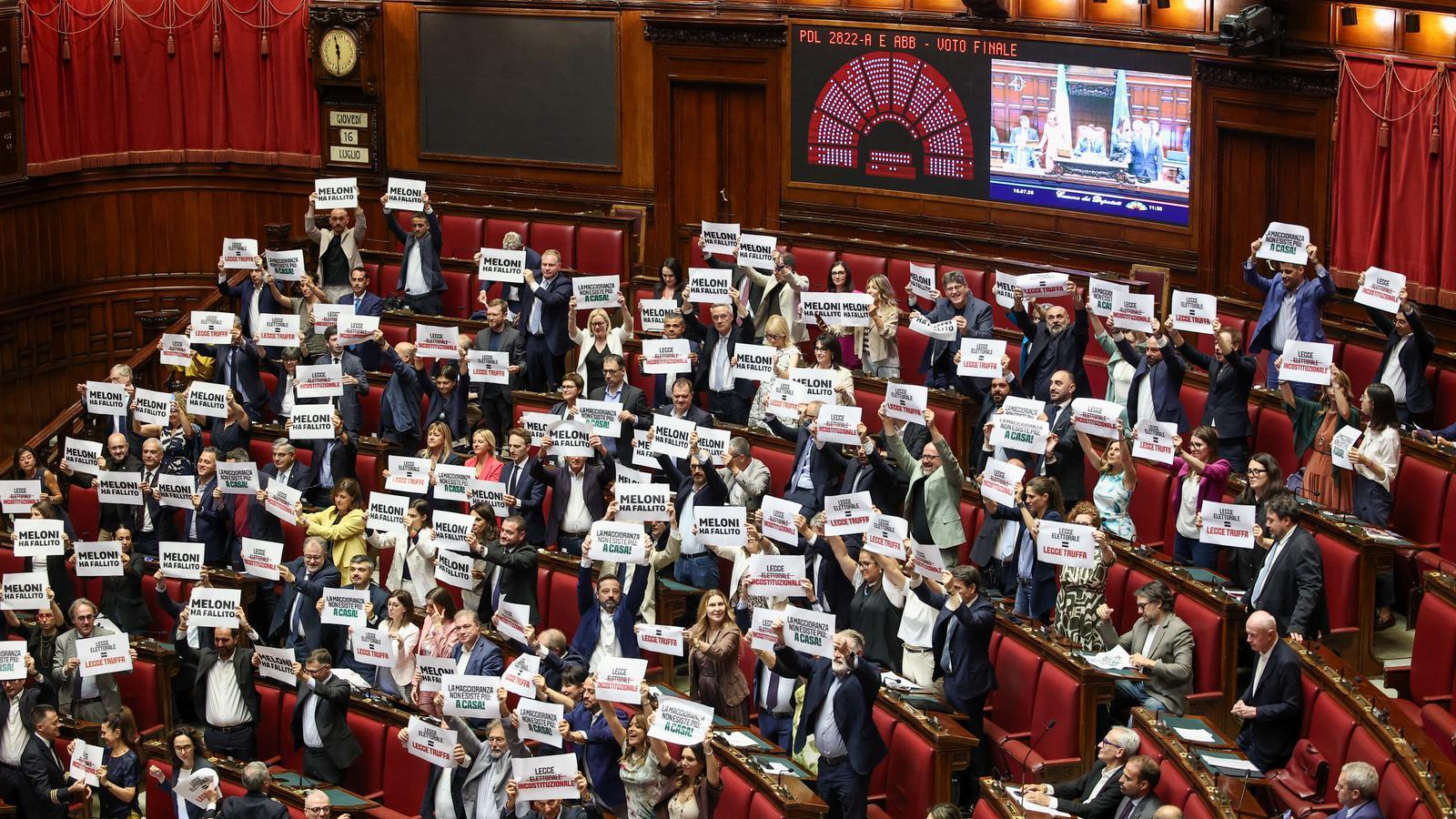
With posters that read phrases such as "Meloni has failed" or "This electoral law is a fraud", the opposition has unanimously protested against an electoral reform that it considers tailor-made for the prime minister ahead of the next general elections, scheduled for 2027. "The right does not care about the problems of Italians, but we do. We will work to win with our allies, with any electoral law, to send them home and finally give Italy the government it deserves to improve people's lives," declared the leader of the Democratic Party (PD), Elly Schlein.

The approval of a new electoral law was fundamental for Meloni after none of the initiatives included in the program with which the right-wing coalition presented itself united in the 2022 general elections – the direct election of the prime minister, the reform of justice and that of fiscal autonomy for the regions of the north of the country – has moved forward during the legislature.
This is why the prime minister had been pressuring her government partners, Antonio Tajani and Matteo Salvini, for months to approve it. The problem is that the calculation of seats assigned to Parliament based on votes that Meloni wanted to introduce into the text favors her party – which continues to lead opinion polls – to the detriment of the League and Forza Italia.
Another controversial aspect of the reform is the elimination of the provision that guarantees gender parity in the lists, which has caused discontent among many female parliamentarians, including some from the ruling coalition. "It is sad that the first woman to become prime minister is remembered for having inflicted a mortal blow to gender parity in electoral representation," lamented the spokesperson for the Green and Left Alliance, Luana Zanella.
