Very tight result between Netanyahu and the opposition bloc, according to the first polls in Israel
The participation reaches 74.3% in a day marked by political uncertainty and accusations of irregularities

-
CAT -
CAST
JerusalemIsrael faces a new stage of political uncertainty following elections in which the Likud, the party of Prime Minister Benjamin Netanyahu, has obtained the highest number of votes, according to the exit poll by Channel 12. However, the results do not guarantee either of the two major blocs a sufficient majority to form a government. The sum of the Jewish parties opposed to Netanyahu would reach 52 seats, compared to the 50 of the formations that support him, far from the 61 necessary to reach a majority in the Knesset, the Israeli Parliament. In this scenario, the Arab parties, also opposed to the prime minister, could gain a decisive weight in the negotiations, with a projection of 18 seats, a record figure for this sector.
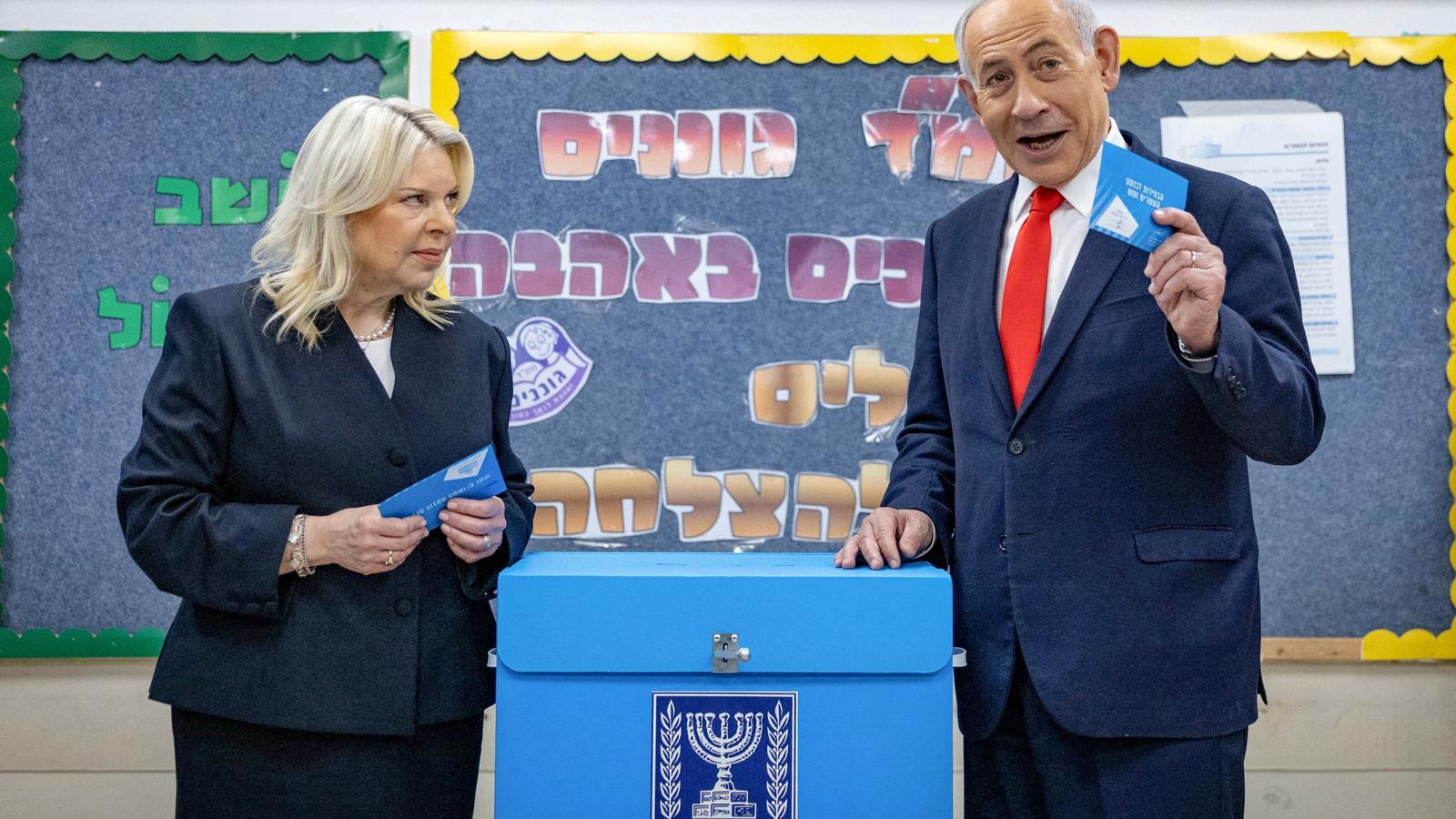
In the early morning, Israel's schools have ceased to be just schools. The classrooms have turned into polling stations, the hallways into waiting areas, and the doors into meeting points for a country that, three years after the attacks of October 7, 2023, is voting again with the war, security, and the political future of Prime Minister Benjamin Netanyahu at the center of the conversation. The image is that of an election day that advances between the normality of the procedure and the exceptionality of the moment: identifying oneself, locating the table, entering the booth, and casting the ballot. A few minutes to decide the future of a deeply divided country.
At the Rothschild school, in the west of Jerusalem, conversations among voters draw a society that shares the same ballot boxes, but not necessarily the same future. The war is present in the words, in the memories, and in the reasons that everyone gives for having left home.
"I am voting for Yair Golan. He is the democratic one, I believe in peace and I think it is the party that will lead us to this promised land of peace," explains a voter. But his argument does not stop at the acronyms. "I lost a friend in the war. I need it to stop. Today we also vote in the name of the dead. He died in the battle of Kibbutz Sufa. For what? A few years later Hamas is still in Gaza." The question summarizes the weariness of a part of Israeli society after the attacks of October 7, 2023, and the war that followed them. Another voter extends his desire for peace beyond the borders of Israel. "We need peace for all peoples, for Nablus, Ramallah and Hebron. We must end the suffering and the fascism." A few meters away, however, another voice defends the continuity of Benjamin Netanyahu. "Wars will not end because of that. That is why I trust Bibi. I always have."
Participation is the big figure of the day. At eight in the evening, 74.3% of the census had already voted, compared to 66.3% recorded at the same time in the 2022 elections. In total, more than 5 million people have cast their ballots, according to data from the Central Elections Committee. It is the highest turnout recorded at this time since 1988.
A record turnout, however, does not necessarily point to a winner. In such fragmented elections, mobilizing is as important as knowing in whose favor each person does it. Throughout the day, the parties have tried to convince their voters that staying at home can have consequences.
Benjamin Netanyahu, who aspires to remain in power, has intensified calls to vote as the day progressed. In messages on social media, he has warned of high participation among Arab voters and left-wing sectors and has asked his supporters to go to the polls. "They are trying to steal the election from us," he stated in a video addressed to Likud voters. The prime minister has linked these accusations to the arrest of three figures who, according to his version, are related to the United Arab List party and were arrested with envelopes full of money for alleged electoral bribes. "It is serious. It is criminal. They will reach everyone. You are warned," he said. He has also presented a possible victory for the opposition parties, both Zionist and Arab, as a threat to the future of the Jewish state.
In another video, recorded at the Bat Yam city hall, Netanyahu has once again asked for votes for Likud and warned that Arab parties had reached a record turnout, just like the left. The recording has generated controversy because election law explicitly prohibits using public buildings for political campaigning.
The opposition has reacted forcefully. Yashar, the party led by Gadi Eizenkot, accuses Netanyahu of trying to undermine confidence in the electoral process and of preparing the ground to question the results. "He is panicking and has started making up stories, and claims that the election is being stolen from him," the group noted.
Tension has also shifted to the rules of the day. Likud and other coalition parties, including Shas and Amcha Yisrael, have asked to extend voting by one hour, until eleven at night, to prevent citizens waiting in queues from being left unable to vote. Yashar has opposed this, arguing that there are no extraordinary circumstances to justify the measure.
Finally, the presidency of the Central Election Commission has ruled out a general extension of hours. It considered that high turnout is not, in itself, sufficient reason to modify the schedule. Voters who are in line at ten in the evening, however, will be guaranteed the right to vote.
Reports of irregularities have been accumulating throughout the day. Yashar, B’Yachad, Yisrael Beitenu, Ra’am, and other groups have reported missing or damaged ballots and other possible interference in the voting. The Central Election Commission maintains, however, that there is no evidence of systematic manipulation and that individual incidents are being addressed.
At the Likud election headquarters, the campaign is also experienced through screens. Videos generated with artificial intelligence to discredit opponents, speeches by Netanyahu in Jerusalem in front of his supporters, and montages in which he appears alongside Donald Trump, all accompanied by music, paint the scene of an election night in which the battle for votes coexists with the battle to control the narrative.
