Israel, out of control in the south of Lebanon
Tel Aviv advances without major obstacles and exercises an undeclared but already effective control

-
CAT -
CAST
BeirutIsrael advances into Lebanon towards the Litani River region, located about thirty kilometers from the border, and on the ground the sensation is clear: nothing stops it. Evacuation orders, bombings, and troop movements paint a reality that is no longer hidden. Southern Lebanon is emptying as a control that no one has declared, but which is already imposed, is gradually being established.
Facing this advance, Hezbollah continues to fight. It launches rockets, uses drones, keeps the front open. But it cannot halt the Israeli progression. “It can strike, but not block,” summarizes Michel Khoury, a retired military man. This imbalance marks the current moment. Israel acts with operational freedom; Hezbollah responds within limits. The mutual deterrence that defined the border for years has stopped working. “If Israel decides to advance, Hezbollah has no way to completely prevent it,” he maintains.
The Lebanese army, which had deployed in the south after the November 2024 war, is now withdrawing from key positions, including areas like Marjayoun. There is no direct confrontation, what there is is abandonment. Lack of resources, lack of room, lack of options. The army cannot confront either Israel or Hezbollah without putting itself at risk. "It is an institution designed to prevent internal collapse, not to wage a war on two fronts," qualifies Al Khoury.
This limit already existed after the 2024 ceasefire. At that time, the military deployment and the government's attempt to reassert its authority seemed to open up a possibility. For the first time in years, the State was trying to regain ground and distance itself from Hezbollah. The government of Nawaf Salam and President Joseph Aoun opted for a progressive strategy regarding the monopoly of weapons without provoking a direct confrontation. But that did not last long.
Hezbollah never disarmed. It kept its military infrastructure, maintained funding, and adapted its structure towards a more flexible model, based on dispersed units and asymmetric warfare capability. "The idea that Hezbollah could be dismantled in a few months was unrealistic," states Mohamad Obaid, a specialist in the pro-Iranian movement. "It is not just a militia. It is a hybrid system as an armed organization, a political actor, and a deeply rooted social network."
Hezbollah's deep roots
This rootedness, undoubtedly, is key. Hezbollah continues to count on significant support in broad sectors of the Shiite community. In large areas of the country, especially in the south and the Bekaa Valley, it remains more than a military force. Hezbollah is present in daily life, it fills gaps left by the state and maintains a direct relationship with the population. Therefore, any attempt at disarmament by force would have been explosive. “The Lebanese state does not have the coercive capacity to impose its authority in these areas without triggering a major crisis”, adds Obaid.
The government knows this, and the army too. “If the military tried to confront Hezbollah, it would not just be a military clash, it would be a much larger internal problem”, points out Khoury. “And that is something that nobody in Lebanon wants to repeat”. Thus, while the state avoids this scenario, Israel advances. As its troops approach the Litani, Hezbollah is forced to withdraw and reorganize further north. “It does not disappear, but it yields space. It gains time, but loses ground. And in this movement, the war changes its shape”, explains Obaid.
And in this context, the other element of strength, the United Nations Interim Force in Lebanon (UNIFIL), also no longer acts as a brake. It has been hit by gunfire, with casualties among its ranks, and is limited to observing. Its presence, which for years served as a buffer, no longer has weight on the ground. The blue helmets' mission, caught between two fires, seems to have reached a premature end.
The Israeli occupation is already a fact
Without a deployed national army, without an effective international force, and with Hezbollah active but limited in stopping the Israeli advance, the south remains open. And here enters the key element: no one is setting limits. “Israel is redrawing the situation on the ground,” notes Obaid. “And it does so knowing that there is no pressure forcing it to stop”.
Israel has made it clear that it wants to control the territory up to the Litani. And, for now, it finds no real obstacles. The United States supports it. Europe reacts, but without consequences, and the UN observes. “With every crisis, the argument of Chapter VII [of the United Nations Charter, which provides for the use of force and international coercive action to restore peace] is invoked for political purposes. This happened in 2006 and again in 2023-2024”, observes a Western diplomatic source, who believes that such a scenario has not been contemplated.
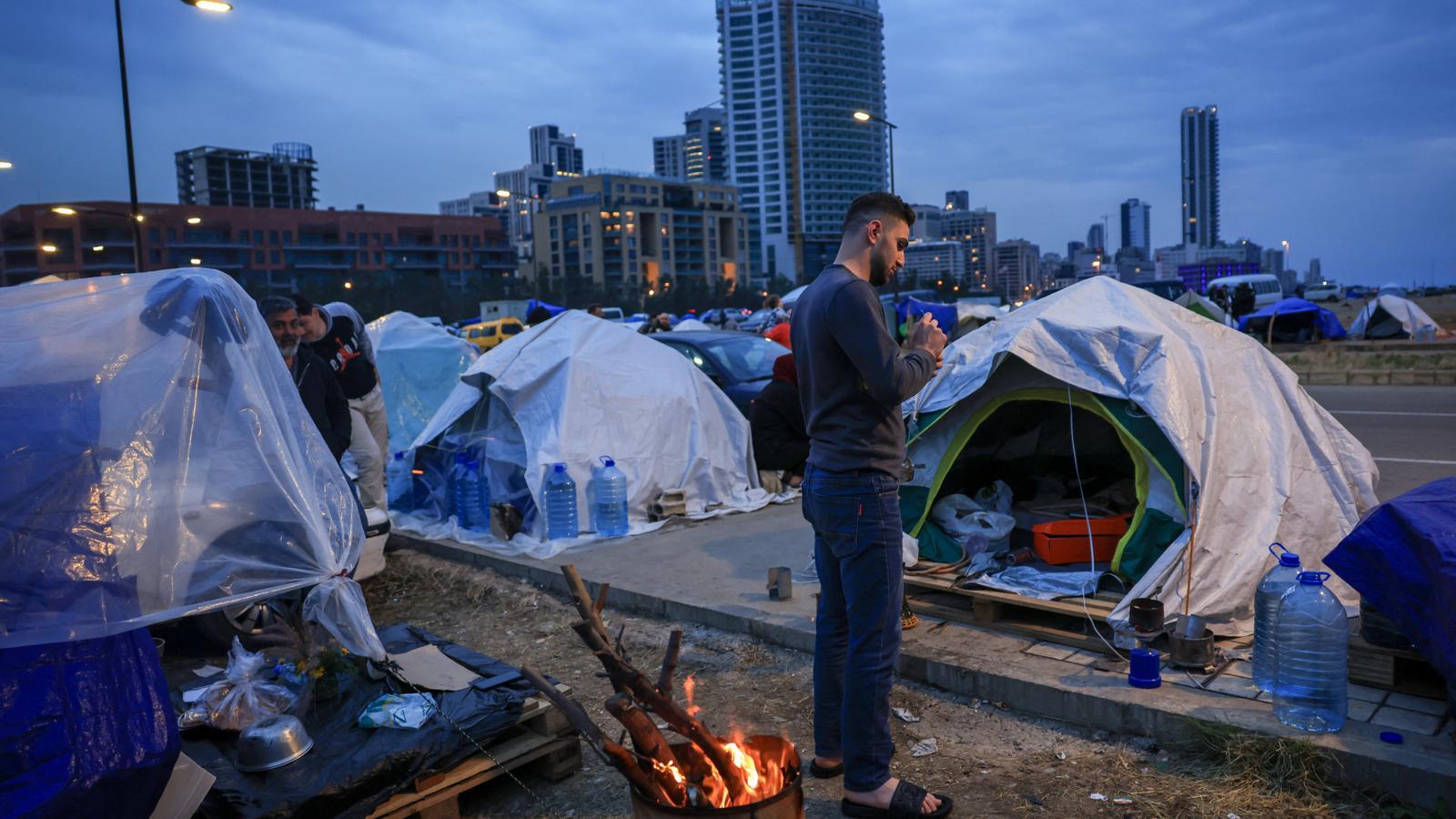
The consequences are visible. More than a million displaced people, empty villages, destroyed infrastructure. Communities that had returned after the 2024 war are leaving again. Every advance expands the uninhabitable zone. The Lebanese state, weakened by years of crisis, can barely respond. It depends on external aid, tries to manage the emergency, but does not control the situation.
In this context, occupation ceases to be a hypothesis. It is not announced, nor does it have a clear line or an official date, but it consolidates as a reality with every evacuation, every position taken, and every area from which return is no longer possible. And Lebanon, trapped between the impossibility of confronting Hezbollah and the inability to stop Israel, is once again caught in the middle.

