8 examples of the best current Girona architecture: rooted in villages, far from the city model
Single-family houses continue to be the majority of works selected at the Girona Counties Architecture Awards 2026, but public works are gradually making their way back

-
CAT -
CAST
GironaNew construction single-family homes, renovations and refurbishments in small towns in Empordà, near the Costa Brava. Mostly second homes for families from Barcelona. In keeping with the surroundings and made with local materials. This would be the most representative example of the award-winning architecture currently being produced in the Girona region. This is determined by the projects selected in the latest editions of the Girona Region Architecture Awards, organized by the Girona delegation of the Architects' Association of Catalonia (COAC).

In the 28th edition, the proportion of selected houses has decreased, but it continues to be a highly representative sample. One example, in the words of the Girona architect Ramon Bosch, a member of the jury along with Bea Borque from Barcelona and Stephen Bates from London, of "the lack of public works," which leads to all current muscle being in the hands of private architects and developers. Despite this, this year's awards, which will be presented on May 29th at 7:30 PM at the COAC Girona headquarters, show a certain turning point.
the project for the future Girona Health Campusthe project for the future Health Campus of Girona, which includes the new Trueta, which is already under development.
The importance of intermediate spaces
This lack of public works again places Girona far from the radar of award-winning architecture. Of all the selected projects, only one is in the city and it is an ephemeral work from the last edition of Temps de Flors. Regarding new works or rehabilitations, the "symptom of a certain return to the appreciation of autochthonous and traditional techniques" is maintained, in the words of Ramon Bosch, such as the use of the Alicante blind. In the case of the jury's selection, there is a "special appreciation for intermediate spaces, galleries, patios and arcades, which has to do with the typical Mediterranean culture of enjoyment" and the generation of passive elements to combat the heat.

Growing with volumes and a large porch
House in FonolleresParlavà (Baix Empordà)Anna and Eugeni Bach
A large porch with a wooden roof and protected by Alicante blinds, which extends beyond the house to invade the pool, is the great protagonist of this project in Fonolleres signed by the Finnish-Catalan architectural couple formed by Anna and Eugeni Bach. It is the rehabilitation of a house from 2000 based on a central volume, the original, and adding others as annexes around it. An idea inspired by what was usual in traditional Catalan farmhouses, as they were constructions that advanced with time. Beyond the blinds, we find traditional elements such as artisanal adobe from Baix Empordà, with an ochre tone that also inspires the entire palette of earthy colors of the house.
Returning to the village after years in the city
The last house on the roadJuià (Gironès)NUA arquitectures
If there is one thing the jury has emphasized in the selection of this year's Architecture Awards finalists, it is the "contextualization" of the project. A prime example is this house, for a family that after years in Barcelona has returned to their village, in Juià, Empordà del Gironès. As explained by the Tarragona-based studio NUA arquitectures, formed by Arnau and Ferran Tiñena and Maria Rius, Mas Nadal is a small, linear urban fabric structured around a single street. This sequence of ordered units culminates in the presence of a farmhouse, which marks the transition from street to path and serves as the entrance to Les Gavarres.
This house, located directly opposite, seeks "dialogue with the surroundings through the loggia of the party walls, preserving the original topography of the site." At the same time, the project "mirrors the neighboring farmhouse" and, like the house in Fonollera, is organized through different intermediate spaces for cross-ventilation and solar control, also using Alicante blinds. What for NUA arquitectures is the version of a "contemporary farmhouse".
Integrated into the landscape of Cap de Creus
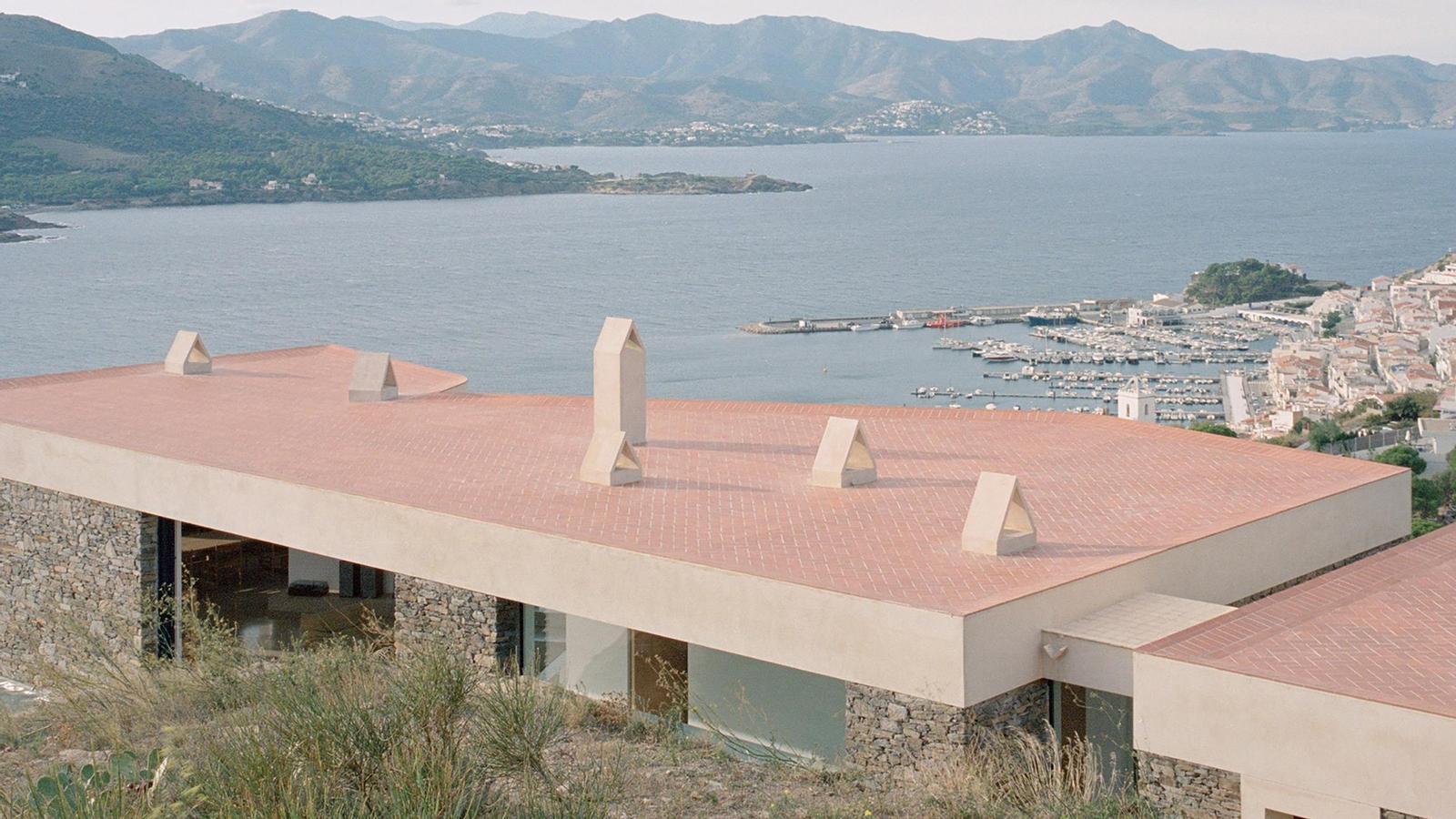
Casa Balma MuradaPort de la Selva (Alt Empordà)Measurement
At the edge of the Cap de Creus Natural Park, Casa Balma Murada is an example of a newly built house integrated into the environment with the typical slate from the area, with which thousands of kilometers of dry stone walls are made, and at the same time a minimalist and contemporary interior. The multidisciplinary Barcelona studio Mesura (architecture, interior design, furniture design, urban development, and research) signs this project in which it uses very wide walls to provide climatic protection and thermal inertia at the same time, while the geometry provides natural ventilation. At the same time, the house is designed to withstand the onslaught of the tramuntana wind while offering magnificent views of the Albera mountain range when it reaches Llançà and Colera.
How can we inhabit a ruin?
Can SargantanaSanta Pau (Garrotxa)Bayona Studio
Far from the coast, Can Sargantana is a farmhouse located in the Garrotxa region of Santa Pau, renovated by the Olot architecture studio Bayona Studio. Signed by Xevi Bayona and Cristina Montero, the project confronts us with a multifaceted question: how can we inhabit a ruin? Instead of starting from the construction of the spaces to be inhabited, the renovation uses "emptiness as a driving force" and then the house adapts to the existing space. Stone and wood play a major role externally, also in the renovation of the old barn, while, as in the rest of the projects, intermediate spaces are once again key. A large porch has been created that serves as a hinge between the interior and the exterior, presided over by an old pond that has been recovered and rehabilitated for swimming.
Time to revalue space for primary care
Expansion of the Moisès Broggi CAPL'Escala (Alt Empordà)Coll-Leclerc
Twenty-three years after being finalists in the architecture awards for the renovation of a Primary Care Health Center (CAP), the Barcelona-based architect duo Jaume Coll and Judith Leclerc have once again been selected for the Architecture Awards for a similar proposal. In this case, it is no longer the new construction of a CAP, as was the case in the Montilivi neighborhood of Girona, but the expansion of the Moisès Broggi in L'Escala. This shows where public works are heading today: with renovations and expansions of existing heritage. The expansion is conceived as a replica of the existing building from 2001, more for "an attitude of affection than for heritage criteria." The same modular structure of concrete pillars and toasted brick as the main material are reused, with a whole system of courtyards and ventilation for the space.
A bakery with three spaces: sale, fermentation, and oven
Forn Lleva'tAvinyonet de Puigventós (Alt Empordà)Quim Olea
Not all are single-family houses in small towns. In Avinyonet de Puigventós, the young architect from Girona, Quim Olea – winner of the prestigious European Europan prize for an urban planning reform in Waalwijk, the Netherlands – signs the rehabilitation of an old warehouse in the historic center to turn it into the Lleva't bakery. Based on the existing structural reading, the project is articulated in a sequence of three areas for the workshop and sales point, the fermentation space, and finally a third room, with independent access, for storage and services under a stone and lime mortar barrel vault. The action seeks minimal intervention and plays with textures and irregularities, superimposing a new functional and hygienic layer. Wood and tile have weight, but the main objective is that all the prominence goes to the bread-making process and the baker's craft.
An amphitheatre by the sea
Theatre in the Gardens of Santa ClotildeLloret de Mar (Selva)scob
Since last October, the Santa Clotilde Gardens in Lloret de Mar have had a new open-air amphitheater with the aim of expanding the cultural offerings in the municipality from this privileged location. It is the work of the Barcelona architecture and landscape design studio scob, formed by Sergi Carulla and Oscar Blasco, who had the challenge of creating a space that would fit into one of the best-preserved Novecentist gardens in Catalonia, the work of Rubió i Tudurí. The recipe has been to start from the "principles of simplicity, order, and clarity characteristic of the movement", thus the stage, perched above the sea, becomes a circle surrounded by a sinuous wave. To also integrate in terms of materials, sandstone is used.
The seaside path that the waves can swallow
Maritime frontL'Escala (Alt Empordà)OAB Carlos Ferrater + Pep Mariné, Gerard Olivé and Xavier Frigola
For almost a decade, the seafront of L'Escala has undergone a total transformation at the hands of the internationally awarded Barcelona-based studio OAB. It has been a constant change based on the premise of "work by absence." That is to say, eliminating elements that "distort the quality of the place to allow the essence of the landscape to become the protagonist again." The promenade is a privileged spot from which to glimpse Cape Norfeu, the Bay of Roses, Canigó, and Sant Martí d'Empúries, as well as closer maritime elements such as the port of en Perris or the Cargol rock. The renovation, also designed for night lighting, takes into account the action of the easterly winds so that the water returns to the sea.
