Germany accuses Russia of the drone attack attempt at Leipzig airport
Europe is on alert for "a new phase of hybrid warfare"

-
CAT -
CAST
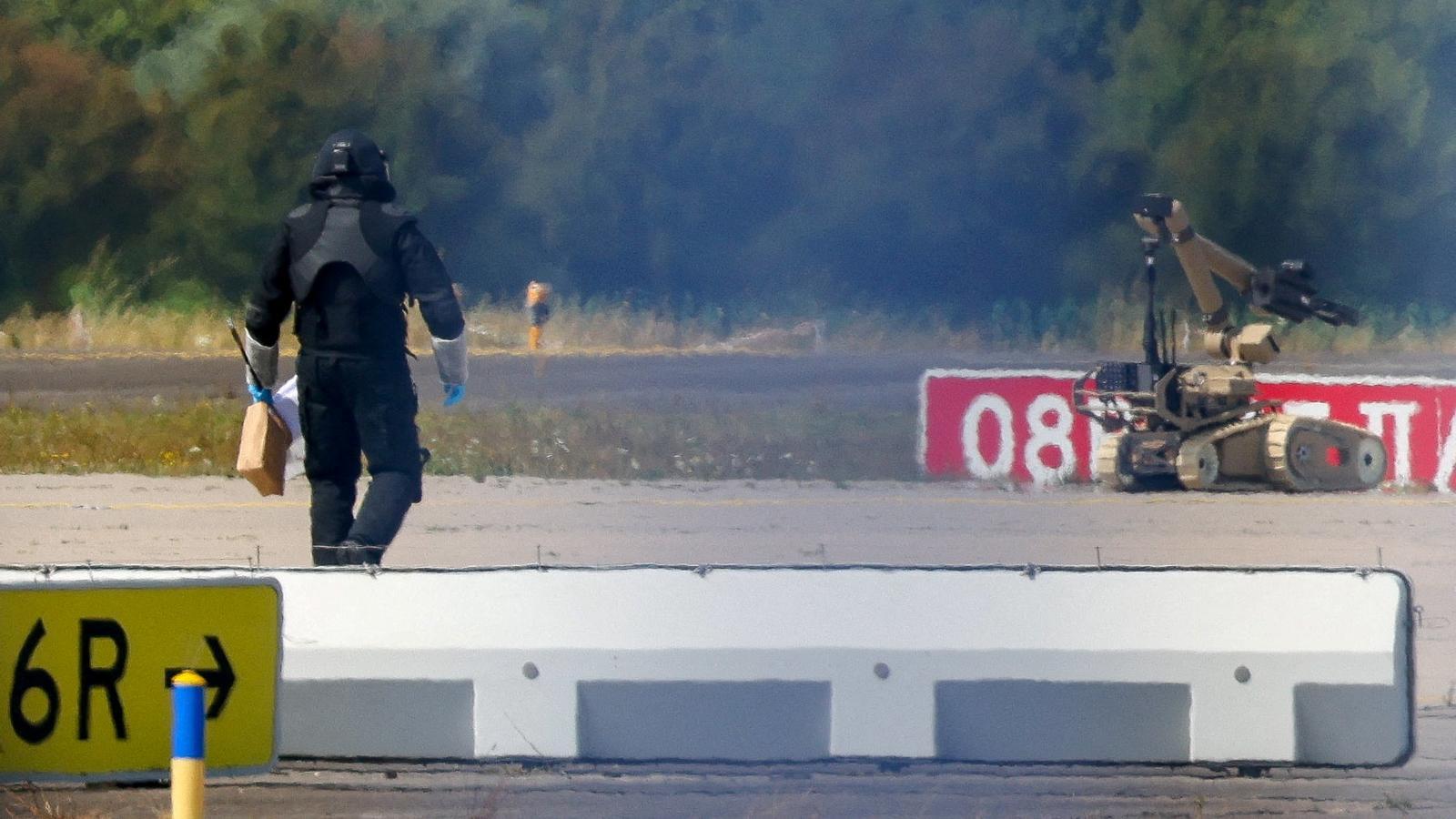
BarcelonaPoland, Estonia, Latvia, Sweden, Romania, Lithuania, and now also Germany. Incursions and drone threats in NATO territory have become more frequent in recent months and have intensified. In early August, a drone loaded with explosives impacted a Ukrainian cargo plane at Leipzig airport without detonating, in one of the most direct sabotage attempts recorded so far at a key NATO logistics center and further into European territory. After nearly a month of investigations, this Tuesday, for the first time, the German government has directly blamed Russian intelligence services for the incident.
Police investigations, crime patterns, and intelligence service conclusions have led the German executive to attribute "Russian responsibility for the attempted attack on Leipzig airport," stated German Interior Minister Alexander Dobrindt. As the minister himself hinted shortly after the incident, Berlin understands that the drone incursion is part of a broader Russian hybrid warfare campaign aimed at destabilizing Europe. "We are the daily target of hybrid warfare," Dobrindt said at the time. "Espionage, sabotage, cyberattacks, or covert operations by foreign powers intended to destabilize Germany or inflict direct damage are a constant reality," he added.
So far, the Kremlin has shrugged off responsibility, claiming there is no proof of its authorship. Moscow, which in August called the alleged attack a "manufactured provocation" and expressed "concern about a new wave of anti-Russian hysteria in Germany," stated this Tuesday that it will respond to Germany's "anti-Russian actions." In fact, Russian President Vladimir Putin addressed this during his participation in a summit in Kyrgyzstan. According to the leader, Berlin's accusations are explained by the internal problems of the Merz government: "Companies are closing, people are losing jobs, and the standard of living is falling. It is not clear why this is happening. They can only explain it by the need to counter an aggressive Russia," Putin alleged.
The Leipzig events are part of a series of similar, increasingly common incidents, reminding us that Europe is not on the sidelines of the war in Ukraine. On several occasions, the Atlantic Alliance has had to mobilize resources to intercept Russian fighter jets and intelligence aircraft (such as the Il-20 or Tu-22M3) over the Baltic Sea, flying without transponders to avoid detection. In the east of the continent, several airspace violations have been recorded in Poland and Romania by Russian drones, which have had to be shot down by NATO fighters. At the end of May, an unmanned Russian aircraft deviated from its target in Ukraine and injured two people in the Romanian city of Galați, the first victims on EU territory.
"Since the Leipzig incident, we have entered a new phase of hybrid warfare," Domènec Ruiz Devesa, senior researcher at Cidob in security and defense, tells ARA. He emphasizes that rather than the quantity of attacks, it is the quality that surprises him, having moved from the digital to the physical sphere, which implies that "we are getting closer and closer to conventional warfare." However, he insists that the objective of this type of attack is to sow chaos and make Europeans tired of supporting Ukraine, rather than having real effects.
A joint response
The incursion of the drone loaded with explosives into German territory has been the last straw and has put European governments on alert. "[The incident in Leipzig] is a sign that we must consider the possibility of more direct and violent actions on our territory," assured last week Céline Berthon, director of the French counter-intelligence agency DGSI. Berthon warned at a business forum of a "meteoric" increase in hybrid threats – such as cyber penetrations and violent acts perpetrated by local intermediaries – in the defense and technology industries, and in strategic sectors such as energy and communications.
In line with what Chancellor Friedrich Merz had advanced – who assured last week that his government will make "the perpetrators of hybrid attacks pay a price" – the German executive has announced that it will take measures against Russia such as the closure of the Consulate General of Russia in Bonn and the termination of the agreement with the Russian House cultural center in Berlin. According to information from the German newspaper Bild, Berlin could go even further and expel employees of the Russian embassy from Germany. For his part, French President Emmanuel Macron has been forceful in a message on X, in which he assured that these types of attacks "cannot go unanswered".
The German Chancellor advocates for a response to the attempted attack against Leipzig coordinated with European and NATO partners, which should arrive "in the coming days". This Wednesday, the President of the European Commission, Ursula von der Leyen, will meet with the Secretary General of NATO, Mark Rutte, in Brussels, to discuss the hybrid threats facing Europe.
According to diplomatic sources cited by Politico, the plan currently being reviewed – and which will be discussed this Tuesday and Wednesday at the informal meeting of EU Foreign Ministers – foresees massive sanctions against some 1,600 Russian actors, including 800 individuals and 800 companies. It is also expected that the debate on the use of frozen Russian assets will be reopened, although Belgium, the state where the seized funds are deposited, will need to be convinced first.
