China prohibits turning apartments into small cemeteries
Many Chinese resorted to this option due to the lack of space and the high cost of cemeteries

BeijingChina's rapid urbanization has limited cemetery space. This, along with the aging population in the country, has caused the price of burying the deceased in cemeteries to grow enormously and be one of the highest in the world. All of this has led many Chinese to use apartments as an alternative to store the ashes of their deceased. But the Chinese government has recently approved a law that prohibits giving housing this use. The new regulation coincides with Qing Ming, which is celebrated these days and would be equivalent to Catalan All Saints' Day.
In Beijing, when Qing Ming arrives, families go to clean graves in cemeteries and it is common to receive mobile alerts reminding them of the need to book an appointment to go. Population density – the Chinese capital has more than 21 million inhabitants – causes access collapse and capacity is limited. The alerts also encourage the population to overcome traditions and remember ancestors through online tributes in which the whole family can gather remotely, thus avoiding crowds. There are specialized companies and applications for this service.
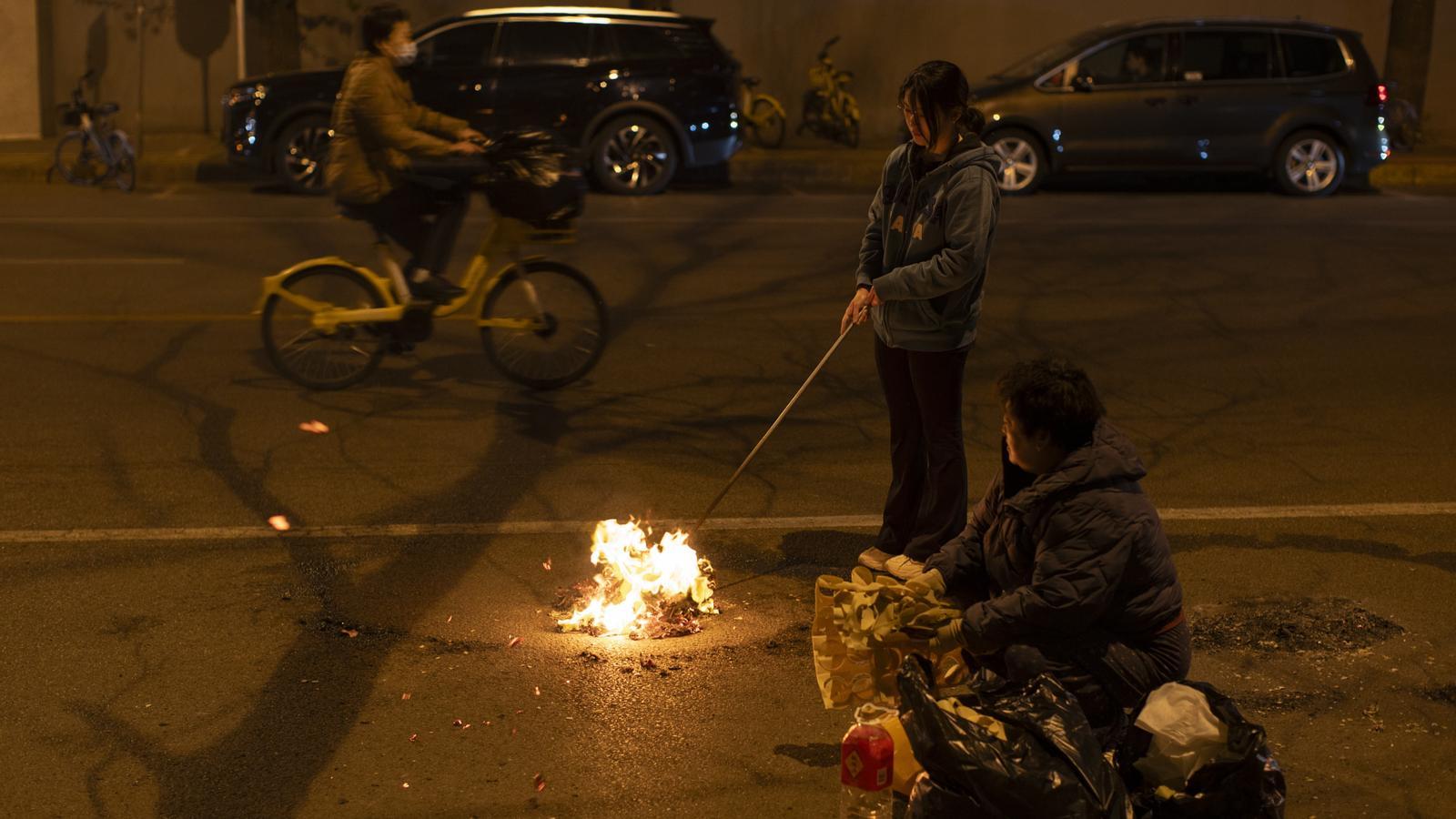
The municipal government also reminds that incense or traditional fake money cannot be burned in public places in tribute to the deceased. However, it is a prohibition that is often not respected. During these days it is common to find Chinese people in the street making small bonfires with incense and gold paper in the corners to remember their deceased relatives.
This year Qing Ming was celebrated on Sunday, but the official holidays extend until today. It is also common for cemetery visits to be made a week before the celebration and throughout the following week. This year, in addition, to municipal regulations, this new national law has been added that prohibits using residential building apartments “for the deposit of ashes”.
Candles, lights, and urns
These apartments are known in Chinese as guhui fang, which means "apartment for storing the ashes of the deceased". In fact, families buy them specifically for this purpose, that is, to turn them into mausoleums. On social media, you can see photographs of some of these apartments: they are decorated to create a space for remembrance, with candles and red lights, and the ancestors' urns are kept aligned by generation. The curtains are always drawn and the windows sealed so that no light enters.
The Chinese resort to this option because of the high cost of depositing urns in a cemetery. Cemeteries have little land and high demand, and the population is increasingly aging. Last year in China, a total of 11.3 million people died, and in the future, the number of deaths is expected to increase further.
Currently in Beijing, the price of a plot in a cemetery for two urns and a headstone ranges from 13,000 to 37,834 euros, while the price of housing in the country fell by 40% between 2021 and 2025. Furthermore, while cemetery plots can only be rented for 20 years, property ownership of apartments in China is for 70 years.
Although apartments for ashes are not a solution in large cities like Beijing and Shanghai, where housing prices remain prohibitive, they are in smaller cities that are considered third or fourth-tier. These are areas where the real estate bubble has left neighborhoods half-built and prices have fallen.
The guhui fang were a solution for the Chinese middle class, especially in the suburbs of large cities and in rural areas. According to social media, they are abundant in the south of the country. Be that as it may, the phenomenon has grown so much that the government has been forced to legislate on the matter and prohibit the practice.
Incineration, almost mandatory
In China, with a superpopulation of 1.405 billion inhabitants, land burials are limited and incineration is almost mandatory. According to article 4 of the funeral regulations, in densely populated areas or where arable land is scarce, cremation must always be resorted to. Each region, however, adapts the regulations depending on the characteristics of its territory. Furthermore, minorities, such as Muslims, are exempted from incineration.
Unlike Spain and other countries, in China scattering ashes at sea is not a crime, on the contrary, it is encouraged. In 2025, Shanghai boasted of having closed the year, exceeding for the first time in its history 10,000 incinerated deceased, whose ashes were thrown into the sea. It is considered an ecological option.
