J.D. Vance, to Orbán's rescue: the US enters the Hungarian election campaign in full
The US vice president travels to Budapest to give support to the Hungarian prime minister, who for the first time in sixteen years faces a rival whom polls point to as the winner

-
CAT -
CAST
BarcelonaViktor Orbán is likely facing the most decisive week of his political career. After governing Hungary since 2010 with absolute majorities, for the first time he faces an opponent who could unseat him. Orbán, who is the longest-serving European leader, will contend for it this Sunday, April 12, with Péter Magyar, a defector from Fidesz, the ruling party, who has become the only opposition figure with a real chance of defeating Orbán.
A defeat for Orbán would be a hard blow not only for him, but for the global far-right movement. The Hungarian prime minister has established himself as the leader in Europe of what is known as "illiberal democracy," that is, an autocratic system that disguises itself as democracy. This is why some of the world's leading exponents of this sector have shown their support for Orbán: Giorgia Meloni, Alice Weidel, Santiago Abascal, Javier Milei, Benjamin Netanyahu... and, of course, Donald Trump. In January, the President of the United States sent a letter to the Hungarian prime minister wishing him "the best of luck" in the elections and expressing his desire to visit the country soon.
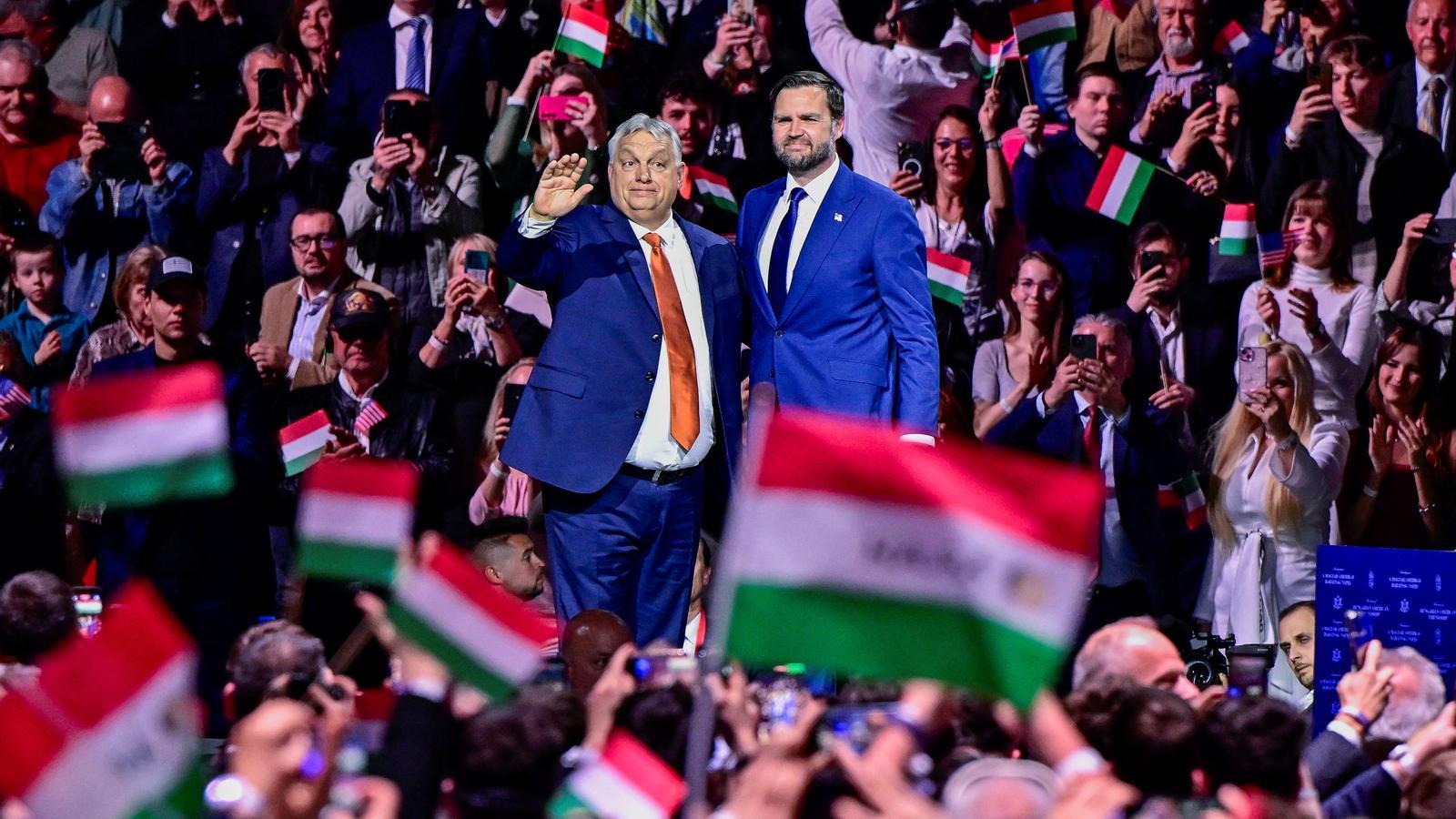
This Tuesday, just five days before the elections and with the United States embroiled in an increasingly poisoned war against Iran, US Vice President J.D. Vance has arrived in Budapest to become directly involved in the election campaign, and has participated in an Orbán rally in a football stadium.
At the same time, these elections are being watched with more interest than ever from Brussels. Also from Kyiv and from Moscow. Orbán's Hungary has become an obstacle to any European initiative to help Ukraine in its defense against Russia, and has also opposed sanction measures against Russia. Magyar has promised to bring Hungary closer to the European Union and distance it from Russian tentacles.
Exceptional turnout is expected in these elections: according to research by the think tankthat calculates the average of the country's various polls.
Politico, that calculates the average of the country's various polls.

together, with a system of control of the media and propaganda that favors Fidesz. Now, Magyar has based his strategy on a physical presence in as many cities, towns, and villages as he could. During the last week of the campaign, the opposition leader plans to visit up to seven different places in various regions of the country on the same day. His last event is planned for Debrecen, a city of particular significance. It was here that, two years ago, when just as he was beginning to emerge in Hungarian politics and was a complete unknown, he gathered 10,000 people, in what was one of Fidesz's most important strongholds. Since then, he has not stopped traveling the country to try to conquer Fidesz's territory.

The struggle in rural areas
Magyar has shown much more mobilization capacity. "In a way, they are better at selling hope," admitted the director of the Nézopont Institute, a think tank linked to Fidesz. However, the country's demographic characteristics are beneficial for Orbán: more than half of Hungarian voters live in small towns and villages, traditional bastions of Fidesz.
Anti-corruption organizations have denounced that Fidesz has established over all these years a network of collaborators throughout the country based on the distribution of money from the European Union: "Fidesz deputies and mayors form the local clique that decides important matters, such as who gets European and state funds. And for ordinary citizens, often very impoverished, they decide who gets a job, which is the main factor for survival. In exchange, they give them their vote," summarized in an interview to l'ARA Miklós Ligeti, head of legal affairs for the Hungarian branch of the NGO Transparency International.
According to an investigative documentary published two weeks ago, mayors have been assigned the number of votes each town must secure for Fidesz. Interviewees claim that the party has promised incentives including cash payments, food vouchers, prescription medication, and even illegal drugs in exchange for voting for Fidesz. Those who refuse to give them their vote lose the opportunity to participate in public works projects, often the only local job available. Furthermore, they explain that on election day cars and buses are organized and that there are "escorts" for illiterate or sick people to ensure their vote.
Accusations against Ukraine
Ignoring the polls, Orbán has called for surpassing even the 2022 results: "We have to win, not like four years ago, but better [...]. We have to achieve a historic victory," he said on March 15 in Budapest, at his main campaign rally, on the same day and in the same city where Péter Magyar was holding his own mass gathering. "All that matters [to Orbán] is to cling to power at any price," said the opposition leader, who accused the prime minister of using the threat of war to intimidate Hungarians and encourage them to vote for him.
Orbán has wielded the dichotomy between war or peace throughout the campaign, as he did in the European Parliament elections two years ago. He presents himself as the sole guarantee of peace in the country, and accuses Brussels and Ukraine of trying to drag Hungary into the conflict. He also includes Magyar, whom he describes as a "puppet" controlled by the European Union.
Especially in the final stretch of the campaign, Orbán has focused on criticizing Ukraine and accusing it of acting against Hungary. In fact, it was one of the central themes of his main rally. "This is the millennial state of Hungary. You will not be able to generate fear with the oil blockade," he said, addressing Zelenski, referring to the blockade of Russian oil transit through the Druzhba pipeline, which sends Russian oil to Hungary through Ukraine. Orbán continues to use this issue as a pretext to block economic aid from Brussels for Kyiv, despite the fact that it was a Russian attack that damaged the pipeline and that the EU and Ukraine have already agreed to repair it.
This Sunday, another of Orbán's allies, Serbian President Aleksandar Vucic, joined the campaign, stating that explosives "of devastating power" had been found near the Turkstream gas pipeline in Serbia, which transports Russian natural gas to Hungary, although he provided no further details or images. A former Hungarian intelligence official told Reuters that there had been discussions in Hungarian security circles in recent days about a plan for a "false flag" operation that would affect the pipeline in Serbia to influence the elections.
Various media outlets have also reported that the Kremlin has become directly involved in the campaign, with a disinformation operation with actions including the possibility of staging a fake assassination attempt against Orbán to boost his popularity.
"What has happened in this country, what has happened in the middle of this electoral campaign, is one of the worst examples of foreign electoral interference that I have ever seen or read about," Vance said this Tuesday. But he was not referring to Moscow, but to Brussels: "The Brussels bureaucrats have tried to destroy Hungary's economy. They have tried to make Hungary less energetically independent. They have tried to increase costs for Hungarian consumers, and they have done it all because they hate this guy (Orbán)".
The nerves among Orbán's allies are evident. And among the critics of the Hungarian prime minister, there is a feeling of unprecedented hope in the last decade and a half, although contained, aware that they have against them an electoral system that the governing party has been modifying to make an opposition victory increasingly difficult.
