Ayatollah's missiles target futuristic Dubai towers
Decisive hours are coming in the third Gulf War: Trump's "hell" against Iran threatens the other side of Hormuz

-
CAT -
CAST
Dubai (United Arab Emirates)This article is being written from the 41st floor of one of the many superlative hotels in Dubai.
Through the window –a glass wall–, an analytical view is contemplated: the sky is full of towering cranes building more towering skyscrapers that will, in a few months, be very expensive hotels and residences. The construction boom of the rogue city of the United Arab Emirates is not news. For years, economic prosperity has been blowing in favor of the Gulf monarchies, which attract more investors and foreign residents. Everyone wants to join us (Everyone wants to join us), I read on an airport sign.
The paradox of this horizon with so many cranes working is the war, which is also working, which is also under construction.From the 41st floor, the elevator takes 54 seconds to reach the ground floor. The previous night, Iran's army launched missiles over Dubai. In the sky, one could hear the Emirati defenses intercepting Tehran's fire. I ask at the hotel's golden reception.
—Does this hotel have any shelters?
—What do you mean by a shelter?
—If it has a designated place to protect oneself from a bombing.
—Ah, no, sir, we don't.
Dubai's futuristic towers did not account for the ayatollahs' bombs. "Here we build swimming pools, not shelters", a voice close to the United Arab Emirates government told me a few days ago.
I go out to the hotel pool, 8th floor. The scene is calm: children are bathing, the lifeguard is watching, parents are sunbathing. Two Russians appear on the scene: in white bathrobes, straight from the
spa. The roar of a military fighter jet cuts through the city. It's war. It's the Emirati army's planes, patrolling and defending the country's airspace. Hours later, a black cloud spreads across the sky. "It seems that [Iran] attacked the airport area", it is commented in the city's Telegram groups. The facilities of Dubai Airport, one of the largest in the world, have been a usual target for the ayatollahs. There will be no official confirmation. Gulf countries try to hide the extent of Iranian strikes because their economy is at stake.

From the bad night of February 28, Ferraris, Lamborghinis, and Rolls-Royces roared stridently through the streets of Dubai yesterday. When the when Washington and Tel Aviv launched the first bombs on Tehran,The war calculations make the monarchies on the other side of Hormuz dizzy. If Trump fulfills the infernal promise – and Netanyahu will pressure him to do so –, it is feared that Iran will react with even more fury and more bombs against their cities. The escalation would have no end.So far, Arab countries have not militarily responded to the attacks of the ayatollahs, who seek to pressure Trump by sowing chaos. Containment has been chosen as a way to accelerate the resolution of a war they tried to avoid until the last moment. But five weeks later, the United Arab Emirates and Saudi Arabia
A phrase from the Emirati president, Mohamed bin Zayed Al Nahyan, has become a slogan in the country: "We are not an easy prey, and no one should underestimate our strength."
The Ferraris accelerate
Wars have their whims.
The people of Dubai were not comfortable with the melody the government had chosen to warn them of the arrival of Iranian bombs. The authorities alerted the population via SMS, which appeared on all mobile screens and sounded like the one used in Catalonia during episodes of heavy rain. The government reached an agreement with the people: from nine in the morning to nine at night, the sound was the one previously planned, strident; from nine at night to nine in the morning, when people were sleeping, the notification was much softer, like a WhatsApp message. The people of Dubai paid little attention to the alarms. Life went on.
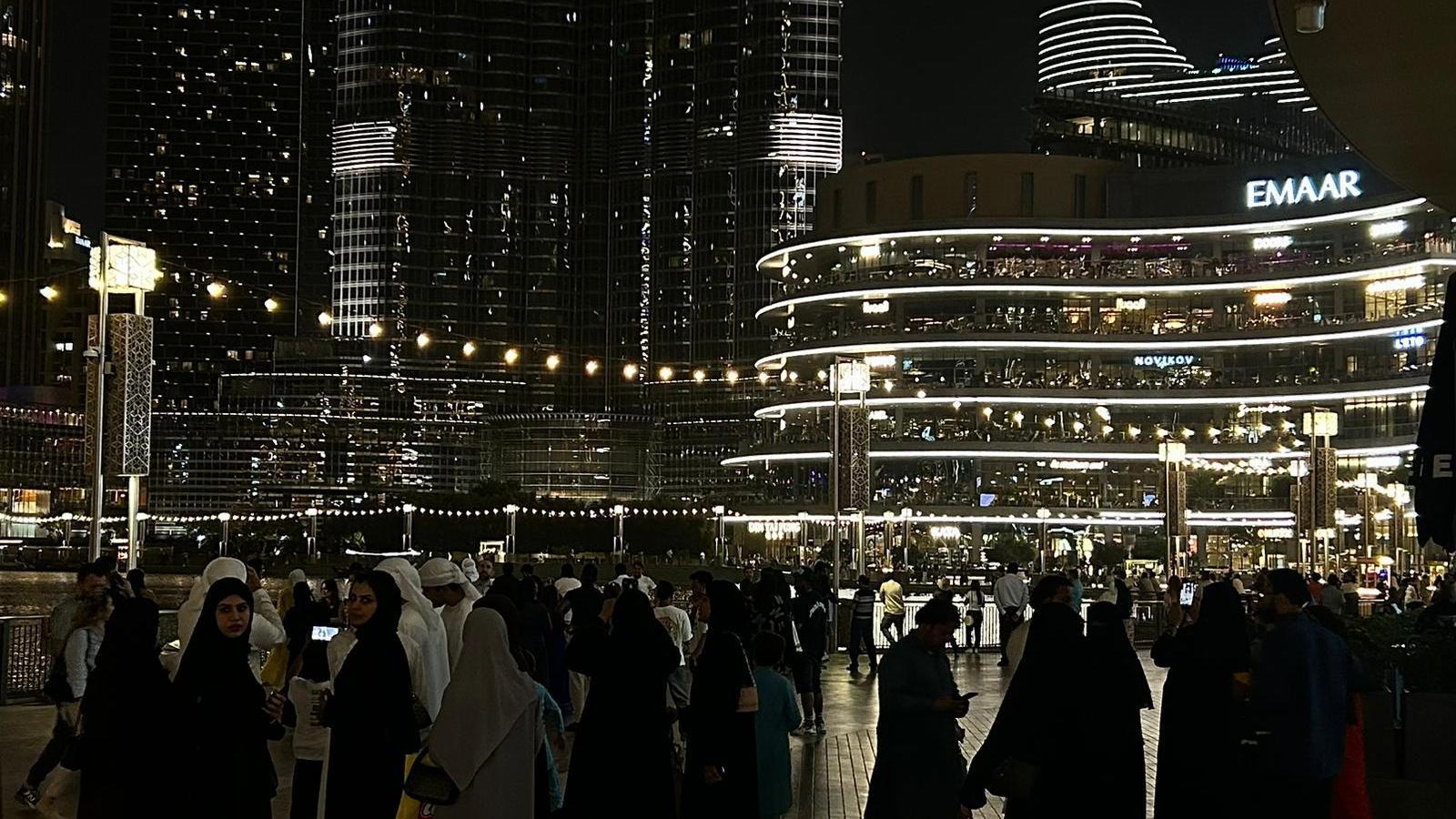
Ferraris, Lamborghinis, and Rolls-Royces roared stridently through the streets of Dubai yesterday. When the crypto-bros accelerate, the roar of the supercars has warlike nuances. In the city center, residents and very few tourists took photos around the Burj Khalifa, the tallest skyscraper in the world: 829.83 meters and 165 floors. Every half hour, a musical show made the turquoise fountain waters dance. The Burj Khalifa dressed up in flags and lit up in green, red, white, and black. They must see it well from Tehran.
The Ferraris, Lamborghinis, and Rolls-Royces roared stridently through the streets of Dubai yesterday. When the “Does this look like a war zone to you?” an Emirati man asked me as he walked through the center with his family. His wife urged him on: “Dubai is the best
.” Two Turkish girls, who have lived in the capital of luxury for years, got angry with the press: “Journalists lie, we are safer here than in Europe.” An Egyptian man, a resident of Dubai for three years, was more direct: “Bro, whatever happens, we are safe here.”
It's hard to talk to people in the Gulf these days. The monarchies are suggesting silence to the population because they don't want the war to disrupt their slogan to the world: an oasis of security and stability that fosters economic prosperity. The slogan has already been disrupted. Time will tell how deep the blow of the war will have been. Abu Dhabi and other governments have arrested people for posting war videos on social media, such as interceptions of Iranian drones and missiles in the sky. Warnings are posted in public places. “Think before you share. Spreading rumors is a crime,” it says in the elevator of the hotel where I sleep.
The war is underway, but in Dubai, more and more futuristic towers are being built.
On the direct flight from Barcelona, the seat screens sold luxury. An advertisement was repeated. It was from the Trump Foundation and showcased the real estate projects that the United States president's company has deployed across the Middle East: gleaming hotels and golf courses. The slogan was surreal. “The leading luxury developer brings you Trump's contributions to the world.” What will Trump's contributions to the world be? What world does Trump want to export?
The plane screens said that one of the Trump hotels is in Dubai.
On Thursday, a taxi driver took me to the address indicated by Google Maps. The application showed images of the building: a blue glass skyscraper with the president's name on the main facade. But Google Maps was lying. The taxi arrived, and there was no building there. There was a construction site, with dozens of immigrant laborers from India, Bangladesh, and Ethiopia working. A man approached. He was the site's civil engineer. He was from Damascus.
—Is this that is being built the Trump Tower?
—Yes. Many people come to see it.
—I thought it was already built.
—No... we started the work two months ago. In two years, God willing, it will be finished.
—And if the war allows it, right?
—Well, yes... We hope so. The client is in a hurry.
Cranes and war operate simultaneously in Dubai.

