Charts to understand Iran's strategic weight
The Strait of Hormuz and the gas and oil reserves make Iran a highly coveted territory.


BarcelonaDonald Trump and Benjamin Netanyahu go launch a large-scale war against Iran a week ago, with unpredictable consequences. We have included key data about the Persian country in some charts, which explain its regional and global importance.
Geography
Iran is situated on a plateau surrounded by mountains: the Zagros Mountains (to the southwest) and the Elburz Mountains (to the north). What truly determined Persia's historical dominance was its strategic position, with access to the Caspian Sea to the north and the Persian Gulf to the south, including a vital point for international trade: the Strait of Hormuz.
In terms of land area, it is the second largest country in the Middle East (after Saudi Arabia) and the 17th largest in the world. It is also very rich in natural resources: it is the world's ninth largest oil producer and third largest producer of natural gas.
Located in a turbulent region, it shares borders with Iraq, Turkmenistan, and Türkiye. Afghanistan and Pakistan (who have just declared war on each other) and Azerbaijan and Armenia (who in the summer agreed to a peace brokered by Donald Trump).
The population
Iran has 92 million inhabitants, most of whom live in the western half of the country, where the terrain is more rugged, with fertile valleys and large rivers. Of these, 78% live in urban areas, and 9.6 million live in the capital, Tehran.
Iranians are remarkably young. Nearly 60% are under 39, and the median age is 33-34. Thus, the majority of the population was born after the 1979 Islamic Revolution that overthrew the regime of Shah Pahlavi.
Furthermore, it is a very diverse country where several ethnic groups coexist. Persians make up 61% of the population, and other significant minority groups include Azeris (16%), Kurds (10%), and others such as Lurians (6%), Arabs (2%), Balochis (2%), and Turkic groups (2%). Regarding religion, Iran is the center of Shia Islam (approximately 90% of the population), but there are also Sunnis and other branches of Islam. Other minorities include Baha'is, Christians, Zoroastrians, Jews, and Madhans.
Economy
Traditionally, Iran's economy has been state-controlled, heavily reliant on oil and gas, but with a large agricultural sector. Strangled by sanctions, the Iranian regime is virtually unable to export. To meet its expenses (many of which are related to dents, some foundations that do not pay taxes despite controlling between 20% and 30% of the country's economy), The government has been forced to print a lot of banknotes, which has devalued the currency. and trigger inflation. The consequence of this is soaring prices and a decline in the purchasing power of citizens and public services. This situation triggered the protests in the country in January..
While GDP and GDP per capita have risen in recent years, the depreciation of the exchange rate is causing purchasing power to plummet because the local currency (the rial) is worthless for importing basic goods. Furthermore, Iran exports mainly oil to China (36%) and in Turkey (20%), but also in Kuwait (6%), Pakistan (5%), and India (4%). These countries, especially the Asian giant, are taking advantage of the fact that Iran has no one else to sell its crude oil to in order to obtain very substantial discounts.
Politics and Government
Iranian politics combines a seemingly democratic system (elections, parliament, president) with an authoritarian and theocratic power structure that is supreme. The key figure is the Supreme Leader, the center of political and religious power, who has the final say in all decisions made in the country. The assassination of Ali Khamenei on the first day of the US-Israeli attack was an unprecedented blow to the regime, but this does not necessarily mean it must collapse. An interim government has been appointed, and the succession process has been set in motion. Aside from this theocratic leadership, citizens elect Parliament, the Assembly of Experts, and a president; the Guardian Council decides who can run for office. Military and police power is fragmented, with the Revolutionary Guard as the elite force wielding significant political and economic influence.
Regional Allies
SÍRIA
Milícies
xiïtes
TURQUIA
LÍBAN
Hezbollah
IRAN
Guàrdia
Revolucionària
de l’Iran
IRAQ
Milícies
xiïtes
ISRAEL
PALESTINA
Hamàs
Jihad Islàmica Palestina
ARÀBIA SAUDITA
OMAN
IEMEN
Houthis
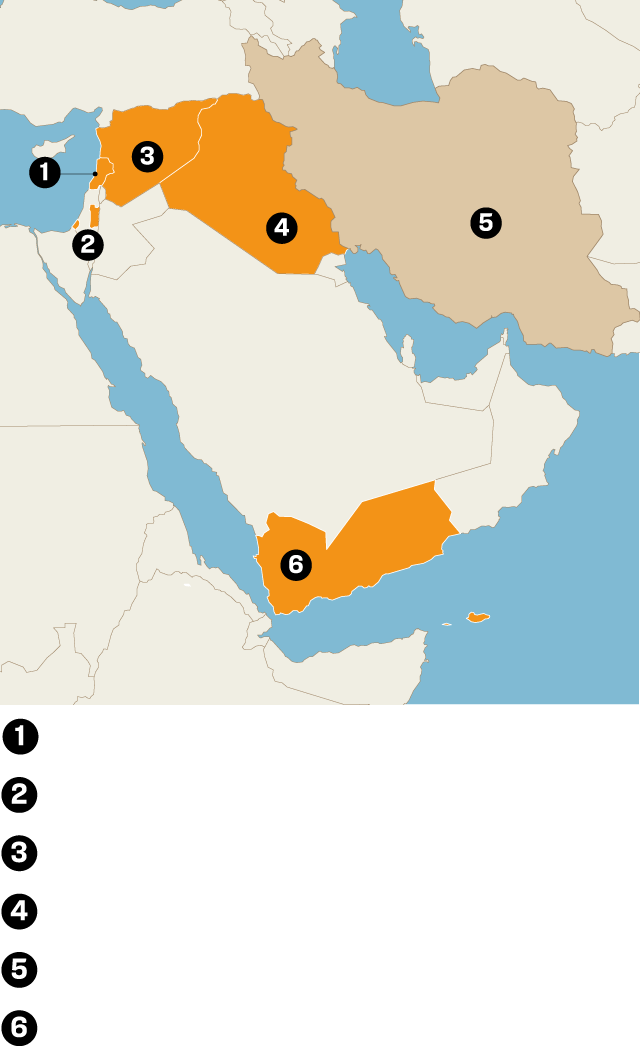
LÍBAN / Hezbollah
PALESTINA / Hamàs i Jihad Islàmica Palestina
SÍRIA / Milícies xiïtes
IRAQ / Milícies xiïtes
IRAN / Guàrdia Revolucionària de l’Iran
IEMEN / Houthis
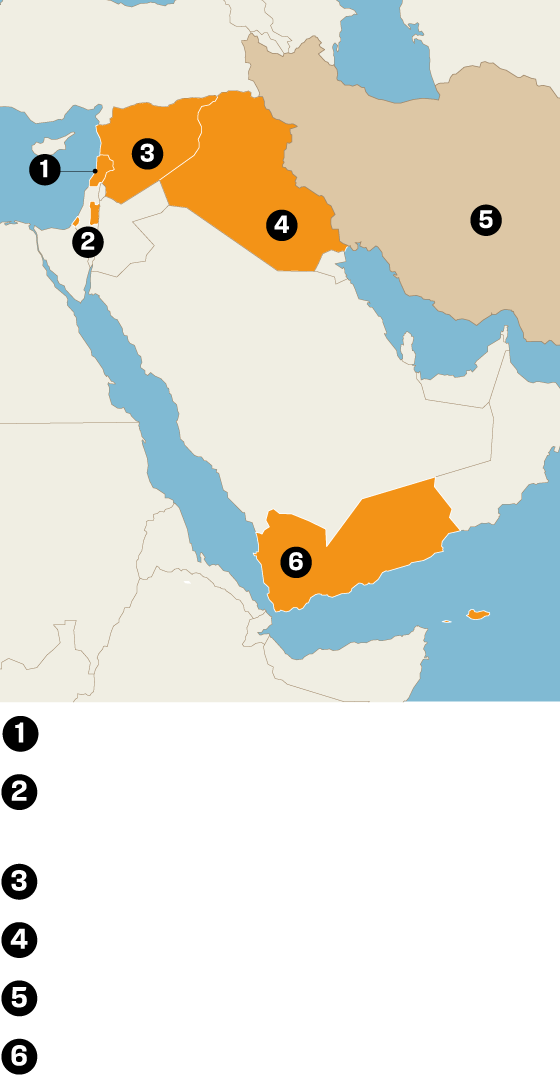
LÍBAN / Hezbollah
PALESTINA /
Hamàs i Jihad Islàmica Palestina
SÍRIA / Milícies xiïtes
IRAQ / Milícies xiïtes
IRAN / Guàrdia Revolucionària de l’Iran
IEMEN / Houthis
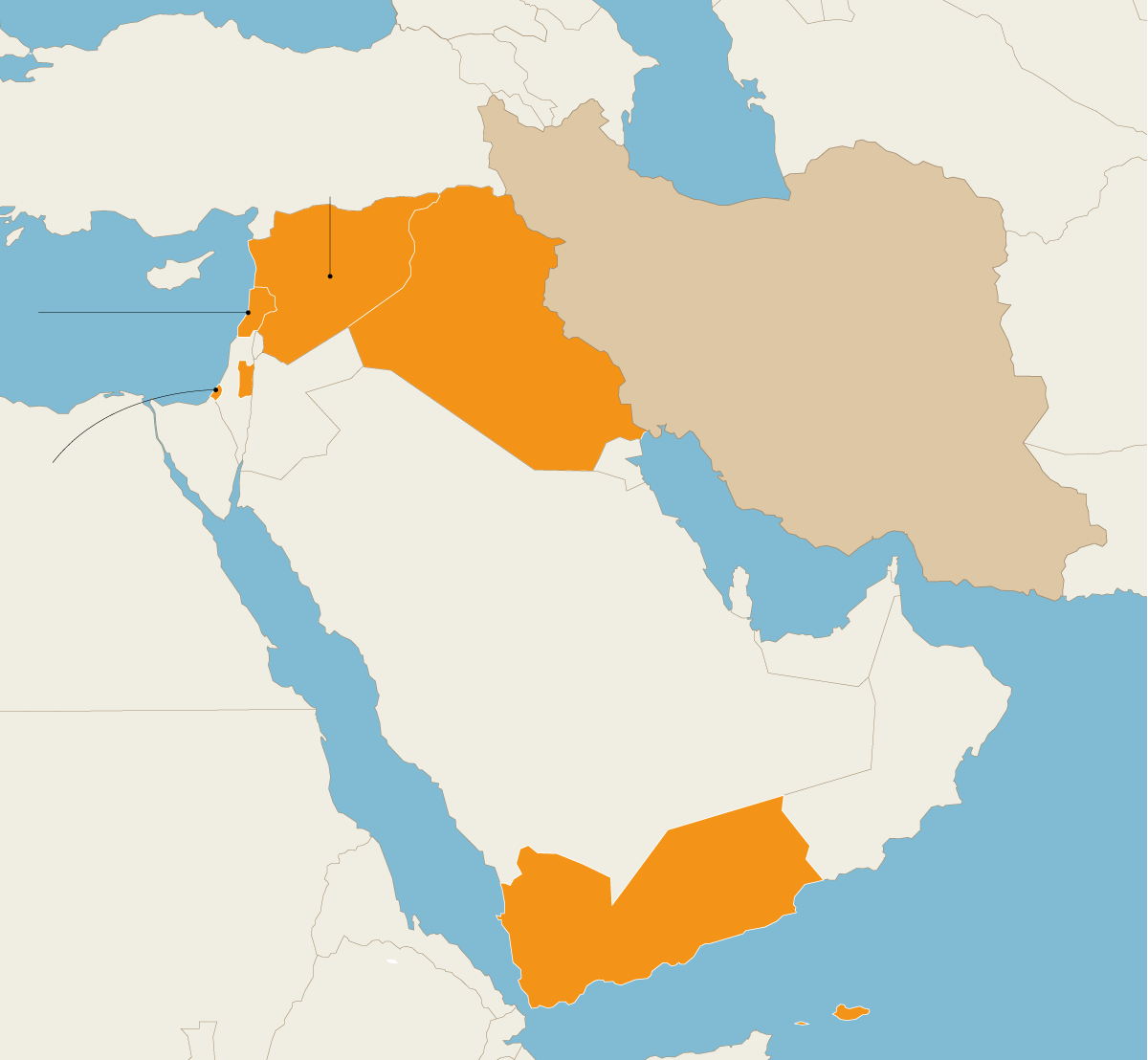
For decades, Iran has confronted Israel and the United States not directly, but through allies in the region whom it arms and finances. The main actors in this proxy war are the so-called Axis of Resistance: Hezbollah in Lebanon (its most powerful and long-standing ally), the Houthis in Yemen (key to controlling the Red Sea), the Shiite militias in Iraq, and Palestinian groups such as Hamas and Isha. Until recently, it also included the Assad regime in Syria, but since its fall, the new Syrian government has broken this alliance.
