Classical music is not scary
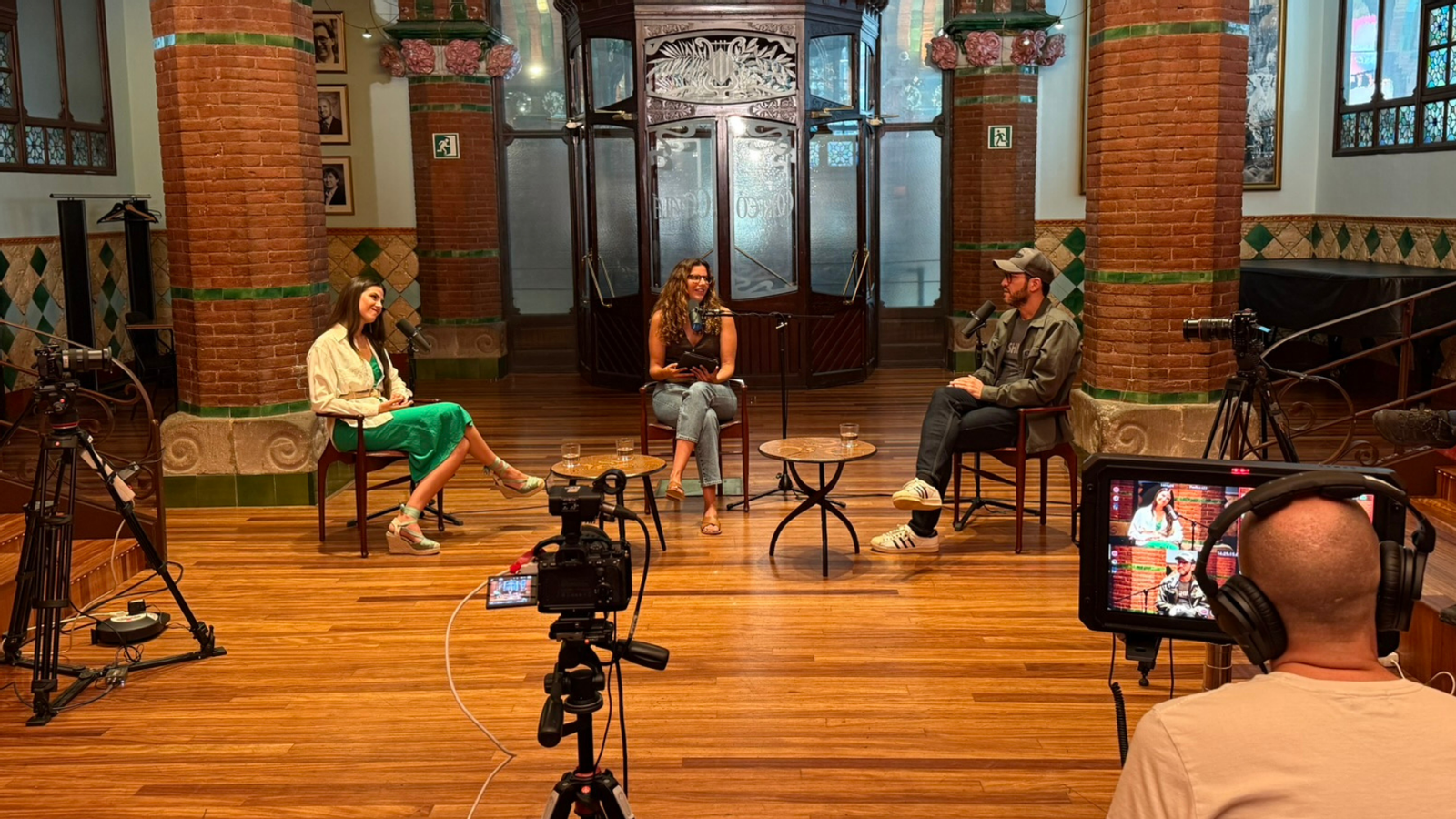
The soprano Serena Sáenz and the singer Òscar Danielo are in charge of demystifying classical music in Sala d'Assaig, the video podcast of the Palau de la Música Catalana. Confronting it with pop we will understand that there are no superior styles or unique experiences, only ways of experiencing music.
-
CAT -
CAST
Under the invisible baton of the first bars of Ludwig van Beethoven, with the unmistakable G-G-G E, F-F-F E from the Fifth Symphony, soprano Serena Sáenz and singer, composer and music producer Òscar Danielo converse about music as a driver of new experiences, confronting classical music and pop in a new episode of Sala d’Assaig, the video podcast of the Palau de la Música Catalana.
Pop vs. Classical is the title of this episode and the Fifth Symphony evokes these fears for us. Considered one of the most emblematic works in the symphonic repertoire, its dramatic force confronts us with our own fears. But, after all, who is afraid of classical music?
Serena Sáenz is one of the young voices with one of the brightest futures in Europe and Òscar Danielo is the soul of the music group Delafé y las Flores Azules. Positioned in two opposite worlds, they both face losing their fear when talking about classical music with pop.
"Classical music doesn't bite for anything in the world. What happens is that if you have distrust, it makes you respectful, and if there's no one to introduce you to it in a friendly way, you don't dare". Serena Sáenz explains how at 10 years old she had her first contact with classical music. It was at school, singing with the choir precisely in the Rehearsal Room where this video podcast is recorded. "There were 60 of us children, all with the same curiosity, and we had a superb time".
School, family and recommendation
School, and also family, are in many cases inspiring. Often, however, this link does not exist and hinders learning. "For me, the problem with classical music is that I never knew how to get into it, because when I asked them to explain something to me, they did it in a way that was a bit too advanced, so it went in one ear and out the other," explains Òscar Danielo. The lack of role models, unlike in modern music, hinders this connection.
In pop music, the performers, dead or alive, are recognizable. In contrast, in classical music, they are not. "There is no original recording and it is the Berlin Philharmonic, or the Copenhagen, or whichever one that performs. You know there are versions, but you don't know which one to choose, so you're a bit lost." As Serena explains, "classical music consists of compositions made 100 or 200 years ago and we reinterpret them," so no matter how "wonderful" the music is, it will reach you or not depending on its interpretation.
Sáenz argues that music is, above all, emotion and that, beyond a recommendation or minimal contextualization, the spectator should not feel the need to study a work beforehand to be able to understand it, as happens in certain operatic productions. Therefore, Serena asks, "I don't know if we are doing a good job because people should come and simply have a good time."
Excellence versus improvisation
The protocol, sometimes too rigid, doesn't make it too easy either. Nevertheless, "I'm one of those who let myself go," says Serena. For Òscar, who comes from rock, the sensations are different. "My background is much more street-level and classical music for me is always like a classroom." In pop, they allow themselves more liberties, even "a crackle in the voice," while in classical music "the pressure not to make a mistake is always there," confirms Serena Sáenz.
Excellence in classical music is paramount. Much more so than in pop music where, any mistake, "you end up resolving it differently." For Danielo, self-demand is less. "In pop or hip-hop, the important thing is that you are relaxed, you give a good image and you have a good time. At concerts, people go to have a good time, forget about work, dance, drink, disconnect or fall in love" and any mistake becomes "an anecdote".
The dress code
The staging also forms part of the concert ritual. In pop, Òscar Danielo admits that he has always performed with practically the same green shirt – his “gig shirt” –, sneakers, and some other practical detail without excessive aesthetic reflection. In contrast, in classical music, the scope is different. Serena Sáenz clearly distinguishes between the concert format and opera. In a solo recital, she can choose her attire, always in coherence with the orchestra and the rest of the performers. “If the orchestra wears tailcoats, I will wear an evening gown. There must be harmony on stage,” she points out. The code is not rigid, but it does respond to a certain idea of shared elegance.
In opera, on the other hand, the costume is part of the character and can go to extremes. Sáenz recalls productions where she has sung suspended by a harness, characterized as a manga puppet, with heavy boots and an impossible wig. A stage requirement that adds to the vocal and musical pressure. “In opera, there are many inputs when you go on stage,” she explains, between coordinating with the conductor and the orchestra.
And the audience? Extreme solemnity is not required either. “As long as you don't dress as if you were going to the beach,” says Sáenz, “I think you have to make a little effort. When you go out to dinner, you dress up; to a concert, too.” Danielo resolves it his own way: jeans, a polo shirt, and comfort. The important thing, after all, is to feel part of the experience.
Music for everyone
If fear was the starting point, music is the answer for both. For Òscar Danielo, it has literally been the soundtrack to his life. “Music has been everything”, he states. Serena Sáenz agrees from another perspective. For her, music has the capacity to amplify any emotion. “There is a very wide range of colors to choose from”, she explains. And music, she says, can change your mood in a matter of seconds.
The differences appear in the realm of creation. Danielo claims to be an intuitive creator, alien to academic norms, while Sáenz feels comfortable interpreting others' scores. Two complementary profiles that show there is no single way to experience music.
In the end, both agree on an essential idea: there are no superior styles or unique experiences. There are life moments. Perhaps there are stages when a massive concert is more appealing and others when the calm of a hall like the Palau is appreciated. But in all cases, music continues to be a meeting space, an experience that strikes and transforms us.
Because, whether pop or classical, music simply doesn't bite.
