Caution among shipping companies after the agreement between the US and Iran
Until autumn is not expected to recover the activity prior to the start of the war, when around 140 ships a day were passing through the strait
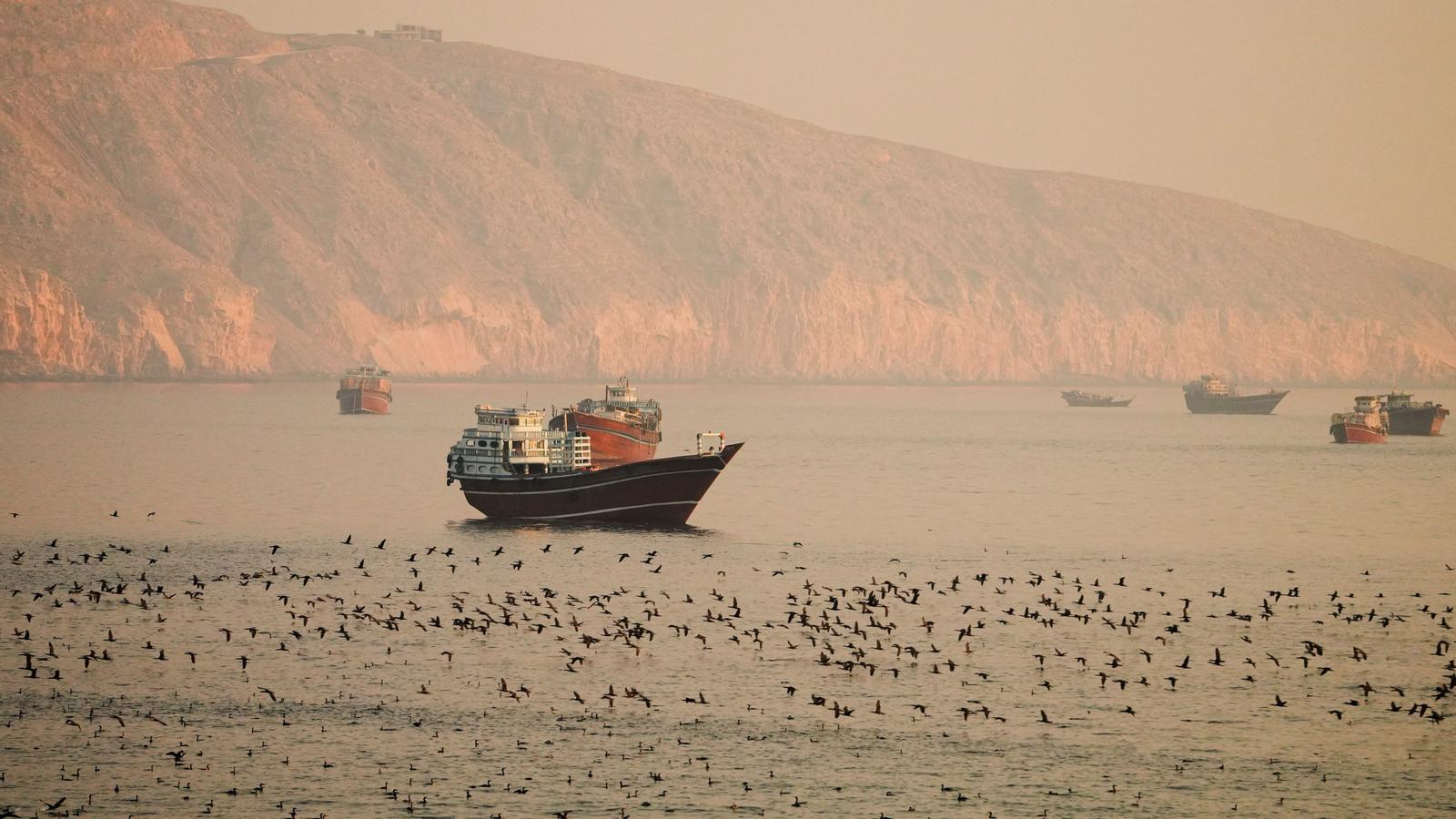

-
CAT -
CAST
BarcelonaThe framework agreement between the US and Iran to end the war initiated by Donald Trump and Benjamin Netanyahu on February 28 has been met with hope in the Middle East and financial markets, as demonstrated by the fall in oil prices. However, after countless breaches of previous truces and false proclamations of the conflict's imminent end, caution prevails among most international shipping companies.
"Both the US and Iran continue to apply their respective blockades in and around the Strait of Hormuz. It is very risky and difficult to pass through," Jakob Larsen, security director of BIMCO, the main shipowners' association, told US radio station NPR. The agreement, announced on Sunday and defined as a memorandum, is expected to be signed probably this Friday.
Although in recent weeks the number of ships daring to cross the strait had already begun to increase, the figure is still very far from the usual flow before the outbreak of the war and has not grown significantly since Sunday. Experts' forecasts point to a progressive increase in traffic in the Persian Gulf starting on Friday and in the coming weeks, provided there is no return to hostilities. However, it would not be until well into autumn that pre-war activity would recover, when about 140 ships a day passed through the strait.
, a tanker ship heading to India with 62,000 tons of liquefied gas from Qatar.
The danger of minesMost turn off the device that emits a signal to the Automatic Identification System (AIS) and allows their movements to be tracked, as required by international navigation regulations. According to an investigation by the Reuters agency, a total of 116 ships, mostly oil tankers, have secretly crossed the strait with the assistance of the US military since the beginning of May. In many of these cases, the operation would have included a transfer of oil cargo to other ships near the Strait of Hormuz before they could be attacked by Iranian drones with the aim of increasing oil supply to global markets and containing its price.
Since President Trump announced the memorandum on Sunday and sent the message "turn on the engines and let the oil flow again" on social media, only a limited number of ships have crossed the strait. The official Iranian news agency Fars has reported that in the last few hours, three Iranian ships, including an supertanker, have managed to reach the Gulf of Oman without being intercepted by the US Navy.
The Iranian Minister of Foreign Affairs, Abbas Araghchi, described the news as "a good sign that shows that the memorandum is in its first phase". The ships that have made the journey in the opposite direction in the last three days would be around a dozen. Among them, the Disha, a tanker heading to India with 62,000 tons of liquefied gas from Qatar.
The danger of mines
The main fear of shipping companies is that even after the US and Iran's commitment to allow free passage through the strait comes into effect, a danger has not yet been eliminated: the explosion of sea mines. Washington reported in the early stages of the conflict that it had destroyed several Iranian ships attempting to lay mines in the Persian Gulf, but it is unclear if they were able to complete their task. "We have no accurate information about the danger of mines. But, apparently, neutralizing the mine threat could take weeks or months," Larsen maintains. Several European countries have expressed their openness to collaborate with the demining process in the Persian Gulf once the hostilities have ended.
Since the agreement has not yet been officially signed and the statements by US and Iranian leaders have been consistently contradictory, the concrete resolution of several disputes remains uncertain. There is the potential imposition of tolls by Iran for crossing the strait. The Iranian regime, in dire need of funds to rebuild a devastated country, has reiterated on several occasions that it will maintain the toll system it implemented at the start of the war, an approach that clashes head-on with the position of the international community. In fact, international law guarantees free passage through international maritime routes.
A possible compromise would be to draw inspiration from the Montreux Convention, the treaty that regulates passage through the Bosphorus Strait, which is under Turkish sovereignty. In this case, ships must face a mandatory fee to cross, corresponding to signaling, rescue, and pilotage services. However, unlike the Bosphorus, which is an internal strait, the Strait of Hormuz is shared by Iran and Oman, which could complicate negotiations.

