Andy Burnham, the king of the north of England, conquers London
The withdrawal from the leadership race by former Health Secretary Wes Streeting opens the door to a coronation for the former mayor in mid-July

-
CAT -
CAST
LondonA mid-morning this Monday, as the acting premier, Keir Starmer, had just announced his decision to throw in the towel and leave Downing Street, the former mayor of Manchester, Andy Burnham, 56 years old, married to a Dutch citizen and with three children, arrived at Manchester Picadilly station to catch the train to London. He was carrying a bag containing a suit and, undoubtedly, many hopes. Burnham appeared surrounded by journalists, and all sorts of passers-by pointed their mobile phones at him. He was escorted by a pair of police officers; however, he was accompanied by some of his female advisors. He did not shy away from the attention, nor could he avoid the nerves. To such an extent that he declared to the BBC cameras that he was going down to London to take possession of the mayor's office. "I said as mayor; I mean as a Member of Parliament." A slip of the tongue.
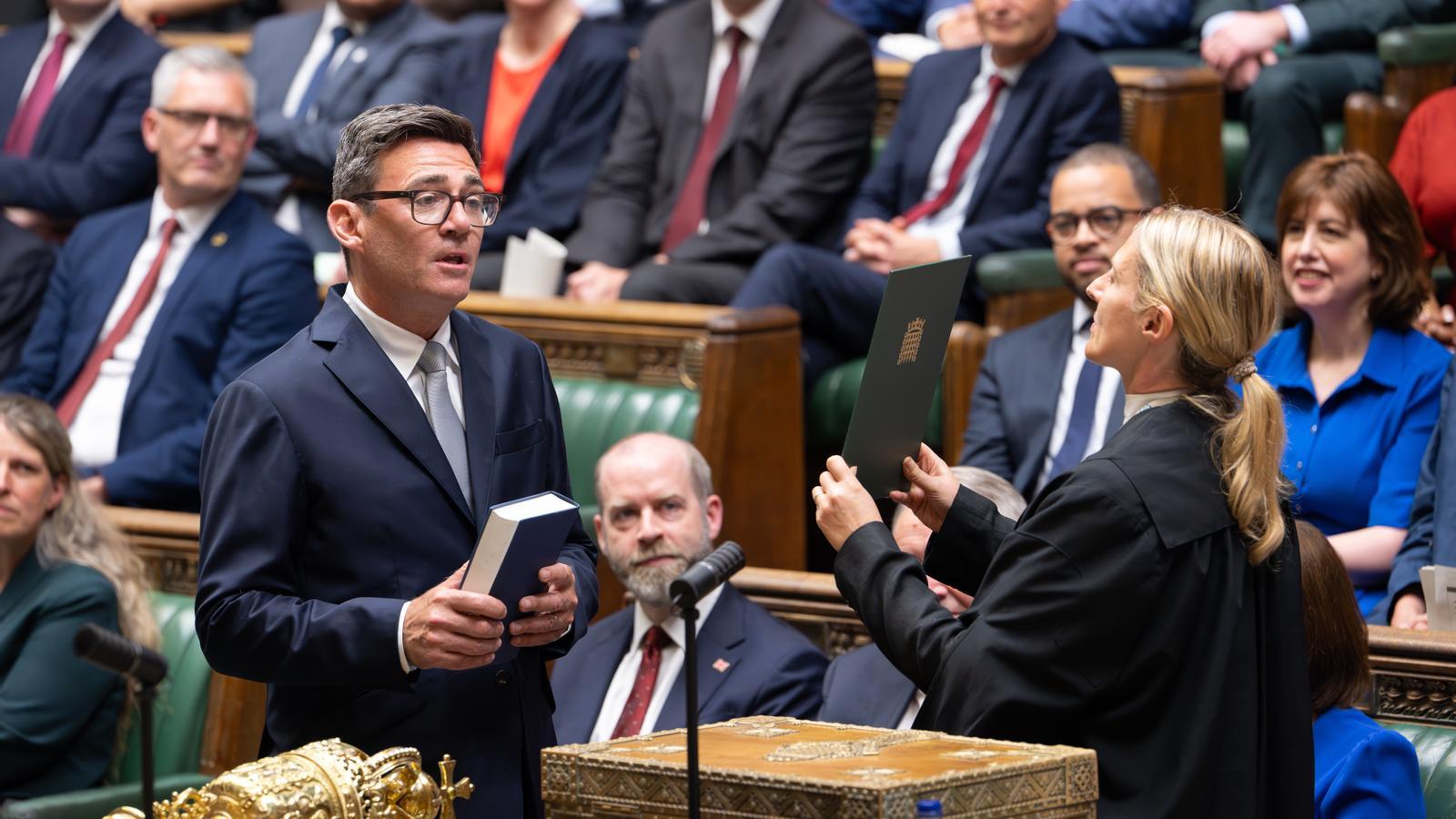
The so-called King of the north, the king of the north, an Everton supporter – Liverpool's smaller team – has thus begun his descent to conquer the capital. His train was a few minutes late, but nothing exceptional. And shortly after 2:30 PM, local time, he swore the oath of office as a Member of Parliament for the Makerfield constituency (north-west England) with a Bible in his hands. He won the seat last Thursday, and, as had been anticipated for weeks, it was the key that would catapult him to number 10 Downing Street, probably in less than a month. The United Kingdom already has two kings: Charles III and Andy Burnham.
During the brief swearing-in ceremony as a Member of Parliament, the atmosphere in the Commons had moments of humor, almost theatrical. The veteran Conservative MP Desmond Swayne provoked laughter and applause by shouting "Rome is saved!", an ironic reference to Keir Starmer's replacement. Immediately after, another elected official exclaimed in reference to Burnham: "He is not the Messiah", evoking a famous scene from the film The Life of Brian. After a brief pause, Burnham joined in the joke and replied that he was perhaps just "a very naughty boy", reproducing the line that follows the original phrase in the film.
Shortly after the laughter died down, Burnham met with part of the Labour parliamentary group, the first test for his authority which, at this point, seems uncontested. Not only because of the enthusiastic reception he has enjoyed in the Chamber but also for the massive selfie he took with his MPs in Westminster Hall. Some of those present were loyal to Starmer until practically this very Monday. But a king is dead, long live the new king. And everyone joined in wholeheartedly.
Since 2017, Burnham has been away from Westminster politics. But he is returning to a place he knows well. The new MP was already a Member of Parliament between 2001 and 2017, during which time he held various ministerial portfolios during the governments of Tony Blair and Gordon Brown, including Health, Culture and Treasury. He stood twice for the leadership of the party, and lost both times. It wasn't his moment. Paradoxically, it has been the nine years in Manchester and the distance from London that have built his prestige and opened the famous black door in Whitehall alley.
Patriotism and 'Manchesterism'
From the great northern city, with a weekly radio program in which he directly answered listeners' questions, he has built an image of an approachable, pragmatic leader, rooted in the territory. He has been able to confront both conservative governments –especially during the pandemic– and the leadership of his own party when he has considered that the interests of Northern England were being questioned.
His career is marked by a combination of social democratic sensibility, a kind of English civic patriotism, and a fierce defense of decentralization in a country suffering from the malaise of "Londoncentrism". The son of a working-class family and deeply influenced by the political culture of Northwest England, Burnham and his two brothers were the first in their family to go to university, in his case to Cambridge, where he graduated in English literature.
He has often presented himself as the voice of communities that believe London excessively concentrates the political, economic, and media power of the United Kingdom. This position has allowed him to connect with traditional Labour voters, but also with sectors that supported Brexit and who demand more investment and autonomy for the old industrial regions, now depopulated.
Regarding the European Union, he himself declared last year, during the party congress, that he would like to see the United Kingdom return to the Brussels club. However, this is a commitment that in the recent Makerfield campaign he has practically hidden to avoid undermining his expectations in a constituency that overwhelmingly voted to leave the EU, ten years ago this Tuesday.
Analysts have dubbed his way of governing "Manchesterism". But rather than a closed ideology, it is a way of doing things based on the transfer of powers from Whitehall to large metropolitan areas, the coordination of public services at a local level, and an economic policy aimed at reducing territorial inequalities. Inspired by the experience of Greater Manchester, "Manchesterism" advocates that city-regions should have greater capacity to manage transport, housing, health, or vocational training, even without shying away from the renationalization of some or all of these essential services. What he has achieved with Manchester's transport system, managing to lower fares by 15%, is emblematic of his actions.
His supporters present him as an alternative to London centralism; his critics, as a Trojan horse for covert English federalism. In any case, he has turned Manchester into a political laboratory observed with interest by the rest of the country and also with nervousness by the financial markets of the City.
Keir Starmer has established a timetable for the succession, asking the Party's National Executive Committee to open the period for nominations of candidates on July 9 and to close it a week later. But the withdrawal of one of the MPs who had nominated himself as a candidate, the former Minister of Health, Wes Streeting, who has supported Burnham, has opened the door to his coronation. As early as July 17 – or even before – he could become the seventh British premier in a decade. And the first to be an Everton supporter, Liverpool's second team. An alternative power, as he, deep down, wants to represent.
