The new British prime minister promises the "most important changes in forty years"
The former mayor of Manchester, Andy Burnham, prepares a ten-year plan to set the country on a new course and cleans his government of Starmer's allies

-
CAT -
CAST
LondonThe image is too symbolic to let it go: the United Kingdom has changed its prime minister through the back door. While Buckingham Palace reserves the main entrance for tourists, it forces the political power to reach the audience with the king through the so-called luggage door due to the restoration work being carried out there. It is through there that Andy Burnham entered, who this Monday at noon received the commission from Charles III to form a new government.
All in all, an involuntary but powerful metaphor for the state of the country. A former power with a still imposing facade but one that does not withstand microscopic analysis. Internal structures need a profound reform: stagnant economy, housing crisis, political confidence at an all-time low, and a demographic winter advancing silently. The monarchy has accepted that the United Kingdom is not for triumphant entries, but must stand firm while the changes last.
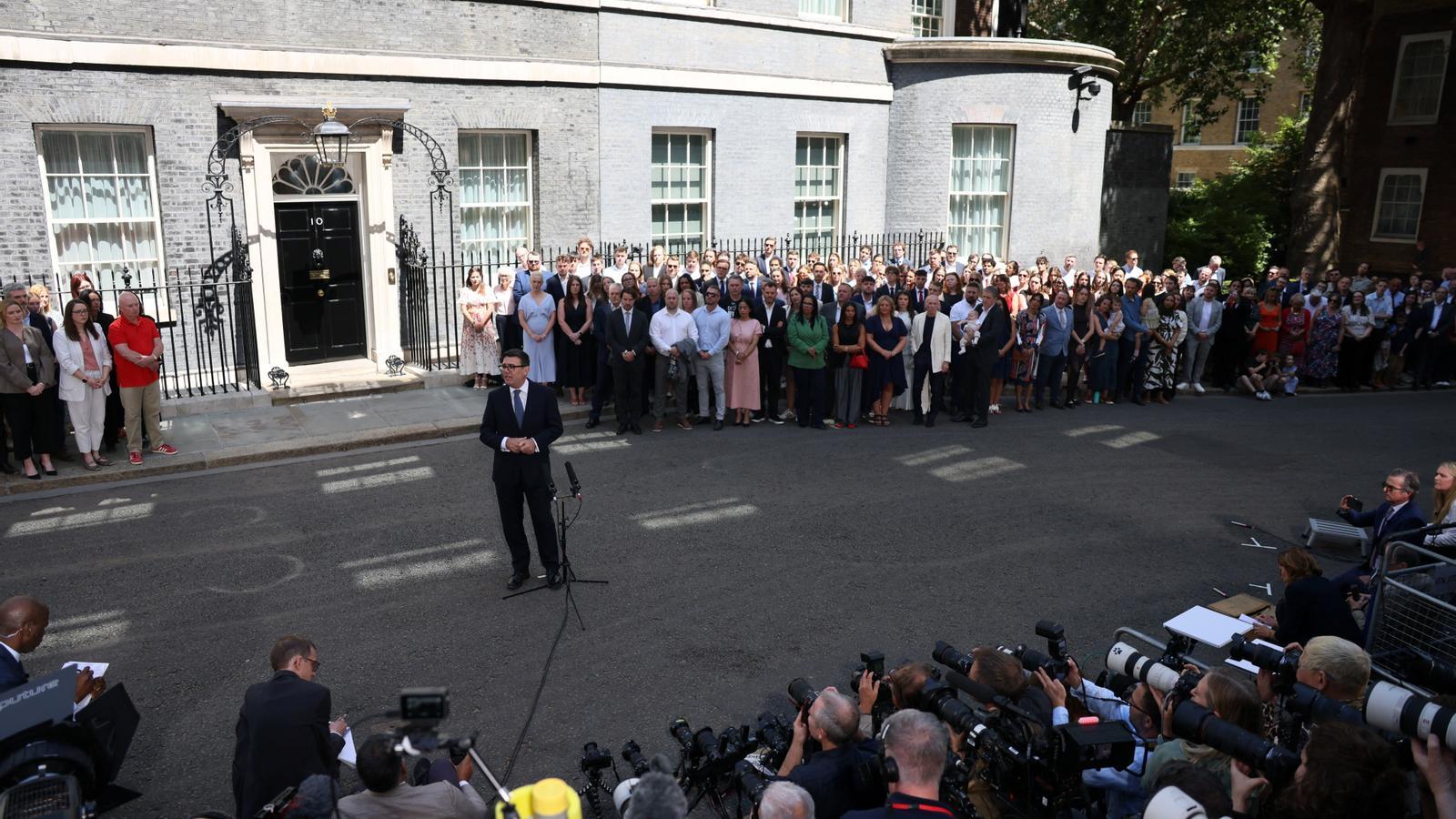
And Burnham is the man who has to try to fix the patches. After the meeting with Charles III, the premier subsequently headed to Downing Street, where he delivered his first speech as prime minister, the seventh in ten years, and the fifth in the last four. The first message was in form, because unlike his predecessors, Burnham addressed those present with only one microphone in front of him, without a lectern or notes, breaking formalities from the first moment.
He then intoned the mea culpa as a politician: "The United Kingdom must show the world that it can regain stability once again, and this is our challenge: to make politics work, and work better. I know many people are fed up with politics. I hear you, and I want to be honest with you. We haven't been good enough, and we have to do better. And we will."
The newly appointed premier has promised to drive "the most important changes of the last forty years: a new political model and a new economic model", which he will have to detail in a ten-year plan that he will present after the summer, and of which, for the moment, practically nothing is known. Without pointing to specific measures, in just over four minutes of speech, the former mayor of Manchester assured: "We will regain firmer public control over essential services so that they become affordable again." And he also guaranteed a "reindustrialization of the United Kingdom by using public procurement to support British industry".
The new government commits, in Burnham's words, to implementing immediate measures to alleviate the cost of living, facilitate young people's access to the labour market through educational reforms, provide more support for mental health, and expand the social housing stock. And, as he has done in Manchester – albeit with mixed results – the new premier has said: "Very soon I will walk through the door behind me [that of 10 Downing Street] and give my first instruction: to end homelessness in our country". How will he do it? Will his desire alone be enough? Who will foot the bill? Too many unknowns, for now.
An unexpected appointment
The music might sound good, but what about the lyrics? Initially, what stands out most from Burnham's first decisions is the reshuffling of his government, removing eight to nine ministers considered Starmer's allies. Regarding the most relevant appointment, it has been the head of Economy – because everything else depends on it – John Healey, who six weeks ago resigned as Defence Secretary. Healey considered that the already former prime minister did not allocate enough resources to the army. The appointment has surprised everyone, as the odds indicated that it would either be the Minister of the Interior, Shabana Mahmood, from the right wing of Labour and very tough on immigration, who will finally remain in charge of the same department, or Ed Miliband, from the moderate left, who has moved from Energy Security to Foreign Affairs. Miliband's appointment as head of the Foreign Office will allow Andy Burnham to focus on the domestic agenda.
Healey had openly criticized what he defined as the "Treasury orthodoxy," that is, the traditional way of understanding the department's economic policy, which he will now lead. When he left the Ministry of Defense, he reproached his predecessor, Rachel Reeves, for not understanding the need to increase defense spending and even stated that the ministry considered this item "a burden and not an engine of growth." The new head of public finances described this internal culture as "a brake on a dynamic government." The unknown for now is whether these criticisms will translate into a change of course from within the department itself or if he will end up assuming the usual functioning of the ministry.
The market will receive the name John Healey calmly, as they consider him a safe option thanks to his extensive experience in different areas of government. A look at his resume can explain the choice of the first. Healey knows the Treasury well, where he held positions such as economic secretary and financial secretary, giving him an insider's view of public finances. He has also held responsibilities in local and regional government and housing, two of the Burnham government's priorities. And his past as a trade unionist in the 1990s may evoke sympathy and arouse fewer suspicions among the more left-wing sectors of Labour.
These moves have coincided with Louise Haigh's return to government as Chancellor of the Duchy of Lancaster, in practice, First Secretary of State and one of the most influential figures in government after the Prime Minister. Haigh had also repeatedly questioned the Treasury's excessive concentration of power, despite having previously left the executive following controversy over an old fraud conviction which, according to her, she had previously communicated to Keir Starmer. Be that as it may, her appointment and that of Healey fuel expectations of a possible redistribution of power within the British government, with much more prominence for Downing Street and less influence for the Treasury. Burnham appears to want to take the economic reins and this Tuesday announced a series of relevant measures to alleviate one of the biggest concerns of Britons: the rising cost of living.
Another of the most notable appointments has been that of Angela Rayner, one of the most popular figures on the left wing of the party. In September 2025 there was from leaving the government Starmer as Housing Minister for not having paid the full taxes in relation to the purchase of a second home, a circumstance from which she was subsequently exonerated. With Rayner's return as Housing Minister, Burnham fills some of the main ministerial seats with representatives from all sectors of the party.
On the other hand, Burnham's first calls have been to the President of the United States, Donald Trump, whom he has taken the opportunity to invite to Manchester next year, on the occasion of the G20 meeting, and to the Ukrainian President, Volodymyr Zelensky.

For his part, at the time of the farewell, an hour before Andy Burnham appeared on Downing Street, Keir Starmer also wanted to summarize in just over four minutes the milestones of his legacy as leader and as premier. Very significant has been the claim – which he has made again and again – of how he has transformed Labourism since he took the reins, in the early days of April 2020: "Six and a half years ago I took our party over after a historic defeat in 2019, I transformed it so that it would be ready to face the country's challenges and we achieved an overwhelming victory in the general elections of 2024, I transformed it so that it would be ready to face the country's challenges and we achieved an overwhelming victory in the general elections of 2024." That victory was decisive, but only in terms of MPs and thanks to the particularities of the British electoral system. The 33.7% of the popular vote obtained was the lowest percentage ever recorded for a party with an absolute majority in the Commons.
Starmer did not excite
The change Starmer has referred to in Labour is a very elliptical way of saying that what he did was eliminate any internal debate, and that he shackled or expelled the left heir to Corbynism, a strategic error that has also contributed to his downfall. Because the promises he made were hardly possible without more radical reforms. And, even so, Starmer, who has held office for just over two years, has wanted to boast about the changes: "My job is done," he said, and defended that he leaves "a stronger and fairer United Kingdom than it was two years ago." He could not avoid including what he considers improvements, but which are concessions to the right and far-right, such as "the reduction of immigration." In practice, a shot in the foot and a problem for a country that is seriously aged and is experiencing a demographic winter, although not as pronounced as in Japan, Italy, and Spain.
In any case, the prudence and lack of daring of the now former prime minister,as well as his inability to break the fourth wall and speak directly to public opinion and treat it as adult, have ended up condemning him. Starmer emphasized more intangible aspects rather than concrete proposals and measures that would improve citizens' lives. With this track record, very serious errors, such as the appointment of Peter Mandelson – the friend of the pedophile Jeffrey Epstein – as ambassador to Washington and the elimination of aid to cover energy bills for the neediest, were the final nail in the coffin.
Keir Starmer never managed to awaken real enthusiasm among the electorate. With such a low bar, Andy Burnham may be content with solid management and a bit of ambition to completely transform the political landscape. But the new prime minister has little room to prove it. He has asked for ten years to reverse the trajectory of a country that has been moving in the opposite direction to the United Kingdom he wants to build for four decades.

