Andy Burnham "imagines" a new decentralized United Kingdom with control of essential services
The 'de facto' Labour leader delivers a first aspirational speech in which he lays the foundations for his "ten-year" project
-
CAT -
CAST
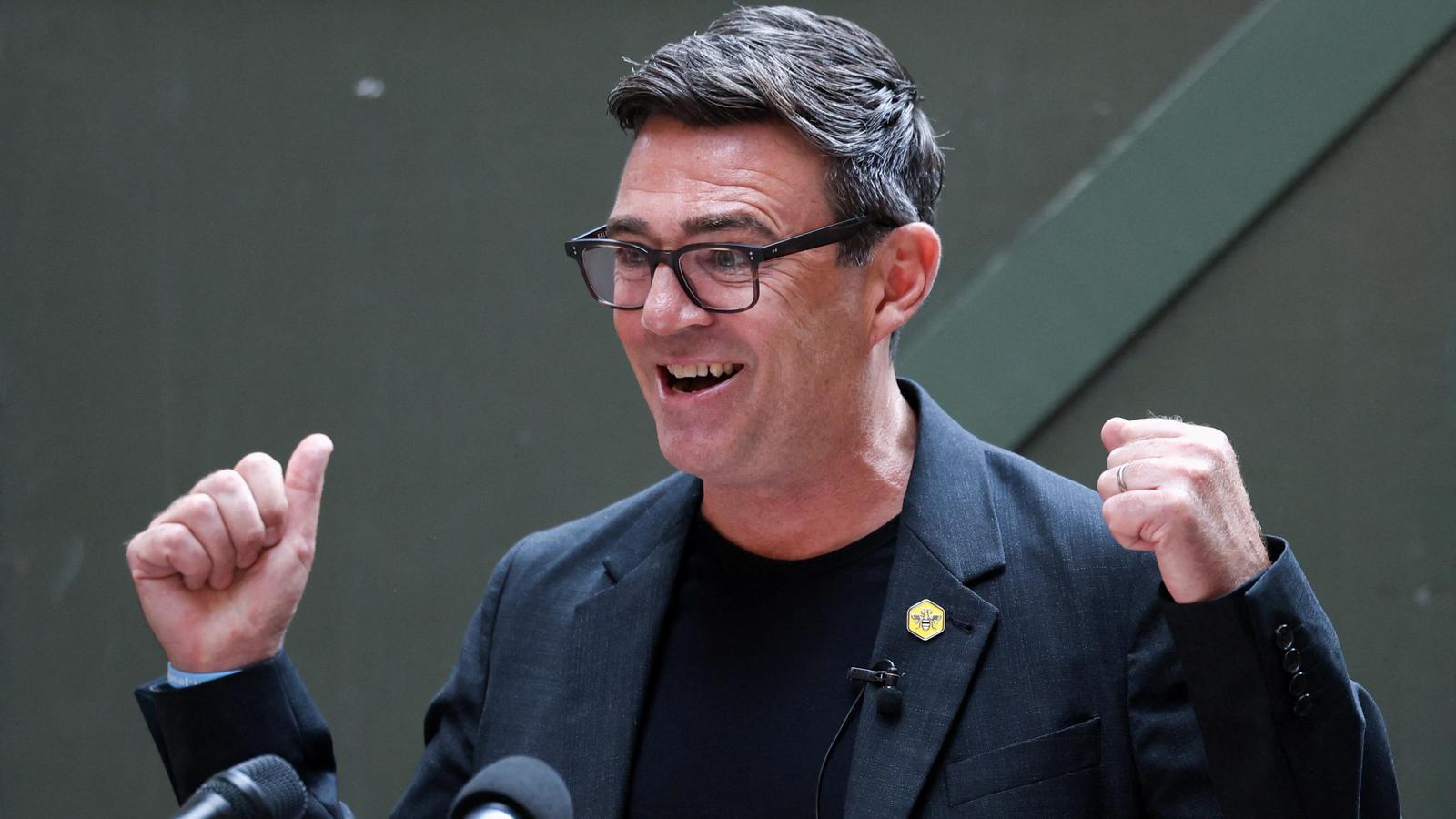
LondonThe United Kingdom has a new messiah. One more or a real one? Or perhaps just another politician, naive enough, who believes he can change the system and not the other way around? Questions that, for now, have no answer. In any case, the man is called Andy Burnham and in all probability will become prime minister in just under three weeks, following the resignation announcement of Keir Starmer a week ago.
This Monday, from a highly symbolic stage, the People’s History Museum in Manchester (the museum of the history of the labor movements, political rights, and the development of democracy), the former mayor of the great northern city laid out the main lines of his political vision for the country in a speech of just over half an hour. A speech that ended with an invocation to John Lennon and his Imagine, in what was also a symbolic union between the Manchesterism that Burnham represents and Liverpool, another beacon of the north that is to benefit from this new utopia. Utopia or facts, though? "Well, enough imagining. Let's make it happen," he concluded.
What needs to be done, then? Burnham's first of the major promises has been to "regain public control over essential services," strengthening state intervention in areas such as water distribution, housing policy, energy, and public transport, with ten-year plans aimed at reducing costs, as he has done as mayor of Manchester. Housing occupies a central place in this strategy. Keir Starmer's successor has promised "the largest social housing construction program since the post-war period," convinced that without a strong public sector, it is impossible to rebuild the British social elevator.
The economic model of recent decades has spoiled it. And that needs to change. Burnham has rejected "the old 'trickle-down' model, the economic drip that supposedly causes wealth from the top to filter down to the popular classes. For decades, he said, the British economy "has been built without thinking about workers." As an alternative, he has proposed a "good growth" model that distributes it territorially and brings opportunities "to every British postal district." On how this should be materialized and who his Chancellor of the Exchequer will be, he has said nothing. "That way the press can speculate until the process is over," he joked.
Burnham has also announced an ambitious reindustrialization policy based on economic strategies designed by each region, and a more active use of public procurement to favor British companies and strategic sectors — steel, defense, energy, or food —. So much change fits within the 2024 electoral program, he said, implicitly confirming that he does not intend to seek the endorsement of the polls for his imminent mandate by advancing the elections.
The right, of course, has already reacted by saying that Burnham wants to take the United Kingdom back to the seventies: years of nationalizations, strikes, social conflicts, and economic crisis. And while the former mayor asks for time, because he speaks of a project with a decade in view, the first symptoms suggest that the opposition will not give him even a hundred days of grace before beginning the siege by land, sea, and air.
Transformation of the state
To make all this ideology possible –"this is Manchesterism", Burnham said–, the de factopremier considers it essential to transform the functioning of the state. The United Kingdom is, in his words, "one of the most centralized countries in the world, [where] power is not in the hands of the places it represents". His response is "the greatest rebalancing of power our country has ever seen". The most visible tool of this new policy will be the creation of what he has named a Number 10 North, a permanent extension of Downing Street located in Manchester that will act as "the nerve center of the reconfiguration of the United Kingdom".
Despite the name, he insisted that it will not be an institution designed only for the north of England. Number Ten North will be the hub of a new institutional architecture "intended to redistribute power to all regions of the country, including Scotland, Wales, Northern Ireland, and also London".
More than a government program, Burnham has delivered a foundational speech on the need to change British political culture. "Westminster has not been at the service of the people... it is broken", he stated, even going so far as to utter a mea culpa: "My generation of politicians, including myself, must take responsibility." And he promised to end a politics based on "accusation" and "self-serving politicking" to govern by seeking "spaces for consensus” with other parties. He stated that he will do things "differently".
Little specificity
The ambition of the project outlined in the speech contrasts, for the moment, with the scarcity of specifics: he has only assured that his executive will respect fiscal rules, a way of trying to reassure markets in the face of a possible greater debt to finance reforms and improvement plans or even renationalization of essential public services. And the markets have received the speech with satisfaction.
A large part of the reforms are part of a "ten-year mission", with the argument that a transformation of this magnitude requires stability and continuity. Burnham himself has admitted the difficulty, and that he may not have that much time, when he acknowledged that "I know people can't wait forever for change".
The speech concluded on an emotional note with John Lennon in the background. Burnham has repeated the verb Imagine several times to describe the country he aspires to build: "If in 1844 people could create the cooperative movement in Rochdale to lower the price of food, why can't we act now with similar courage to improve people's lives? Imagine what things could be like if we achieved it. Imagine what it would mean to live in a country designed to work for workers, rather than against them. Imagine if all local authorities could build affordable housing to the point of being able to guarantee one for everyone. Imagine if we could reduce the cost of energy for people and businesses, and all that would allow".
While awaiting the formalization of his designation, the Labour leader has asked not to be judged by the speech, but by the results he can offer in a decade. The big question is whether a highly polarized and fatigued public opinion after almost twenty years of crisis, austerity and Brexit will be willing to grant him that time. The answer is no.
