Andorra signs an association agreement with the EU to access the single market
The pact, which must be revalidated by referendum, will allow the free movement of people, goods and capital

-
CAT -
CAST
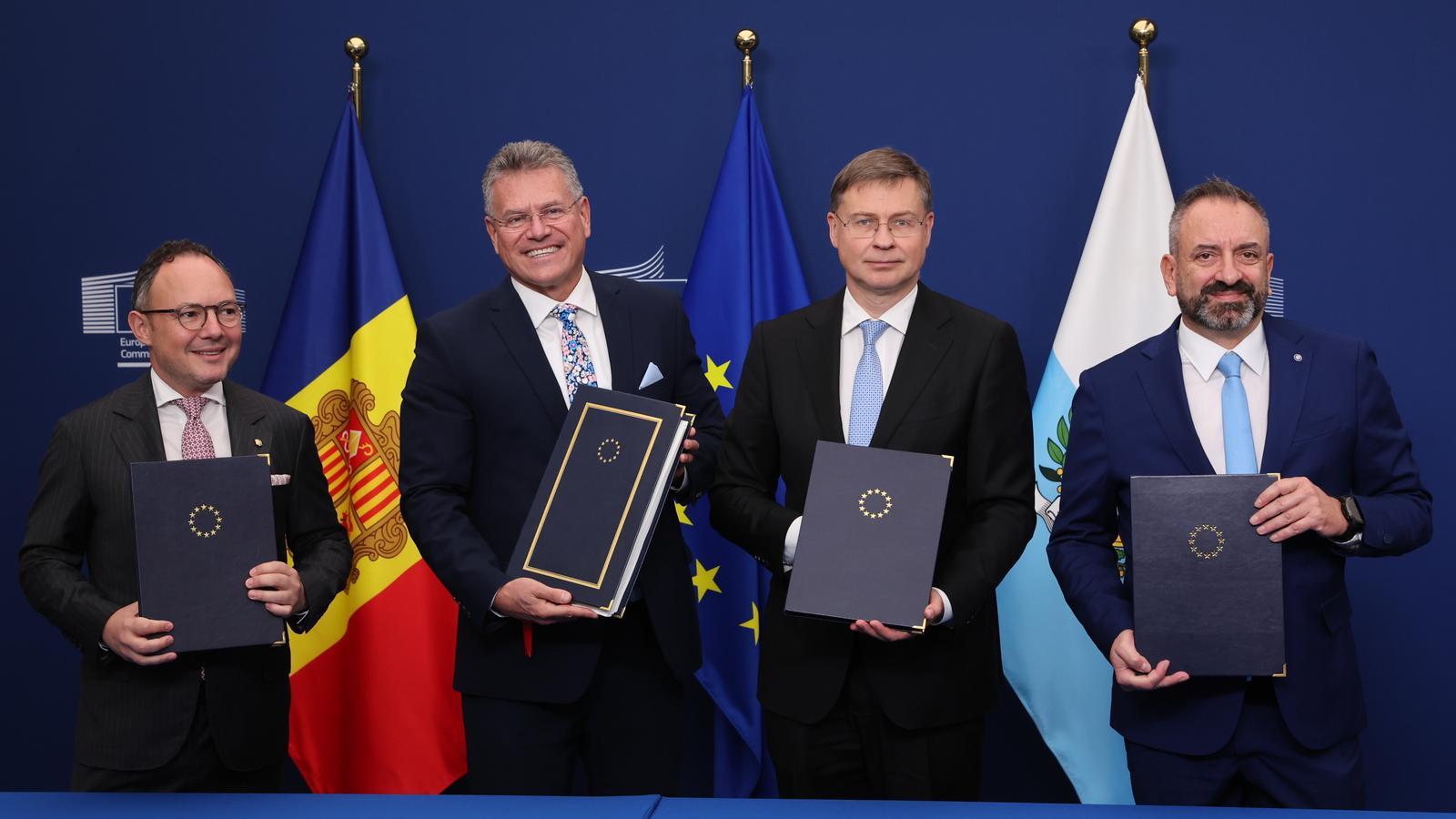
BrusselsAndorra takes another step closer to the European Union. The head of the Andorran government, Xavier Espot, has celebrated the beginning of a "new stage" after sealing the association agreement with Brussels this Monday, which should allow the principality to integrate into the bloc's market.
The text, which has been under negotiation for more than ten years, must be revalidated by the Andorrans in a referendum. Once the Andorran citizenry and the European Parliament endorse it, the agreement will open Andorra's doors to the single market and, with it, to the free movement of people, goods, and capital.
The ceremony, shared with San Marino, which has also signed its agreement, was attended by two members of the European Commission: the Executive Vice-President and Commissioner for Trade, Maroš Šefčovič, and the Vice-President and Commissioner for Economy and Productivity, Valdis Dombrovskis.
Espot has argued that the agreement represents "a leap in quality both for the country's development and for democratic quality" and an improvement in relations between Andorra and the European Union, which date back to the customs agreement of the nineties. Likewise, he has claimed that the pact reinforces the role of small states as reliable, prosperous countries with the capacity for growth.
The agreement gives Andorra access to the internal market with common rules and conditions of fair competition. It offers citizens, businesses, and administrations more legal certainty and predictability, facilitates trade, encourages investment, and boosts cross-border activity, while respecting the particularities of each partner, according to the European Commission's statement.
Gradual financial integration
The agreement also sets a framework for dialogue and cooperation in areas of common interest, such as research and innovation, education, social policy, the environment, consumer protection, culture, and regional cooperation. Regarding financial services, integration will be gradual and subject to specific conditions, including an assessment of the robustness of the regulatory and supervisory frameworks of Andorra and San Marino.
In parallel, the EU has signed updated monetary agreements with both countries to prevent them from overlapping with the new association agreement and to ensure legal certainty.
