Pol López: "I am more interested in the history behind the wine than in the adjective 'cantamañanas'"
Actor
-
CAT -
CAST
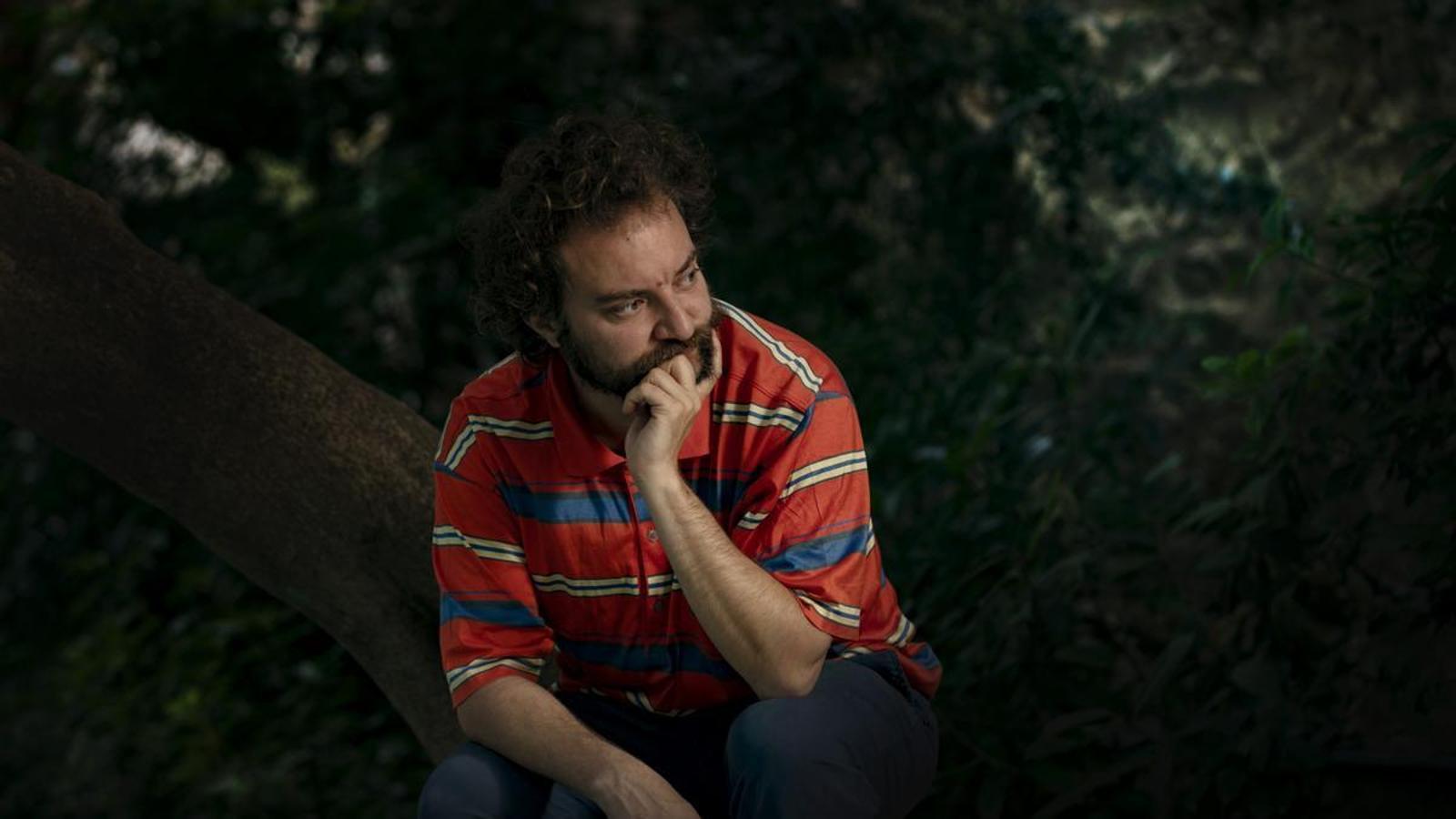
Pol López (Barcelona, 1984) has been Hamlet, Vladimir, Alceste and Raskolnikov. He also played Ivan in Suro (Mikel Gurea, 2022), a role that earned him the Gaudí for best male protagonist in 2023. And the endearing Os in La furgo (Eloy Calvo, 2025). He now has two fronts open: Mal de coraçon, at the Villarroel until June 21 – a play with which the Company Solitària says goodbye to the stage – and La desconocida (Gabe Ibáñez), which has just premiered on Netflix, in which López plays a Gaditan agent alongside Candela Peña.
He has spoken before about his relationship with Bar Tomàs.
— For me it is crucial. There is one thing I repeat, which is Rilke's phrase that says that the only homeland is childhood. For me, Tomàs's braves are that: my childhood, my homeland. I go there at least four or five times a year, and it's something I'm passing on to my children. The good things you are taught or that you experience when you are little...
A sentimental landscape to return to.
— For me it is extremely important. Just like adding a little cinnamon when I make breaded chicken for my children. Or the potato omelette, which I have become obsessed with trying to make like Pili, my grandmother. Or the stew, which I like to feel that I am getting closer to how Grandma Pita used to make it... For me, all this is education, it is love, it is respect, it is a legacy. And I think it is inevitable; it is no longer even a political decision, it simply happens because you want to share what is good.
In Suro there is a very beautiful moment. One has nuts, the other has wine and says to him: this is life.
— It is an apparently harmonic moment. In fact, it comes from a situation that happened exactly like that to Mikel Gurrea [director of Suro]. Two people in very different strata of society, the boss and a worker, and, on the contrary, there is an apparent communion, they complement each other.
Cork is key to the world of wine, even if it is sometimes a little forgotten.
— Furthermore, the one here is of high quality. Where we filmed, in Alt Empordà, it is a whole craft with a very demanding technique and they are very proud of it. It is very good and highly valued.
Was it a world you were familiar with?
— Not at all. My relationship with nature is with the Pre-Pyrenees, enjoying the river and the forest. But taking a pickaxe delighted me. Any of these tasks fascinates me: being busy with an action, with my hands, is wonderful. And especially when you have a technique to improve. I learned a little; those people had incredible art.
Were the people appearing on stage removing the cork workers or actors?
— They were all hard workers. Mikel knew how to direct the milkmaids incredibly well: they were very fine, with an ability to adapt and understand the game right away.
Did you feel the urge to return to the countryside?
— No. I like to go there, but I really like my city.
In an interview he was asked what historical event he admired most and he said distillation.
— I think at that time I was obsessed with oil. I had read about the distillation process, as a chemical process, and it seemed like something almost magical to me. It seems incredible to me that people have come to know all these chemical and physical processes, and how these accidents come to happen. Also beer and wine. I admire that we have come this far.
And for so many centuries!
— It seems incredible to me how human curiosity manages to extract this kind of miracle. Although it is also our desire to find miracles in nature that makes us not stop plundering it.
Is wine part of your routine?
— Yes, totally. I always have a bottle open. I like to drink a glass of wine with dinner, when I get home from the show. I measure myself quite a bit, but I enjoy it very much.
How do you choose the wines you have at home?
— I go to a shop in the neighborhood. Since I already know what kind of wine I like –Ribera del Duero, Montsant, Terra Alta–, I talk to the shopkeeper. And there's something a bit pretentious that I've learned, and that I now joke about with the shopkeeper: that it should be "round". With this adjective I have the equation that works for me.
Like Ali Baba's cave!
— Roundest wines… Abadal's 3.9 [DO Pla del Bages] is exactly the wine that fascinates me, but it's for special occasions.
So does he like to be advised in restaurants?
— I let myself be guided completely. I have a friend who knows a lot and it's a pleasure to go with him. He tells you entertaining things: how they got those vines, where they got them from, some strange story about the place and the village… There's always a fun story.
Are you also interested in when people describe the nuances they find in each flavor?
— It's so subjective, this world… I'm more interested in the story behind than Proustian adjectivation, and cantamañanas. More cantamañanas than Proustian.
A The Unknown Woman acts as an Andalusian police officer. How did she manage to imitate the accent so well?
— My uncle has lived in Marbella for many years and put me in touch with some police officers from there. I was able to listen to them, chat with them, record them a bit… I built the character from there. And I also had a session with an actress from Seville.
It's the first time I've worked with Candela Peña. How was it?
— I loved working with him/her. He/She is a very committed person, knows a great deal, and was very much into the character. He/She has a very powerful capacity for suggestion and imagination. It was really cool to see how he/she prepared, his/her commitment, his/her sense of humor.
Does their way of working also involve suggestion?
— Yes. Especially in cinema, there must be something internally very well worked out: having thought about it a lot and having practiced a lot from silence. In cinema, you have to compress everything. It's a technical matter of trying to fit a lot into the gaze, the breathing; it's a kind of minimalism. In La desconocida there is something sober, and you have to fit someone into this sobriety. On the other hand, what I'm doing now, Mal de coraçon, is all grand, very theatrical.
And is it more comfortable in one of the two things?
— I like them both. What happens is that the playful aspect of theatre is incomparable. The communion with the audience is so powerful that it gains more and more strength. Not only in my life, but in how people's relationship with fiction is changing.
Speaking of communion, in Mal de coraçon they play a game with the eucharist
— We do not distribute wine and bread, but rather invent our own eucharist. We represent the body of Christ as we wish. I will not say with what, but we do offer a substitute and give it away to the public at the end.
When La furgo came out, he regretted that the km 0 claim often did not reach culture. Is there an imbalance?
— It depends on the field you choose. For example, in the field of literature, a lot is published, it's quite lively because of how small it all is. But in audiovisual, there is little Catalan production, it's difficult: due to budgets and investment, which should be higher if we want quality. Theatrically too: it's a small area that needs to be cared for, invested in, and promoted to keep it alive.
