The hiring cracks of Sílvia Orriols' daughter
Her participation in the procedure places the mayor of Ripoll in the eye of the storm

-
CAT -
CAST
BarcelonaAliança Catalana started the week with morale through the roof after a survey by El Periódico placed it as the second force in the next elections to the Parliament. However, the Islamophobic party ends the week with a new controversy related to the management in the mayor's office of Ripoll that has put it in the eye of the hurricane: the hiring of Sílvia Orriols' daughter as an interim local police officer. Now the controversy does not revolve around whether her daughter, Guinadell, met the merits for the position, but rather whether the procedure offered sufficient guarantees of impartiality in the face of a possible conflict of interest.
Mayor's participation in the procedure
"I have absolutely abstained from participating in anything that affects the process." In this way, Orriols defended during this week's plenary session that she abstained from the procedure and did not intervene in the evaluation of the candidates. The municipal decrees demonstrate that the mayor did sign acts related to the call, such as the approval of the process bases (with a practical test and an interview) and the appointment of the tribunal, made up of a sergeant and two corporals from the local police. And the law on the legal regime of the public sector establishes that in case of a close relationship or kinship, the political responsible must withdraw from the call.
Therefore, a public official intervening in any phase when there is a conflict of interest may violate the duty of abstention and, where appropriate, lead to the challenge of the process or administrative responsibilities. It should be emphasized that the mayor intervened in the process when she already knew that her daughter was a candidate for the position because the call was opened on June 11 and she signed the mayoral decree on June 30, which resolved key elements of the selection process. Paradoxically, the decree appointing Guinadell Orriols, which was made public on July 17, unlike the decree that established the selection process, was not signed by the mayor, but by the delegate councilor for the General Administration area, Gaspar Viñas.
Does their participation invalidate the procedure?
The professor of administrative law at the University of Castilla-La Mancha, Josefa Montero, is adamant: "If she knew her daughter was participating, she should have recused herself so as not to taint the entire process." The appointment of the tribunal is, in her opinion, the main point of contention: "The tribunal cannot be made up of members of a body that is under the command of the mayoress, and it was necessary to incorporate personnel from other administrations to guarantee impartiality." "In all processes affecting the local police, the three members of the tribunal are always three commanders of the corps, therefore, there has been no intention to benefit anyone as the opposition insinuates," defended Orriols. Montero recalls that Catalan regulations establish that there must be five and that there must be at least one representative from the School of Police of Catalonia and one representative from the Directorate General of Citizen Security. Article 8.4 leaves no room for interpretation: "In no case can the tribunal be constituted predominantly by active members belonging to the local police corps of the convening municipality." Montero also downplays article 23.4 of the same law, which states that the fact that "an authority does not recuse itself does not automatically imply that all acts are null" and that "the validity of the acts must be analyzed case by case." "If it is a merit-based competition and the tribunal does not influence, the procedure is not altered, but in the interview, if there is discretion, it can be a relevant element to invalidate the procedure," argues Montero.
Urgent call
The City Council justified the appointment due to an "unavoidable necessity" to reinforce the Local Police. Thus, Orriols alleged "an understaffing of personnel" – there are approximately seventeen agents for a population of about 10,600 inhabitants –, which, according to the council, compromised the efficient provision of the service. In this scenario, legislation allows, under certain circumstances, the appointment of interim officials when there is an urgent and unavoidable need.
The opposition, on the other hand, points out that the ordinary process to fill the position had been halted for about six months before being reactivated and that if it was such an urgent need, it is difficult to explain why the process was not accelerated when two positions became vacant more than a year ago. Furthermore, the emergency call was activated on the same day that the ordinary process resumed, a fact that has fueled suspicions about the appropriateness of resorting to this route because it coexisted with other ordinary selection processes that were progressing more slowly. The opposition maintains that, even if the lack of agents was real, the sequence of events requires a particularly rigorous examination of the justification for the urgency.
Exemplariness
The Secretariat department, as well as the legal services of the Ripoll City Council, issued statements this Thursday to defend the selection process and assured that the procedure has been processed with "scrupulous observance of current regulations and the constitutional principles of access to public employment". Furthermore, it concluded that the principles of "equality, merit, capacity, and publicity" have been respected.
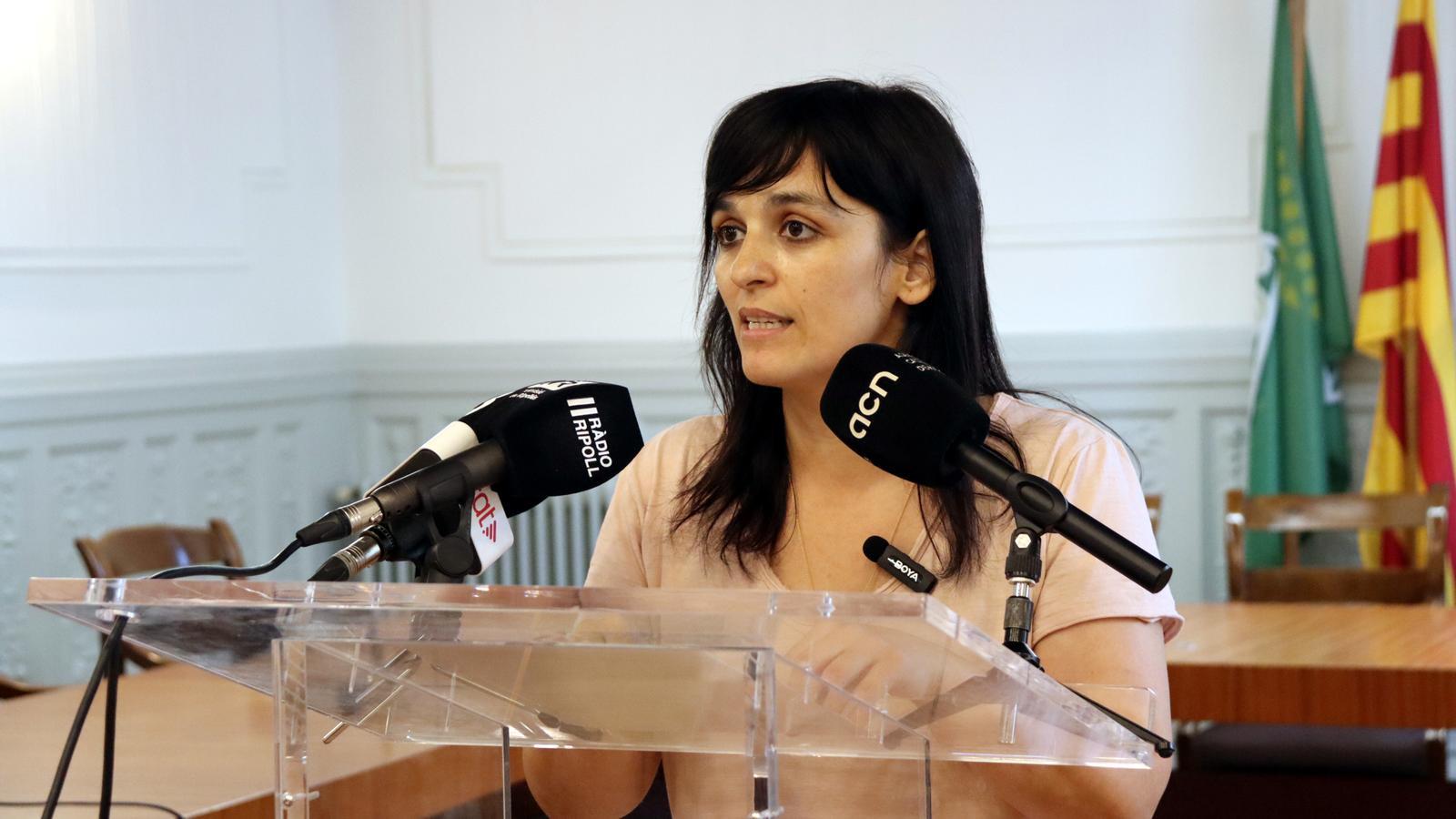
Be that as it may, the action has raised legitimate doubts about institutional exemplary conduct because in situations of possible conflict of interest, it is often expected that the political leader take all necessary measures to avoid any appearance of favoritism. This does not equate, however, to stating that there is proven irregularity or illegality. Going to the plenary session wearing a Local Police t-shirt did not serve to reduce the reproaches from the rest of the parties who accuse him of nepotism.
Lack of information
The municipal government did not inform the rest of the groups about the fact that one of the positions would be for his daughter and Orriols only gave explanations once the controversy was already public. "The day of the plenary session, just as some media outlets entered, they published it and the mayor brought up the issue as soon as it started," say opposition sources, who until then had only heard rumors around town until the secretary confirmed it to them privately on June 15 in an extraordinary plenary session for the neighborhood plan. Orriols said nothing about it at the spokespersons' meeting or in the information committees, according to the same sources. "In fact, at the spokespersons' meeting, the secretary and the comptroller reported that the incorporation of two police officers had been approved, but did not mention their names, unlike the other positions where their names were mentioned," they reveal.
Orriols' appearance the day after the plenary session before the media without allowing questions and her subsequent tweets demonstrate the mayor's nervousness, who has gone so far as to say that if she wanted to plug her in, she would put her "in an office and not on the street fighting criminals, drunks, and terrorists".

