Fire in Vall d'Uixó: "I am not prepared to return and see everything burnt"
The fire in the Espadà mountain range remains active after scorching 10,000 hectares and many residents continue without news of their homes
-
CAT -
CAST
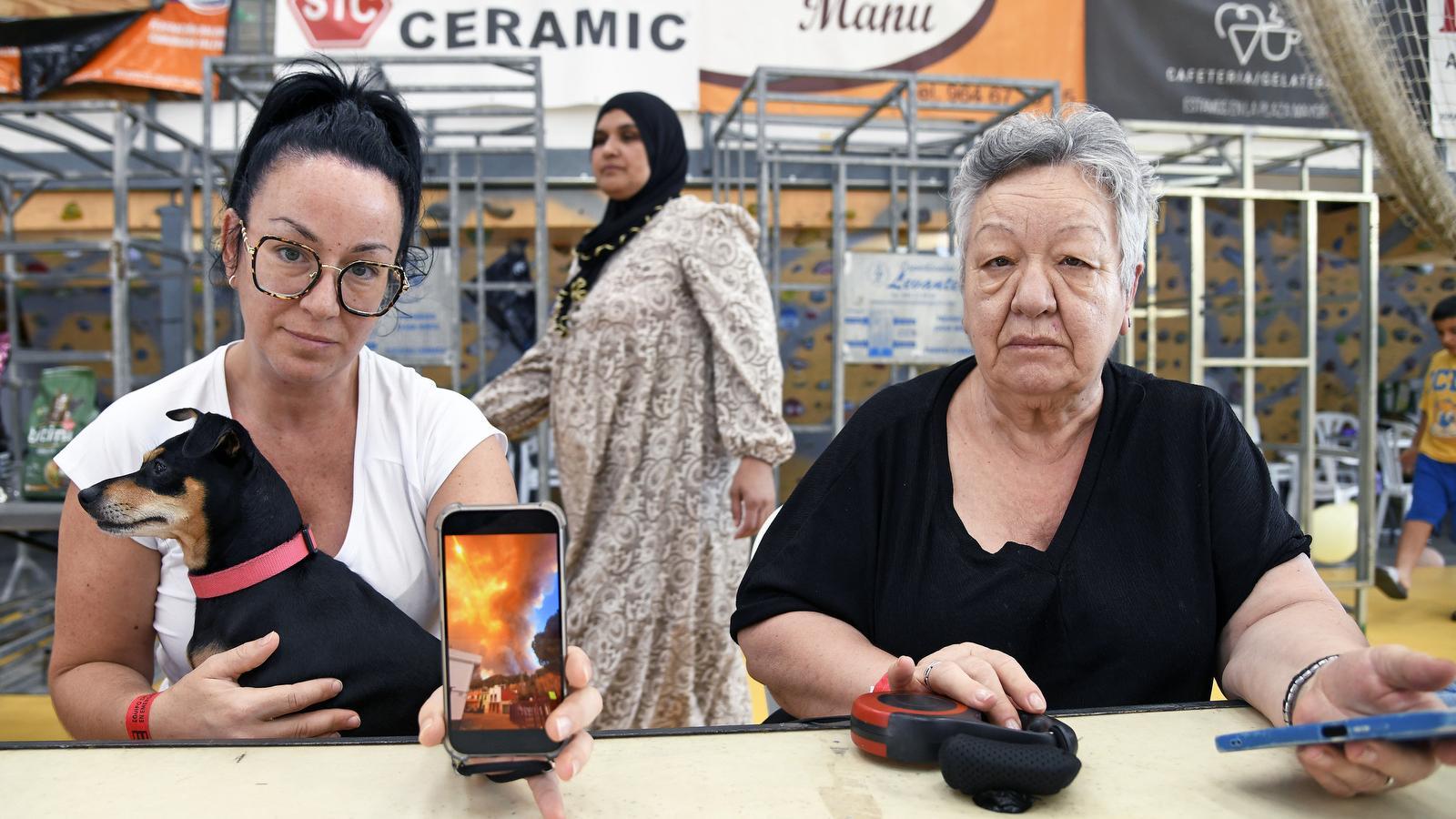
NulesDiscomfort, repetitive checks on the mobile phone and anguish at not knowing what they will find when the flames allow them to access their municipalities. Four days after the start of the fire that has already scorched 10,000 hectares of the Espadà mountain range - in a perimeter of up to 75.5 km -, a green lung and an identity symbol of the regions of Castelló, the atmosphere in the pavilion of the Valencian town of Nules is one of exhaustion. Also contradictory feelings due to the desire to regain normality and the fear of realizing that what was once a natural treasure is now just ash. "I'm not ready to go back and see it all burnt, I know I'll need time," summarizes Yolany Dávila, a resident of La Vilavella.
The conversation with this 35-year-old woman of Honduran origin, who works as a caregiver for the elderly and a cleaner of homes, takes place in parallel to the fight against the fire that, a few dozen kilometers away, is being waged by 400 firefighters (some from Catalonia, Aragon, and Murcia) and 34 aerial resources. A battle that has begun to bear fruit with the reduction of evacuated people, which has gone from 16,000 to 9,000 in the last hours of this Tuesday, and of those confined (from 64,000 to 34,000). Nevertheless, the end of the nightmare is still far away and the fire, which has not even been stabilized, has reactivated this Tuesday in several points.
While awaiting good news, in Nules, one of the three towns housing the evacuated citizens, time drags on. The most uncomfortable with the wait is Ramona Garrido, also a resident of La Vilavella. "I'm taking it terribly. At night I can only sleep two hours straight because there are noises in the pavilion. At four in the morning, my husband and I are already up. We get up, and check our phones...". The woman, 71 years old, explains that to compensate for the stiffness of the folding beds, she and her family have bought some pillows. But it's not enough. She admits that the hardest part is sharing space with strangers. "My glasses broke because I sleep with my handbag under my head in case someone steals it," she details.
"We sleep with one eye open because yesterday there was a fight over a supposed robbery," adds her daughter, Cristina Malpica, 41, who is at the sports venue accompanied by her daughter, husband, parents, and father-in-law. With daylight, things don't improve either. Yolany admits it, pointing out that it is "very tiring" to spend the day sitting on a plastic chair or leaning on a foam mattress, even more so with her two young children aged six and two. Not even a row of large fans with humidifiers helps them to lighten hours that seem "eternal" to them. The situation is more comfortable for Joaquín Llidó, a retired farmer of 76 from Artana who comes to the pavilion to chat with the rest of the neighbors: a friend from Nules has taken him in at his apartment.
Burned cars and houses
Inevitably, the anguish experienced during the evacuation quickly arises in the conversation. Again, the one who had the worst time was Ramona, who was left with the fire at her doorstep. Almost the same is the case of Cristina, who left when the flames were already touching a neighboring building. She couldn't even close the windows of her home and doesn't know what she'll find when she returns. "They were chaotic and very frightening moments," she emphasizes. She also explains that there are people who refused to be evacuated and that others could not do so because the fire surrounded their homes. Fortunately, the firefighters were able to protect the properties, helped by some small cultivated fields that hindered the advance of the flames. "There are people whose car and house have burned down. They are not here, they have been taken to hotels," she points out.

Different, but equally uncertain, is the situation of Javier Zuazu, a 36-year-old resident of Onda who is confined and with whom we speak by phone. He and his family have taken in some relatives from the neighboring town of Suera, which has been evacuated. They have gone from being five at home to 10. They cannot leave the dwelling except to buy food or go to the pharmacy. But this social worker explains that he tries to spend his hours as best he can and entertain his children. They are completing a pending puzzle, playing cards, and watching movies. He only leaves the apartment to go up to the roof. "It's like during the pandemic, but constantly glancing at the fire," he summarizes.
Curiosities of the calendar or not, Llidó points out a coincidence: exactly a decade ago, also on July 25, another fire also burned the Espadà mountain range. "It was the day of Saint James," he recalls. At that time, the fire scorched 1,500 hectares. Now, and due to his age, Joaquín believes he will not have time for everything to return to how it was before. "Surely I have burned an olive grove. The trees may sprout again, but I won't be able to see it as it was," he laments.
When they think about returning, they all swallow hard. "It will be a shock to see everything burned," predicts Cristina. "I don't want to come to terms with it," adds Ramona. "We are already preparing ourselves psychologically," points out Joaquín. The most serene, however, is Yolany. "As a migrant, I came with nothing. If we have to start over, ni modo [a Latin American expression indicating that a situation must be accepted as it is]". Of course, the fact that the fire may have been intentional, as the Spanish government delegation has suggested, outrages her. "I don't understand how you can play with so many people's lives. How can thousands of hectares of forest, wildlife, houses be put at risk...", she denounces.
