Meg Lowman: "We know more about the Moon than about what lives above our heads"
Biologist, author of "The Arboreal Navigator" (Galaxia Gutermberg, 2026)
-
CAT -
CAST
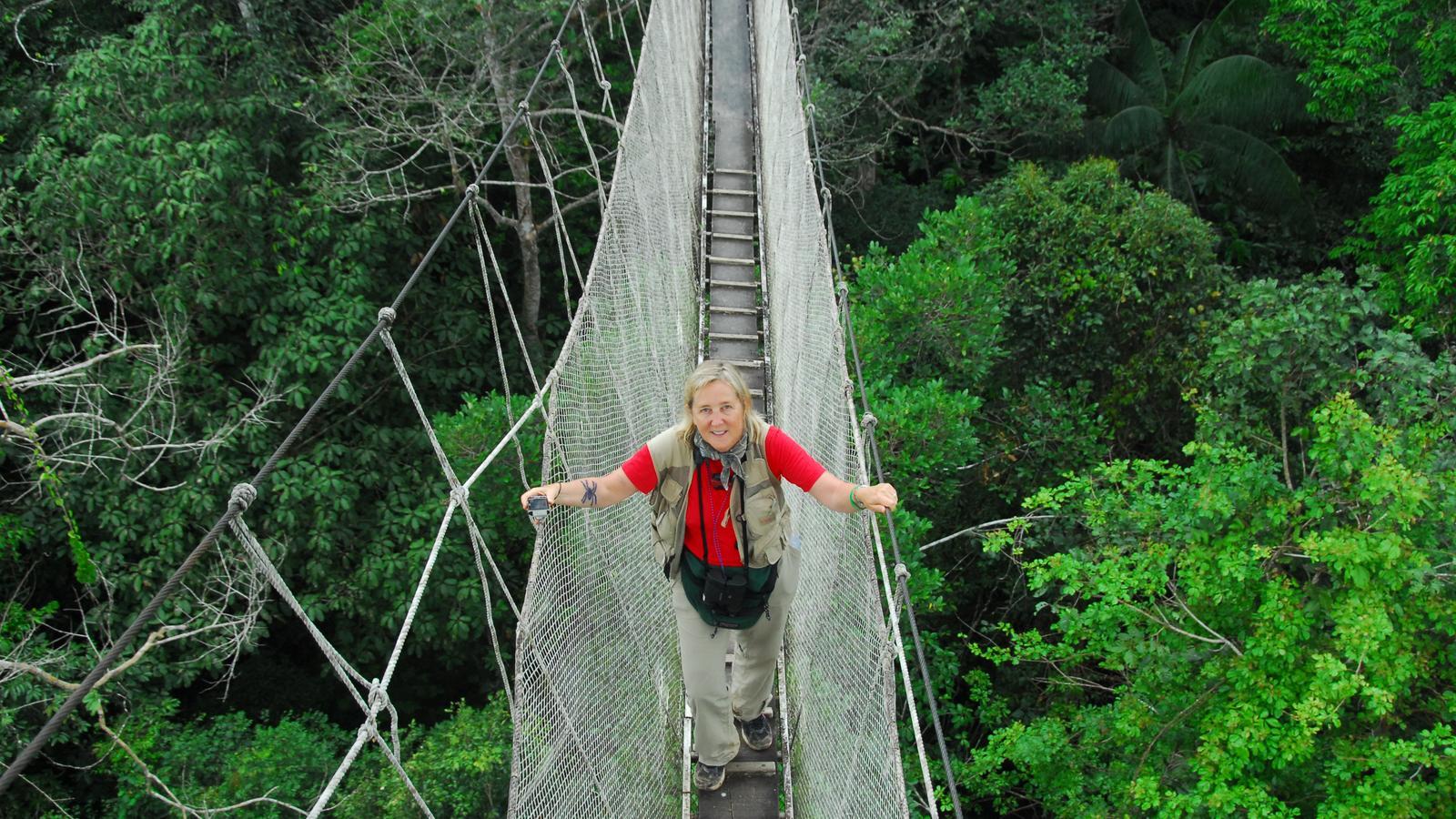
When Meg Lowman (New York, 1953) began climbing trees in the 1980s, hardly anyone studied forest canopies. That world suspended among the branches was, in large part, an unknown territory. Forty-five years later, this American ecologist is considered one of the pioneers in forest canopy research.
She has coined a term, arbonaut, to define her research, which has completely changed our knowledge of forests and jungles, which, this American argues, form the eighth continent, concentrating most of the terrestrial biodiversity. Incidentally, she has also paved the way for women in a traditionally male-dominated field. Lowman, author of the book The Arbonaut (Galaxia Gutemberg, 2026), recently visited Barcelona to participate in the Liternatura Festival, dedicated to nature literature.
We walk through the forest without looking up much. What led you to do it?
— As a child, I loved collecting stones, pressing wildflowers, gathering old bird nests. I really liked nature, but I belong to a generation where it was said that girls couldn't be scientists. It was very disappointing. I consoled myself thinking that maybe I could end up working as a park ranger's assistant or a park cleaner. I continued learning everything I could about nature, and when I was a bit older, I realized something curious: the foresters, who were all men, only studied the upper part of the trees when they had already been cut down. They never went higher than two or three meters. This made me think that I had to study the whole tree, because it had never been done. That's how I became interested in leaves and how it all started.
What did he discover when he climbed it?
— First I had to invent all sorts of tools to be able to get there! Because there are trees, like sequoias, that can grow to be over 100 meters tall. I had to climb them. This led me to make my own climbing systems, which at first were a kind of sling with a metal piece, I sewed myself a harness and borrowed ropes. And so I began to explore that world. I became an arbonaut, a term I coined to refer to someone who explores the treetops.
How was the first time?
— I was terrified. I was convinced the rope would break or the branch would snap or I'd find ants that would bite me. But my climbing system worked, and everything I saw intrigued me, and I wanted to go back again and again. It was like discovering Times Square in New York on New Year's Eve! There was extraordinary activity up there! Then, over time, I developed a second great tool: the elevated walkways between the treetops. Once they are built, it's very easy to access the forest canopy without ending up soaked in sweat from the effort of climbing.

He often states that we know more about the Moon than about the tops of trees.
— It is true. We know the diameter of the Moon perfectly, we know what its soil is made of, and many other details. On the other hand, until very recently we didn't even know what lived above our heads. That's why I came to call the forest canopy the eighth continent. I remember the first big surprise I had when I started studying leaves is that in tropical rainforests they can live up to twenty years. And I thought they would last months, like those in the temperate forests where I had grown up! The other surprise was to find that those leaves were constantly eaten by insects. This opened up a whole field of questions about the relationships between trees and animals.
Have drones changed this job?
— They help us a lot. They allow us to know which trees are blooming or to detect pests. But they still cannot replace direct observation. They will not tell you which insect is pollinating a flower or which moss is growing on bark. For many questions, we still have to climb trees.
After 45 years studying the treetops, what is the most important thing you have learned from them?
— There are hundreds of millions of hectares of forests on the planet and about 70,000 species of trees. I have only studied about 60, less than 1% of the existing diversity. The canopies are the living part, because almost the entire trunk is dead wood, where approximately half of the terrestrial biodiversity lives. They are an enormous habitat that concentrates insects, birds, mosses, lichens, and thousands of species that we still know very little about.
Why is it so important to conserve this biodiversity?
— Because it is an immense genetic library. When we cut down a forest, we don't know exactly what we are losing. Perhaps a future medicine, an essential pollinator for our crops, or a species that fulfills a key ecological function. We still do not know a large part of the content of this library, because, unfortunately, we have not studied the canopies well enough to predict these losses. That is why it is so important to preserve it, and to understand it better in order to protect and maintain it healthy.
He worked a lot in Ethiopia and Madagascar. Why?
— Because they are places where biodiversity is severely threatened and resources to protect it are often lacking. Trees disappear because farmers need more land or because children cut firewood for their families because they do not have other energy sources. In Ethiopia, for example, less than 5% of the original forests remain. There I work with priests because the last trees in the country are found in churchyards. There we build simple walls around these groves together with the local population to try to preserve this biological heritage of the country. Madagascar is another example, where also less than 5% of the original forest remains.
Beyond their ecological value, trees also have cultural and emotional value.
— Absolutely. It is estimated that around 5 billion people in the world use them as a spiritual refuge, not in the West, but in other cultures. We know that people who live surrounded by trees have better physical and mental health. That patients in hospitals recover more quickly in green environments. Trees are part of our well-being in many different ways.

Do you think forests will be able to continue acting as carbon sinks on an increasingly hot planet?
— Yes, but only if we maintain extensive and connected forests. When we fragment ecosystems, they lose their ability to retain water, weaken, and store less carbon. We need large areas of healthy forests. The carbon storage they provide is absolutely critical.
The idea of the collective intelligence of trees, that they can communicate with each other, send each other messages, is fascinating. What do we really know about this phenomenon?
— One of my mentors, Jack Schultz, was the first to demonstrate that when an insect bites a leaf, it releases chemical compounds that alert neighboring trees, which react by activating defense mechanisms, producing more tannins and phenols to protect their own leaves. It is a system of information exchange through the forest canopy that we do not yet fully understand, because it is very complex. We are now starting a new project to listen to how leaves communicate stress.
Listen?
— Yes, we want to investigate, placing sensors on the leaves, if we can detect plant stress from the sounds generated by their physiological processes. You can't hear your blood circulating through the veins and arteries of your body, but a doctor can detect sounds that indicate if everything is working correctly. With plants, something similar happens: we can't hear them speak, but we can translate certain signals into sounds that indicate if a leaf is under stress or if water is circulating correctly. We use a device called PlantWave and this July we will take it to the Amazon with some students. You can follow it at treefoundation.org.
She has also had to break barriers as a female scientist.
— Many. I was the first doctoral student researching tropical rainforests at the University of Sydney. And the comments I received were things like: "What are you doing here? You'll end up getting married and having children." At that time, equal opportunities did not exist. When I applied for jobs in Australia, they would reply: "We can't hire you because you have two children." There wasn't even an interview. The conversation ended there. Then, when I started gaining recognition for my research, I encountered other more subtle forms of discrimination. Some men felt annoyed because a woman was successful. And, in my case, I was also working in a very physical field, because I climbed trees, and there were many expeditions where they simply didn't want a woman.
What worries her most about the future?
— That my generation leaves an enormous debt to the next ones. During my lifetime, approximately half of the planet's forests have been lost. We have altered the climate, degraded water resources, and polluted the environment with plastics. Young people will have to face a gigantic task to repair all of this.
And what makes me keep hope?
— That there are more and more people interested in understanding how nature works. We need good science, but also good communicators. If people understand how much they depend on forests, it will be much easier to protect them.
