The role of justice in the Ceuta crisis

-
CAT -
CAST
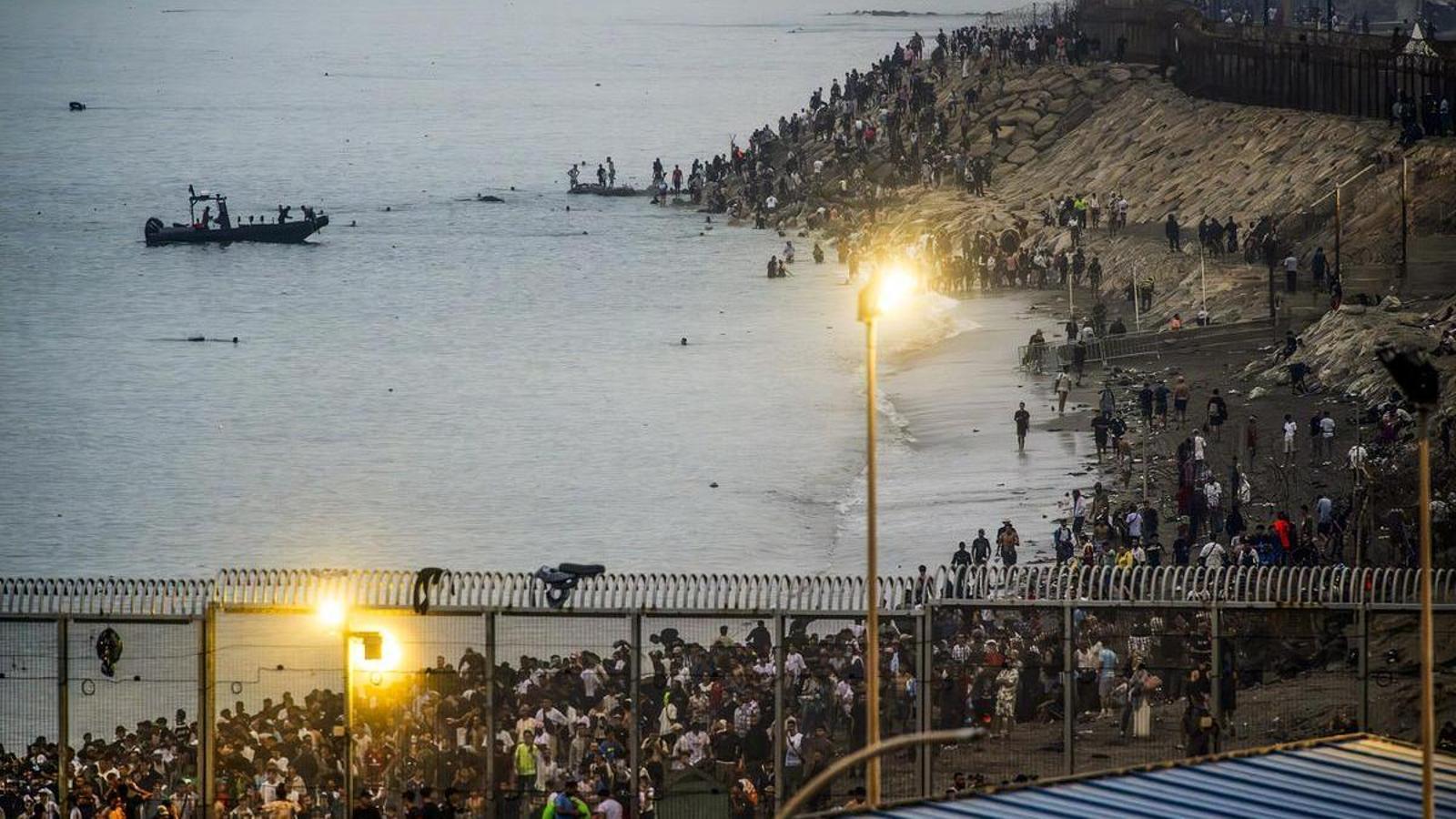
BarcelonaThe National Court judge María Tardón has opened a criminal case to investigate the massive entry of immigrants into Ceuta on July 30 as a "serious attack on the territorial integrity of Spain". Among the crimes that the judge wants to investigate are those that "compromise the peace or independence of the State", which are those from 589 to 597. "It is deduced that the crime has the intent of attacking the State", adds the judge, who recalls that Pedro Sánchez presented the events as a "violation of the territorial integrity of Spain". And she also recalls that a "massive migratory flow" is "one of the characteristic methods of hybrid warfare". Thus, since this Monday there has been a Spanish court –and not just any court– investigating whether Morocco launched a hybrid warfare operation against Spain last July 30.
This case, which may be legally justified, raises many doubts. According to article 97 of the Constitution, the direction of foreign policy and the defense of the State correspond to the executive branch. Here, a clash can occur between the judicial power and the executive power, since the National Court's investigation could end up affecting relations between Madrid and Rabat. It is not the first time that something similar has happened. Let us recall, for example, the extradition request for Pinochet that judge Baltasar Garzón formulated in 1998 against the opinion of the government of José María Aznar, which had no desire to judge the Chilean dictator.
In any case, a new front is opening up for the Spanish government in an already complicated situation, in which it has to strike a balance so as not to upset Morocco and, at the same time, not seem like a puppet of the Alaouite regime. The situation could become even more complicated if the Supreme Court begins to investigate a complaint by a Spanish nationalist entity called Zeolandia, which has filed a complaint accusing the Spanish government of failing to act to stop the massive entry even though it was warned in advance by the CNI and the various judicial bodies. This Wednesday, the Sánchez government plans to make public all intelligence reports from the days prior to July 30 with the aim of dispelling all doubts. From what has transpired so far, it is true that there was a warning of an increase in entries by sea, but there was no specific alert that warned of what happened that day.
Be that as it may, and as in the rest of the areas of Spanish politics, the justice system has made its entry into the Ceuta crisis, and this does not usually bode well for the Spanish government. The judges already decided in the case of the Procés that they were the ultimate defenders of Spanish "territorial integrity", and until the European justice system came into play, nothing stopped them. Now it remains to be seen how far they will go when it comes to a country that plays a key role in the management of Europe's southern border and which, in addition, has the United States and Israel as allies.
