November 11: Fourteen years later, there will be a general strike in the State
CCOO, the UGT, the Tenants' Union and the CGT agree to call a 24-hour strike for the right to housing and the cost of living

-
CAT -
CAST
MadridNovember 11th. This is the date agreed upon by the unions to call a general strike for the right to housing, wages, and the cost of living throughout the State, the first since 2012 –if one does not take into account the 2025 strike for Palestine, which was called by minority unions–. In Catalonia, it will be the second in the same period of time, after the one called in October 2017 against the police repression of October 1st.
The date set this Wednesday afternoon means calling the 24-hour stoppage two days before the electoral campaign for the general elections on November 29th begins. The call, promoted by the Confederation of Tenants' Unions (CSI), is supported by the majority unions, CCOO and the UGT, but also by the CGT, the Intersindical Alternativa de Catalunya, and Acció Social de Solidaritat Obrera.
In a joint statement, CCOO and the UGT have asserted that the general strike is "the response to the insatiable real estate greed that speculates on one of the main rights of citizenship, which makes access to decent housing practically impossible for the majority," as well as "the denunciation by the working class against a business policy that takes advantage of the country's economic growth to fatten its assets with large profits at the expense of the wages of working people." The two majority trade union organizations in the State want the stoppage to also serve to show "the indignation of the majority of the country for an economic model that transfers business margins to prices and the consumption of basic goods to defray the cost increases of the energy crisis caused by the infamy of wars."
"We call for a general strike to urge all public administrations to promote policies that end real estate speculation" and "to put a check on the drift of prices that burden the income of the working class," also says the document published this Wednesday evening.
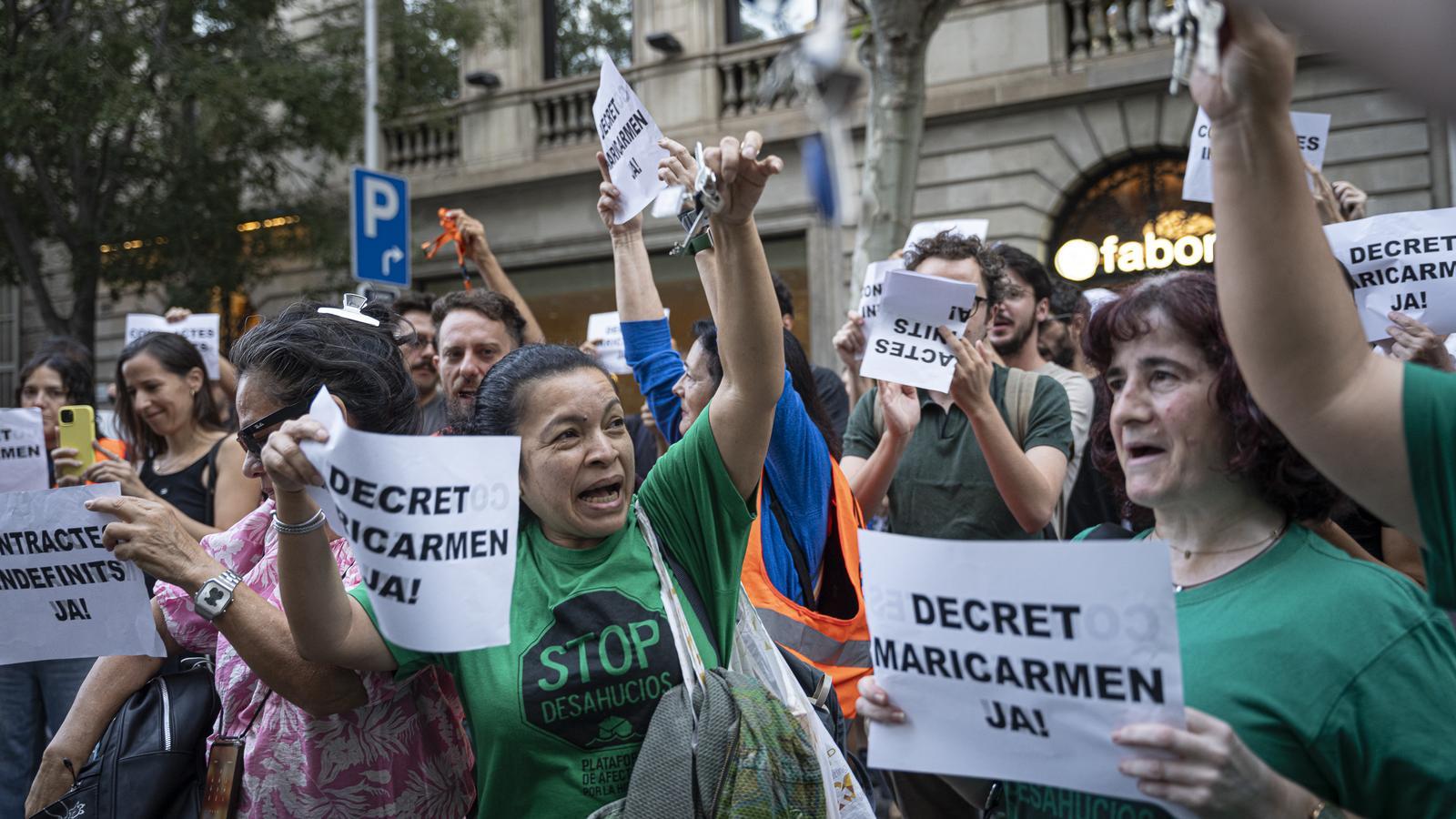
Pedro Sánchez called for early elections on Monday precisely because of the impossibility of approving two housing decrees following the eviction in Madrid of Maricarmen Abascal, who died this very Wednesday after two weeks in the hospital. The case of this 87-year-old resident of Madrid has triggered a wave of indignation throughout the State, with mobilizations, demonstrations, and encampments like the one at Puerta del Sol, in the Spanish capital. The Tenants' Union has led the protests and had been pressuring the major trade unions for days to go on a general strike in the face of the difficulties in accessing decent housing.

It is true that the general strike proposed by the Tenants' Union puts housing and rental prices in the spotlight, which is why CCOO and the UGT were measuring how they could fit it into a socio-labor demand, a legal requirement to call for workers' strikes. The final slogan of the strike includes wages and the cost of living.
The housing problem has an impact on the population's purchasing power –the upward pressure on rental and purchase prices, as well as the rising cost of mortgages, takes up a large part of workers' wages–, and today there are even companies that acknowledge that it is a difficulty when it comes to finding employees, especially in large cities where the cost of housing is higher. This is the point that the two unions have finally latched onto, and they have not hesitated to point out businesses but also public administrations –in particular the Spanish government–, given the need to protect workers' rights regarding wages. The goal of the Tenants' Union is for it to be a "massive strike that paralyzes the country" and that it "succeeds in bringing its demands to a successful conclusion".
Doubts and criticisms from employers
However, the announcement of the general strike call has already received criticism from employers' associations, which have questioned its legal basis, as they consider that it does not respond to a socio-labor motive. The secretary general of CCOO, Unai Sordo, defended this week that the demand "will not only be about housing", but will be "fundamentally" about the "need to promote" an increase in wages: "Housing is eating up half of the wages of many families; they are two things intimately linked", he stated.
