The escalation of prices due to the war forces the Spanish government to maintain aid
Economy states that it "will continue" supporting families and businesses and the Airef warns that the fiscal margin is running out

-
CAT -
CAST
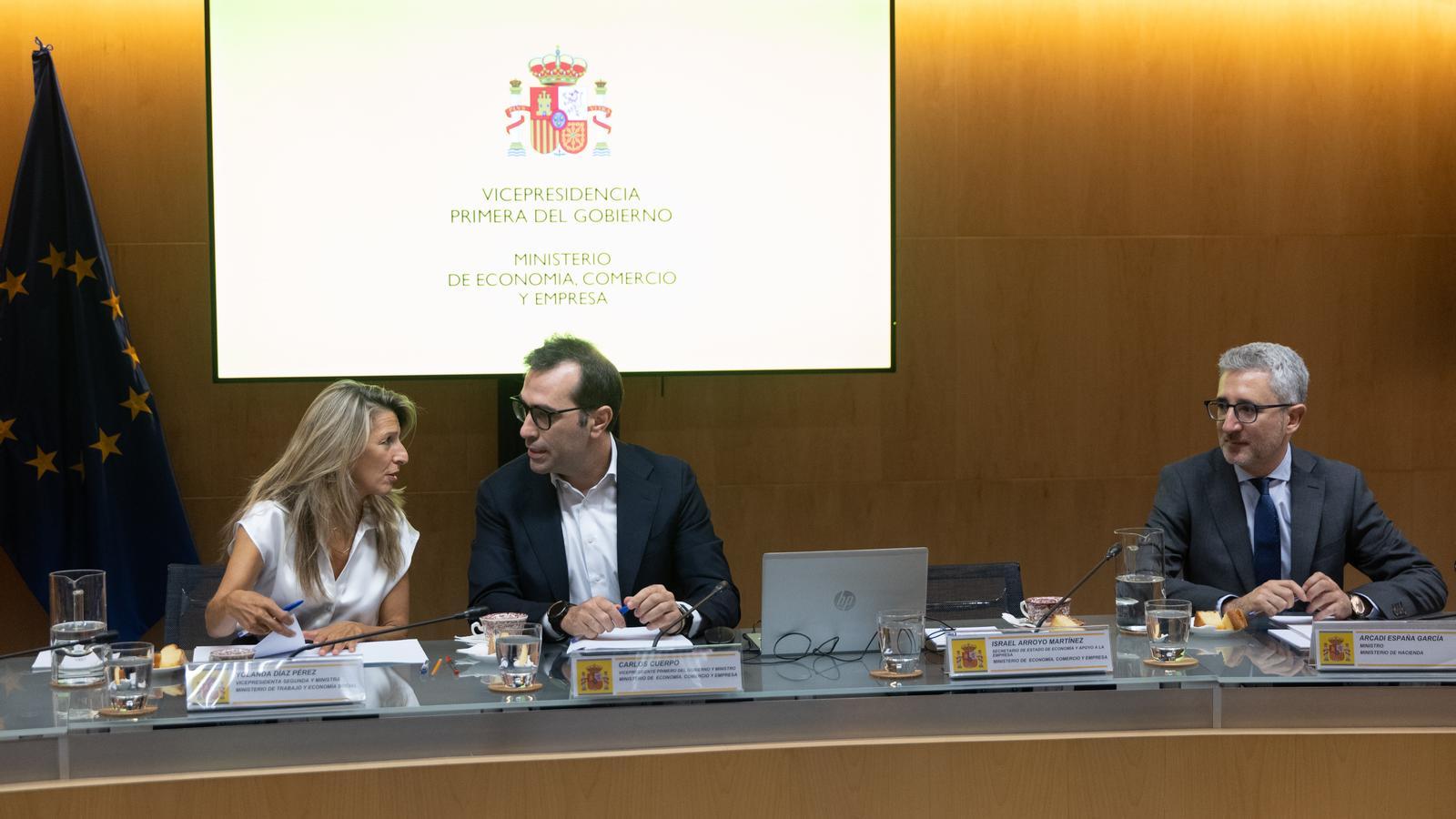
MadridThe escalation of prices, particularly of fuel, due to the war in Iran is forcing the Spanish government to continue deploying aid aimed at families, businesses, and the sectors most affected such as transport or the agri-food sector (with the start of the war, a package of measures was launched that expires this September 30). This is taken for granted at the Ministry of Economy and has been conveyed as such by the head of this portfolio, Carlos Cuerpo, to unions and employers' associations in a meeting this Thursday.
Now, the key will be to see what this support will consist of starting October 1. That is, whether the aid maintains the current design, is modified, or is expanded. Among this aid, the 20-cent reduction per liter of diesel stands out, which this Tuesday was at 1.881 euros, or the 5-cent discount on gasoline (1.899 euros per liter). In fact, next week Cuerpo will meet with the most affected sectors to "calibrate the support measures that may be necessary," according to sources from the Ministry of Economy.

"Six months after the start of the conflict, the pressure from fuel prices has intensified again: general inflation stands at 4.25%, seven tenths above July, a rebound explained by the increase in energy prices [...]. We will work on the measures of the Response Plan [to the war] to continue accompanying and supporting families in the face of rising prices, attending above all to the professional sectors most affected by the impact produced on the rest of the [productive] chain", point out sources from the ministry.
The meeting this Thursday was also attended by the Minister of Finance, Arcadi España; the head of Labor, Yolanda Díaz, and the Minister of Social Security, Elma Saiz. On behalf of the social partners, the highest representatives of CCOO, the UGT, and the Spanish employers' associations CEOE and Cepyme were present.
The CCOO union has proposed intervening in prices and the UGT to expand current measures. "I believe it would be necessary to assess the recovery of the Iberian exception to lower the price of energy and protect the most vulnerable families", defended Unai Sordo (CCOO). For its part, the CEOE requests maintaining the measures for the most affected sectors.
Warning from the Airef
The Spanish government's measures entail a cost for the public coffers, but they have helped to mitigate the effects of inflation, starting by containing it, as the Bank of Spain has acknowledged. The Independent Authority for Fiscal Responsibility (Airef), however, warned this Thursday that fiscal room is running out and that the aid puts compliance with European fiscal rules at "risk." This was stated by the president of the entity, Inés Olóndriz, at an informative breakfast in Madrid, in which she also announced that the agency will lower its growth forecast for the Spanish economy this 2027 by one tenth, to 2.7% of GDP (the Spanish government forecasts that the economy will grow by 2.1%).
Pedro Sánchez's executive continues to monitor economic developments, explain sources from the Ministry of Economy, taking into account the context of high geopolitical uncertainty – for the moment, attempts at a ceasefire in the Middle East have not borne fruit.
Sumar wants new taxes
Meanwhile, Sumar, the minority partner in the Spanish government, is once again putting the spotlight on taxation. The Minister of Labour, Yolanda Díaz, has argued that her proposal in the face of rising prices is to "extend [current] protection measures, limit rents, tax windfall profits, and recover the Iberian exception," she said via the social network Bluesky.
Furthermore, taking advantage of the fact that the negotiation for the General State Budgets (PGE) between Sumar and the PSOE has formally begun, the party is also demanding a tax on large fortunes to reduce child poverty. The parliamentary group in Congress has registered a bill to create a new 3% levy on the concentration of wealth that would affect assets of more than 50 million euros and use the revenue to finance a fund for child protection.
