A new covert strike by train drivers causes chaos in Rodalies
The drivers allege safety reasons but the authorities suggest that behind it there is a labor conflict

-
CAT -
CAST
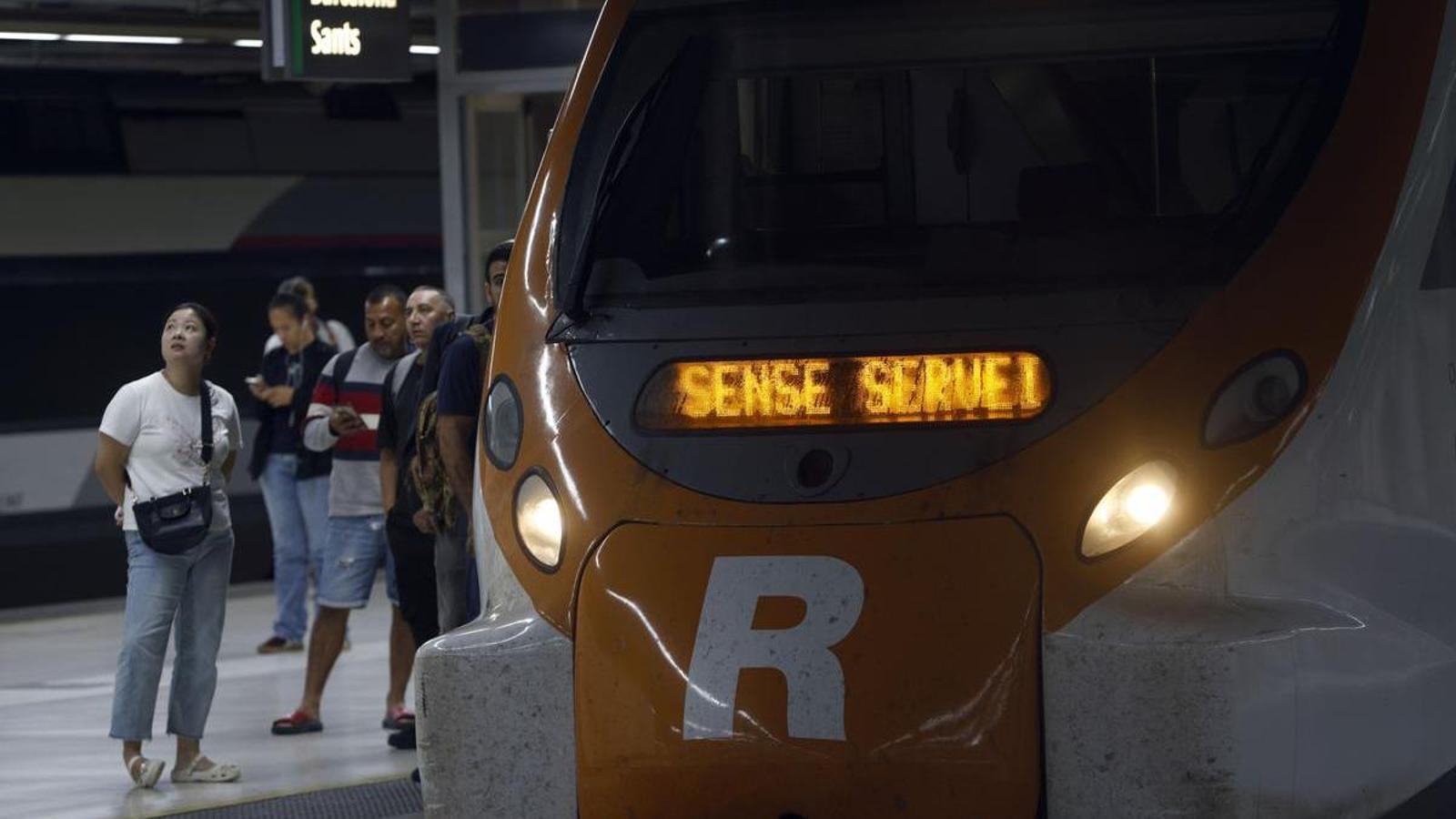
BarcelonaNew day of collapse at Rodalies. A wildcat strike by train drivers, as already happened last winter after storm Harry, has once again caused chaos on the Catalan railway network this Wednesday. A good number of the train drivers did not board the trains this morning, citing safety reasons after the heavy torrential rains that have fallen these days and, especially, after a tree and an embankment fell onto a train in Vilanova i la Geltrú on Tuesday night, without causing any injuries. The operator, Renfe, explained early on that there were "some trains" running "but not at 100%". They did not report, however, which trains were running and which were not, nor where they were passing, and directly recommended that users seek "alternative means".
The train drivers' unions explained to ARA that this early morning the workers did not receive all the safety certificates they requested – the night reports that are made after reviewing the state of the infrastructure – and for this reason they decided not to start their shifts. The director of Rodalies Catalunya, Òscar Playà, also confirmed that the Semaf union, the majority among the train drivers, warned of their position through a statement at one in the morning. "We received a letter in which they said they did not guarantee that all trains would depart. I consider that we are facing a labor dispute. We are not facing a safety problem with the infrastructure, because on Tuesday the trains ran safely," he declared.

"[On demand] They tell us they want a series of reports, which they already requested on Tuesday, and other additional reports, which we will send them throughout this morning," continued Playà, who added: "We have complied at all times with the current safety regulations." In this regard, he stressed that everything is protocolized, and remarked that the train drivers are demanding –apart from the relevant reports– "additional information" which, in his opinion, "does not provide a greater guarantee of safety than the current one."
These reports finally arrived around 9 in the morning in the hands of the train drivers. From that moment on, Semaf explained that they reviewed the result and ratified the reports, and starting at 10, little by little, the workers returned to their workstations. Even so, the delays and altered schedules dragged on throughout the morning.
The alternatives, saturated
And with almost no trains on the tracks, the impact for users has been, once again, enormous. The director of Rodalies Catalunya has admitted that buses cannot absorb all the passengers that the train transports on a normal working day. "It is impossible," Playà acknowledged. In fact, the endless queues of passengers trying to board the buses have been repeated tirelessly in different parts of Catalonia.
Meanwhile, Renfe still has to assess whether to initiate disciplinary proceedings against the train drivers who decided not to board the trains. The head of Rodalies has assured that this issue is being "discussed with Madrid, which is the one handling the negotiations." For their part, user platforms have harshly criticized that any episode of torrential rain causes the collapse of the network.
Both the Public Transport Promotion association (PTP) and Dignitat a les Vies have lamented that the episode is repeating itself practically the same "months after Gelida" and have demanded that the Generalitat decree remote work and be quick in issuing reports, just as was agreed last winter to avoid further tensions. They demand that Adif update the infrastructure: "Every hour counts: the interruption affects the mobility of some 300,000 people, who depend on the train to work, study, or attend to care responsibilities."
A matter of safety or labor conflict?
Even the president of the Generalitat, Salvador Illa, referred to the chaos in mobility during the Government's control session. "The safety of the tracks is not a subjective matter, it is an objective matter, it is in the hands of the agencies. There has been a union that has not made the trains run, we will find out what happened," he insisted. Like Playà, Illa pointed to an underlying labor conflict which, however, Semaf categorically denies. "The only priority [of the walkout] has been to avoid accidents like the one that happened yesterday in Vilanova," the union asserts in a statement in which it accuses Renfe and Adif of "playing with safety during the storm in Catalonia".
The workers' representatives label the attitude towards the storm as "negligent" and "irresponsible" and consider it an "alarming lack of foresight" that the operator and the infrastructure manager had not stopped the service earlier, a fact that would have also allowed for organizing alternative plans and informing users in time.
The fact is that, despite previous inspections, this Tuesday night a hundred travelers were trapped on a Rodalies train after a tree and an embankment fell onto the convoy in which they were traveling while passing through Vilanova i la Geltrú. It is an area heavily affected by yesterday's rains. The incident did not cause injuries, but it did set off alarms among the workers, who are very mindful of the accident in January in Gelida, in which a young trainee driver died, after another storm.
However, the situation arrives at a tense moment between Semaf and Renfe. The train drivers are maintaining an ongoing struggle both over infrastructure problems in Catalonia and the transfer of Rodalies and the launch of the new joint company. On Tuesday, some train drivers already refused to pass through the Plaça de Catalunya tunnel, which was flooded over the weekend, causing delays on the R1 line. Renfe openly admitted "operational problems" related to the train drivers, but today Playà denied it and said that no train driver refused to work.
There are still other episodes of tension. In mid-September, the train drivers also blocked a schedule change on the R4 line planned to improve the line's efficiency and which also had effects on the R1. At that time, the unions Semaf and Alferro refused, and the proposal did not go ahead, according to sources in the sector who spoke to ARA. The same sources detailed that although the workers' representatives alleged they were defending that the changes did not comply with the regulations, the maneuver also served as a pressure tool for another open conflict with the company related to the working conditions of trainee train drivers throughout the State.
