Indra and the State invest almost 20 million euros in the Catalan Qilimanjaro
The quantum computing company completes the first closing of its series A round

-
CAT -
CAST
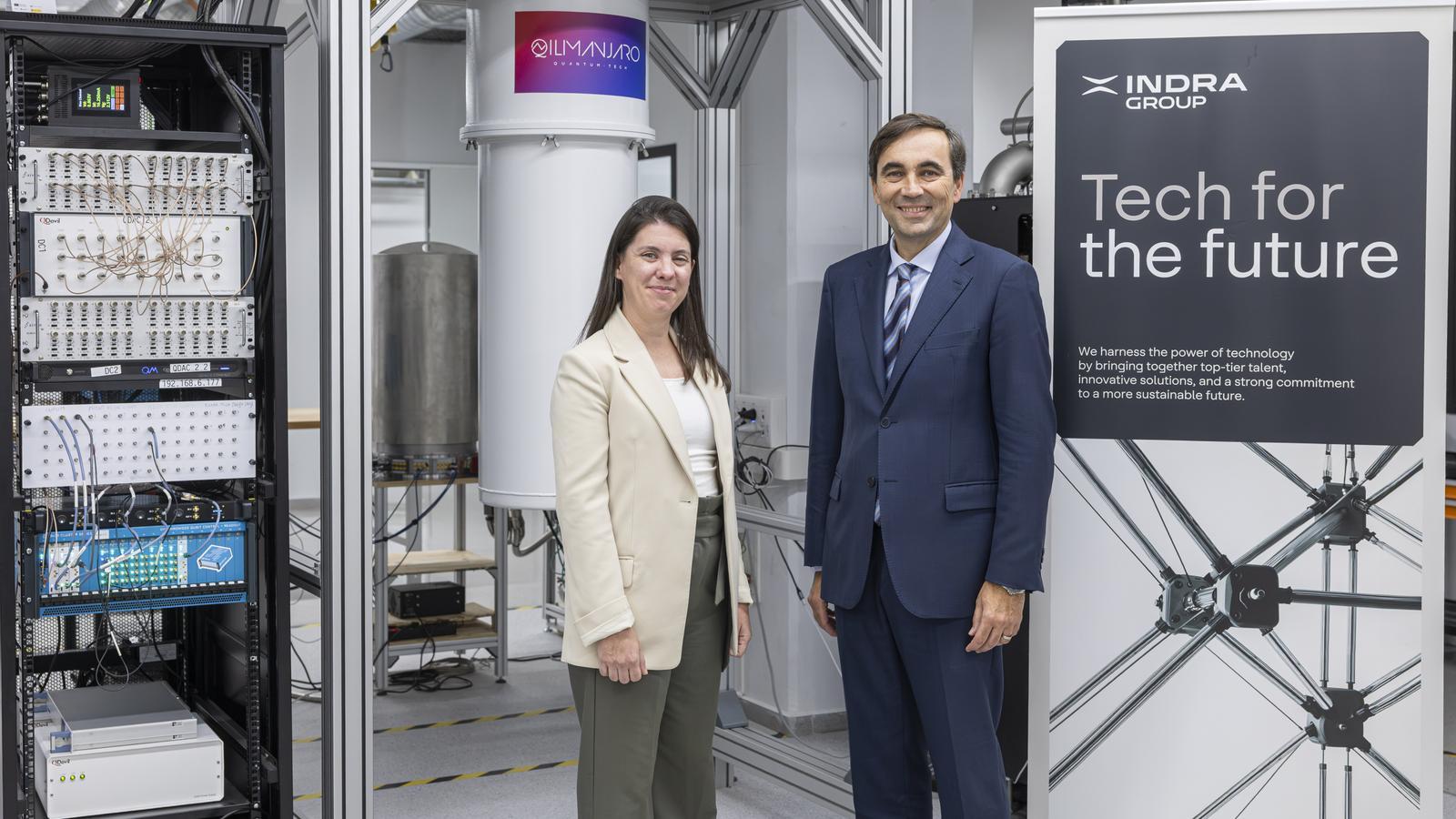
BarcelonaQilimanjaro Quantum Tech, the Catalan quantum computing company that ranks among the European leaders in its sector, announced this Wednesday an initial closing of its Series A funding round, valued at 19.6 million euros. This first operation was led by defense giant Indra, which invested 10 million euros through IndraMind, the group's technological initiative that develops sovereign artificial intelligence. It also served for the Spanish Society for Technological Transformation (SETT), the investment vehicle of the Ministry for Digital Transformation and Public Function, to double down on its commitment to the company with a new investment of 9.6 million.
The investment round planned for this year had, it should be remembered, a target of up to 50 million euros. With this goal in mind, the Catalan tech company expects to complete the operation during the last quarter of the year, with the participation of Avançsa, the public company for industrial promotion and location of the Government of Catalonia, and other current investors.
The new funding, as announced by the company, will serve to "scale and industrialize its quantum computers," a necessary step to facilitate their market launch. They will also seek to develop new generations of chips, as well as expand their manufacturing and technology deployment capacity.
Artificial intelligence
Qilimanjaro has been one of the most vocal Catalan tech companies in terms of the relevance of European sovereignty in critical technologies, such as quantum computing. The company's CEO, Marta P. Estarellas, asserts that the formula that makes up this first closing is a guarantee in this regard: "The renewed commitment of the SETT and the entry of Indra are sovereign capital and industrial capital working together to protect, but also accelerate, national technological autonomy," the executive reasons.
In this sense, Indra highlights the essential capabilities that quantum computing brings to the company, a technology that, they claim, "will mark a decisive leap in the evolution of artificial intelligence and its ability to solve problems of enormous complexity." According to Ignacio Martínez, general manager of IndraMind, the investment in Qilimanjaro serves for the company to "expand its capabilities to develop sovereign and differential solutions for defense, security, and industry."
Qilimanjaro is the only Spanish full-stack quantum computing company; that is, with the capacity to develop all parts of the computers. The Catalan company develops its own chips, software, and algorithms for its quantum systems. They have already applied their model at the Barcelona Supercomputing Center, where three of the company's quantum systems are operating. With 80 employees, Qilimanjaro works with clients in various strategic sectors, from telecommunications to energy or finance.
European mandate
In conversation with ARA, Marta Estarellas ensures that she sees it as "possible" to close the round by the end of the year with an amount in line with expectations, around 50 million. It should be remembered that Qilimanjaro has already proposed redoubling its commitment to financing to continue its growth, and hopes to launch a new round in 2027 with the goal of raising between 100 and 150 million euros, as confirmed by the executive herself in an interview with the Ara Empreses.
Looking ahead to next year's round, as she has insisted on several occasions, Estarellas expects it to be raised "with a majority of European capital". To achieve the objectives, she explains, "it may be necessary to include funds from outside Spain, but not from outside Europe". And, in the event that foreign capital appears, it would be to make "minority contributions". The CEO sets the goal of accelerating the company's internationalization, especially in the United States and Asian markets, both of which are "very advanced in the field of computing".
Although she looks beyond Europe, Estarellas maintains that "it is possible to open a market in the United States without relocating the company". The executive insists, in fact, on the character of "protection of technological sovereignty" brought by current investors, both public and industrial. "And we agree on the mandate," she concludes.
