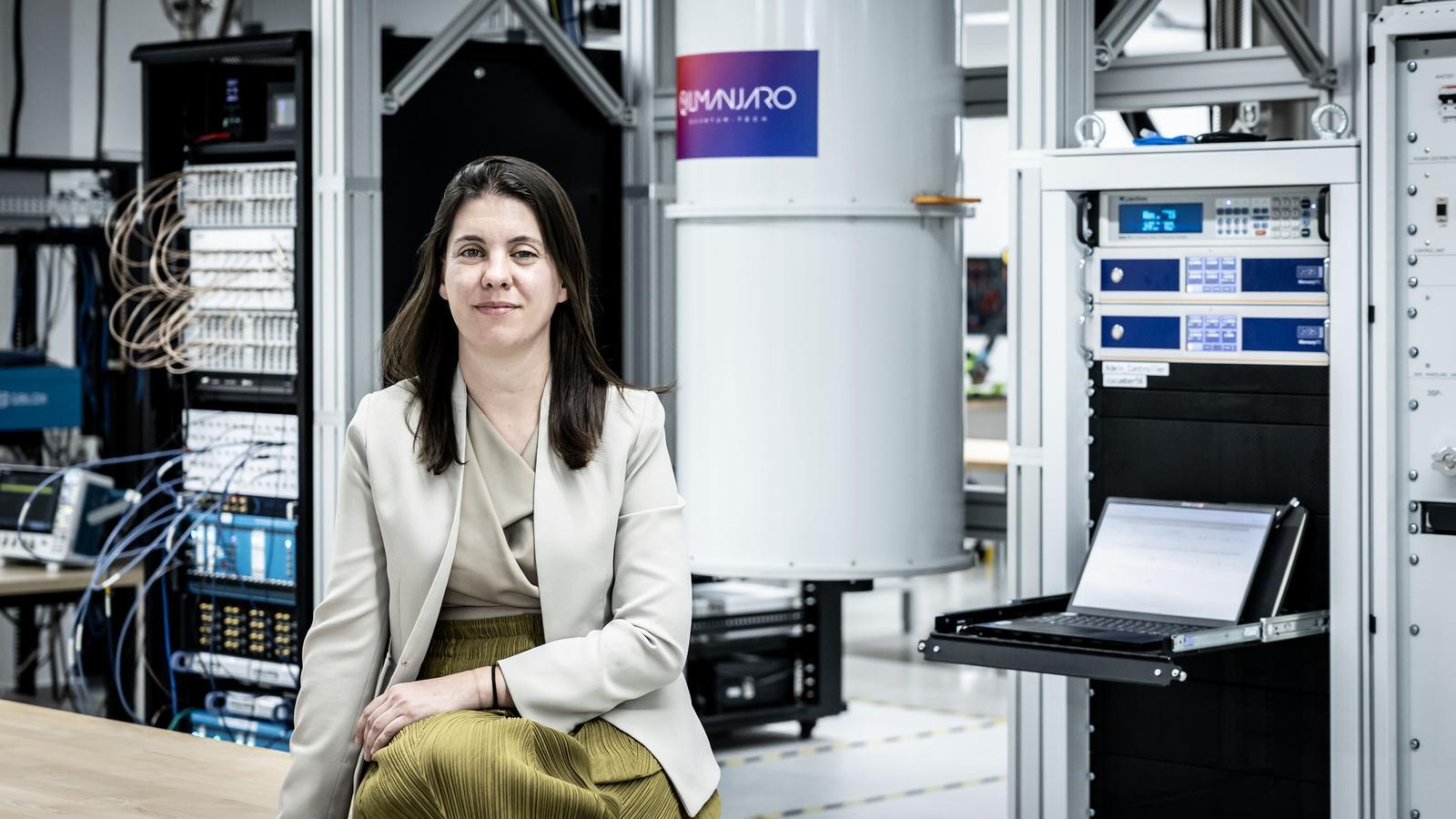
Marta P. Estarellas: "AI has greatly justified the existence of quantum computing"
Chief Executive Officer of Qilimanjaro Quantum Tech

-
CAT -
CAST
BarcelonaThe Minister of Business and Labour, Miquel Sàmper, stated in a recent meeting with Catalan representatives of the quantum industry that Catalonia "is arriving in time to lead" what is set to be the next technological revolution. Among the fifty companies that, according to Acció, are dedicated to this technology in the Principality, Qilimanjaro Quantum Tech stands out with its own light: the company, which has developed the three quantum computers for the Barcelona Supercomputing Center, is one of the leaders in European quantum computing, an economic field in surprising growth. Its CEO, Marta P. Estarellas, receives Companies at the company's headquarters to talk about a technology that "is a bit scary" and is "not very intuitive" for the general public, but whose applications will be unique and will stand out in the country's future.
What is quantum computing? What solutions does it aim to find?
— Conventional computers have been a turning point in our day-to-day lives. I come from the world of chemistry, from drug development. And the first tool that is used in this field –and in others, such as developing more efficient fuels, or more aerodynamic planes– is simulation. What happens? That the more we have, the more we want. And, furthermore, the problems are becoming increasingly complex, because we have a very large number of data points. Now, with the arrival of artificial intelligence, a true explosion is coming. And all these data processes do not happen in our homes: they happen in large data centers, gigafactories, which are increasingly accompanied by a higher consumption of water and energy. We want to automate ourselves more and more, but this requires a lot of infrastructure, and the costs are not scaling very well.
I was talking about chemistry.
— It is the field that brought me here. The microscopic world, which is not visible to the naked eye, behaves under laws different from classical physics, those of quantum mechanics. And the problem is that normal computers cannot efficiently describe a quantum process. It would require thousands and thousands and thousands of years of computing without stopping, assuming we put all available computers to work on it. This is where the idea appears of making a machine that speaks the language of quantum mechanics, an entire architecture that operates with this logic. Quantum was thought of for the first time to solve problems of simulation of the world.
Surpass the physical limits of traditional computers.
— Infinitely! There is an exponential acceleration. Tasks for which thousands of years would have been needed before, as I was saying, can now be done in a few hours. And this has a brutal impact on the way humanity has of understanding the world.
It will not be a consumer technology, then. It will be part of the technological infrastructure.
— Quantum computing will not replace mobile phones, nor the laptops we have at home. It will be an accelerator. We will have data centers, gigafactories, with CPUs and GPUs; and QPUs, units with quantum acceleration, will be added to them. Quantum technology will not replace any technology, but it will allow for the acceleration of many tasks.
How do companies take it when they receive a quantum computing proposal? Do they trust it?
— A few years ago, when we were raising investment rounds, everyone wanted to fund software, because it was the future. Nobody wanted to invest in machines, because they require a lot of capital. This has changed a lot, because, with the growth of AI, huge data processing needs have emerged. AI companies have created a dependency on their software, and they have found themselves in a delicate situation regarding their business models, because the infrastructure cost is much higher than what the user is willing to pay. Quantum is interesting not only as a resource, but to improve processes. It is interesting because it is the great promise of maintaining more sustainable and more affordable computing capabilities for everyone.
How has the quantum sector experienced the advent of AI?
— It has greatly justified the existence of quantum computing. It was noticeable when the Nvidia CEO, Jensen Huang, started talking about quantum, because he saw a huge peak in it. Even Donald Trump started talking about it, because it was clear that limits were being reached in terms of computing, but the market needed to continue advancing in capabilities, and an alternative was needed. Quantum has not yet been industrialized, it is a deep technology; as much from the part of Qilimanjaro as from Google or IBM. But the promise is so great, and the need so high, that there is a lot of interest. And this translates into capital; into trust and into a closer interaction with large companies. We see large multinationals, both from the Ibex and North American ones, that already have their quantum teams.
When will results of this interest in quantum be seen?
— Quantum computing is in the process of scaling. Within a five-year timeframe, the industrialized entry of these systems into productive sectors is already expected. But the place for a quantum computer is not a company, it is a data center, a gigafactory; where any company can access it remotely, in the same way they currently do with the cloud.
How do you assess the administrations' strategy in promoting quantum technology? Are we taking advantage of these capabilities?
— Quantum technologies, and not just computing, have taken on geostrategic importance. Future wars will not be fought with weapons, but with computing power. And this generates significant tensions between countries like China or the USA. China has considered quantum a national commitment for many years, with investments of millions and millions. And the USA has replicated this, to protect itself. Europe sees that it also has to play the game, and the Commission is taking on strategies to support quantum technologies. Many of the capabilities we have so far come from technology transfer from universities; we do this very well. What we don't know how to do as well is, afterwards, to scale companies so they are competitive on a global scale; and so that they don't leave, or get bought from abroad. The problem we have in Europe is that capital has a very different culture from the USA. Here, private capital invests in low risk, and in lower returns, but very immediate ones. In the United States, they are riskier, they make stronger bets. And whoever bets at the beginning on a technology that can revolutionize the world is the one who will have sovereignty and competitive advantages. Europe can still compete, but the train is leaving the station.

Is the difference only capital? In technological terms, can a company like Qilimanjaro look US companies in the eye?
— Yes, but the window is small. How can a Catalan company with 80 employees dare to compete against IBM, or Google? Well, because everything is yet to be done. We are all exploring different paths for quantum technology. One will be the right one; but it may just be the one that Google has funded, or it may not. Perhaps the right path is the one that the company from Barcelona is following. We are still in a situation where we can compete with ideas, with science, and with technological bets. However, if there is no capital to grow the projects, IBM will come and take away the team that has these ideas from here.
What does this difference mean?
— As of now, in Europe there are a series of leading companies in quantum computing. Qilimanjaro is one of them. Two of the companies within this group went public in the US this summer, with valuations of 2 billion. This means that, right now, in their bank account they have on the order of 300 or 400 million dollars. There is nothing stopping them from coming here and saying: I am buying you out.
What danger does it pose for Europe if its quantum companies decide to go public abroad?
— The risk of offshoring. That all the intellectual property of these companies, which we have all financed through universities and research centers, leaves. We see it: everything pushes you to offshore in order to grow the company. But we must persist so as not to have to do so, because if we lose control of the technology, we lose sovereignty; and we leave in the hands of other countries what has been created here.
What is the future of the quantum business fabric in Europe? Will all these companies coexist, or will there be a consolidation?
— Europe is a country of many countries, and everyone wants to have the entire value chain at home. But that is not possible. Everyone must be good at a series of things, and cooperate with those who are good at others. Cooperation is essential; and consolidation, defragmentation, is as well. Perhaps if there is a European company that manufactures a component that only Qilimanjaro needs, the future is for them to merge and work together.
The famous transnational mergers, which are already being talked about in banking or telecommunications.
— Exactly.
What measures should be taken to activate this European capital that is now seeking safer returns?
— Europe must create significant public-private capital funds. There is already a first reference, the Scaleup Europe Fund, which is being managed by EQT. But we must continue to create more, and not only growth funds; also to raise new start-ups. And another important factor is that of large companies: that European multinationals adopt the dynamic of investing in new technologies, as Repsol has done with us. Because in the end, they will be the users of quantum computing. These big cousins are missing to accompany growing companies, to feed them with their experience.
Catalonia has active companies in all fields of quantum technology. What does the country have to have developed this ecosystem?
— Two things: a very good research and university fabric, and clear support from the administration.
Are they differential with respect to other places in Europe?
— Yes. Catalonia's innovative ecosystem in the field of quantum is very special. We have the BSC, ICFO, UPC, UAB, UB..., which have made a series of innovations in quantum technologies that have been transferred to companies. And, once this is done, that is when vehicles like Avançsa, like Acció, come in to help transfer the raw innovation to the market.
Are you optimistic regarding Catalonia's ability to maintain this fabric?
— This remains to be seen. Things have been done well to create companies like LuxQuanta, Quside or Qilimanjaro; but we are passing the tipping point, and the companies must grow. We will see how Catalan private capital, the Catalan market, and the support of the administration respond. There is indeed a clear intention, almost an urgent one, to maintain all this technology.
And Qilimanjaro? What short-term plans do you have to consolidate this growth rate?
— We were raising a round of about 50 million euros; but we have decided to raise a much larger one, from 100 to 150 million, looking ahead to 2027. We will seek to grow in talent, to professionalize the company in all areas. Bringing in experienced professionals, not just technical ones: operations, business, sales, the financial side... We will also open up markets, because we have worked a lot in the Catalan and Spanish ecosystem; but if we really want to compete in the big leagues, we have to go abroad.
Is the intention for all this new capital to be predominantly European?
— 100%. Not doing so would go against the will of Qilimanjaro's partners, and our own vision. We want to build a sovereign company.
