Why is the Juan Carlos I Antarctic Base not yet called Josefina Castellví?
The CosmoCaixa, the great space for scientific dissemination

-
CAT -
CAST
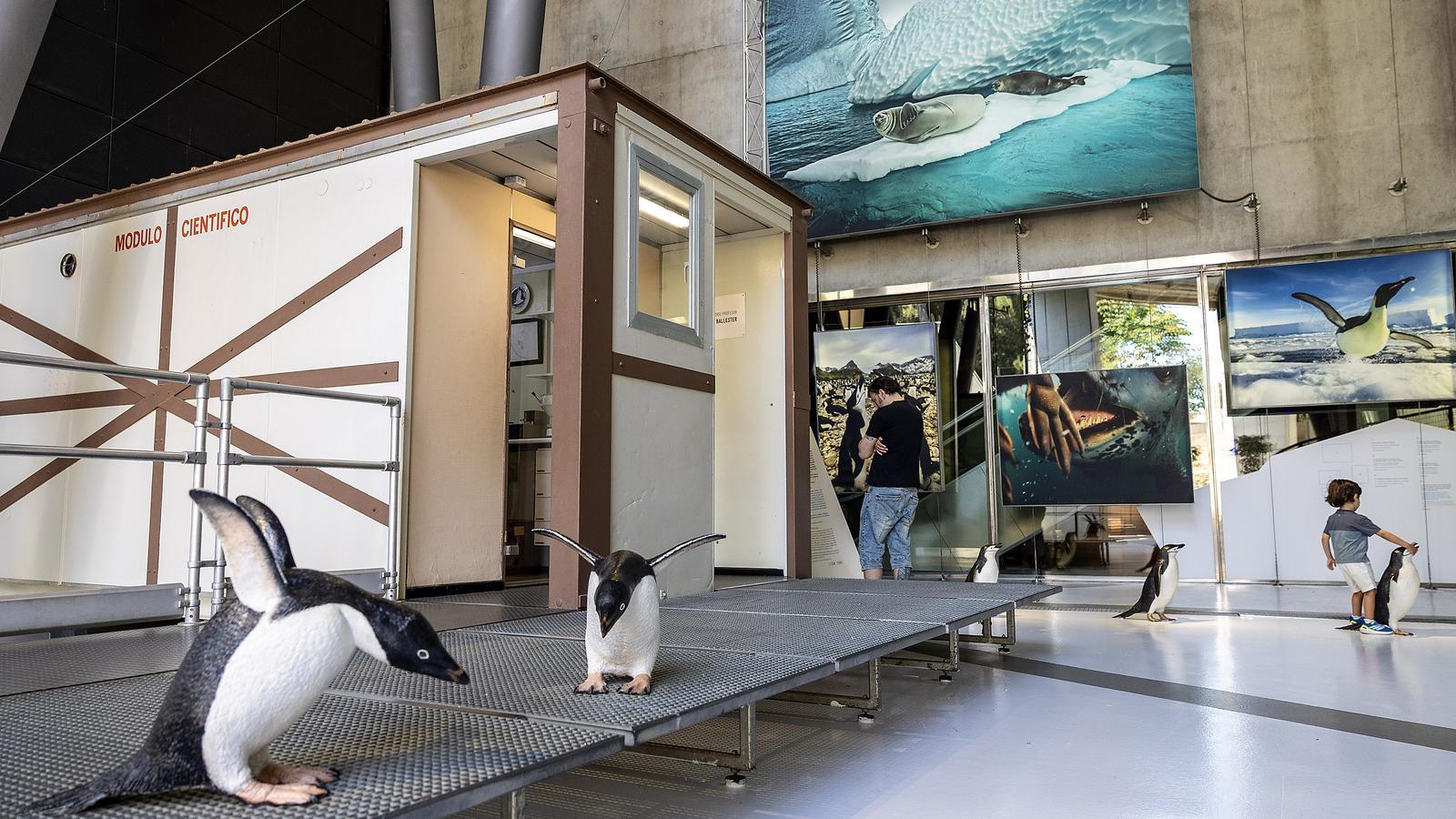
"Antarctica is a good sentinel of climate change", says Rafel Simó, a researcher at the Institute of Marine Sciences (CSIC), who has been to this virgin, fragile, and silent area of the planet several times to conduct research with the Hespérides, a ship managed and crewed by the Spanish Navy. –Wouldn't it be logical for a research institution to do it?–. "And it shows that climate change is accelerating", he assures. "It is also a window into the past climate: deep continental ice contains trapped bubbles from the atmosphere of the last million years", he emphasizes. «In Antarctica there is practically no green, but there is a lot of life. It is marine life. It may seem a paradox that in such a hostile place there is great biodiversity», says Rafel. When we think of the animals of this remote continent, we immediately get the image of penguins, but there are many more: orcas, whales, seals... and an infinity of fish, all of them fed by microscopic plankton. "It is beautiful to see how life adapts to an extreme environment", says Simó, who knows the Juan Carlos I Antarctic Base very well. –And why isn't it named after Josefina Castellví, who directed it? Simó highlights some positive things that are happening in this far south: the Antarctic Treaty, an international agreement signed in 1959 that establishes that Antarctica must be used only for peaceful purposes and scientific research. –"It's a geopolitical miracle in the midst of the Cold War", he says– and that some of the data collected are hopeful, such as those that say the ozone layer hole is closing.As soon as I enter CosmoCaixa, I head to the space dedicated to Josefina Castellví (1935-2026) and research in Antarctica. There is the module-laboratory where Castellví worked, and many others, including Antoni Ballester, the driving force behind the base. I see a lot of equipment that is noticeably old –— I don't like the word 'antiquated'. Most are for microbiology, to analyze the chemical composition of water and its organisms.The director of CosmoCaixa, Valentí Farràs from Cardona, former director of CaixaForum Barcelona, accompanies me. He explains to me that after it fell into disuse, this laboratory –a container made in Tarragona– was repatriated: yes, it made a round trip to Catalonia, and CosmoCaixa "welcomed" it.Before showing me how the origin of the universe is explained here, Valentí indicates the origin of this museum that opened its doors in 1980. "First we opened it to schools and universities for them to test it," he explains. In the beginning it was called the Science Museum of the Social Work “la Caixa”. It occupied a building from the early 20th century, by Josep Domènech i Estapà –some called him, with malice, "Domenech the bad", in contrast to Domènech i Montaner–, which had housed a shelter for blind women, characterized by an innovative pedagogy. Later it became the Science Museum and since 2004, after a major expansion, CosmoCaixa. Today it is a giant of scientific dissemination for all ages, a must-visit. It is a museum to go to for a few days because in one "you won't finish it". "Hold on!", says one girl to another. They are playing at trying to hold their palms out for as long as possible on a large block of ice. Next to them, one of water's curiosities is explained: its three states –solid, liquid and gaseous– can coexist simultaneously at 0.01 degrees. Not so in Antarctica, where water freezes below zero degrees (approximately -1.8 °C) because it is salty.Another curiosity about water that catches my attention is shown in an experiment. We approach it and an educator says to a series of students: "See? Water is not continuous." There is a stream of water that forms a bridge and is illuminated with stroboscopic light, which allows it to be seen broken down into drops.We enter the so-called flooded forest. It is hot, 26 °C and 80% humidity and it's raining –it's rather drizzling– every quarter of an hour. Of course: we are "in" the Amazon rainforest, specifically in the Santarém region. I watch an anaconda move slowly. "It eats two rabbits every fifteen days. It's a slow-digesting animal," says Valentí. Suddenly, my host looks at his mobile. It's not that he wants to ignore me. He wants to show me the number of people visiting the museum. It's a "tracker" that is constantly updating. "There are 1,410 people." It's more or less as if the entire population of Puigverd de Lleida –even very old people, who only leave the house occasionally–, were attending CosmoCaixa.I stop in front of a fossilized skeleton of a woolly mammoth, of considerable size. They made good use of many things from the mammoth: the skin for clothing, the body for food or for making tools. "If they explain it to you, you remember it; if you experience it, you learn it. This is the basis of CosmoCaixa," remarks Valentí. "Accompanied by educators, knowledge is consolidated," he adds as I review the names of great female researchers that fill a wall. The first, Hypatia of Alexandria, philosopher, astronomer, and mathematician (4th century AD). Of course, Josefina Castellví is not missing.

More than a million visitors a year
It has been a few years since CosmoCaixa surpassed one million visitors a year. The majority are Catalans, who come with family or with school. There are 6% from the rest of Spain and 20% foreigners. It is common for world-class researchers, and some Nobel laureates, to explain their research there. A young audience usually attends these activities. Science advances, and CosmoCaixa too. Some of the areas it is betting on are genetics and artificial intelligence.

