Dismissing workers on sick leave and medical checks by the company: Foment del Treball's recipe against absenteeism
The employers' association also demands that companies stop paying Social Security contributions for employees who cannot work

-
CAT -
CAST
BarcelonaWorkplace absenteeism has become the main battleground for Catalan business owners, and Foment del Treball, the employers' association that groups major Catalan companies, is proposing forceful measures to combat it. Among these, notable on one hand is the implementation of mandatory medical check-ups and allowing companies to access certain medical information of their employees in case of sick leave, and on the other, the possibility of dismissing workers who accumulate repeated or long-term absences, a measure that was eliminated with the 2020 labor reform.
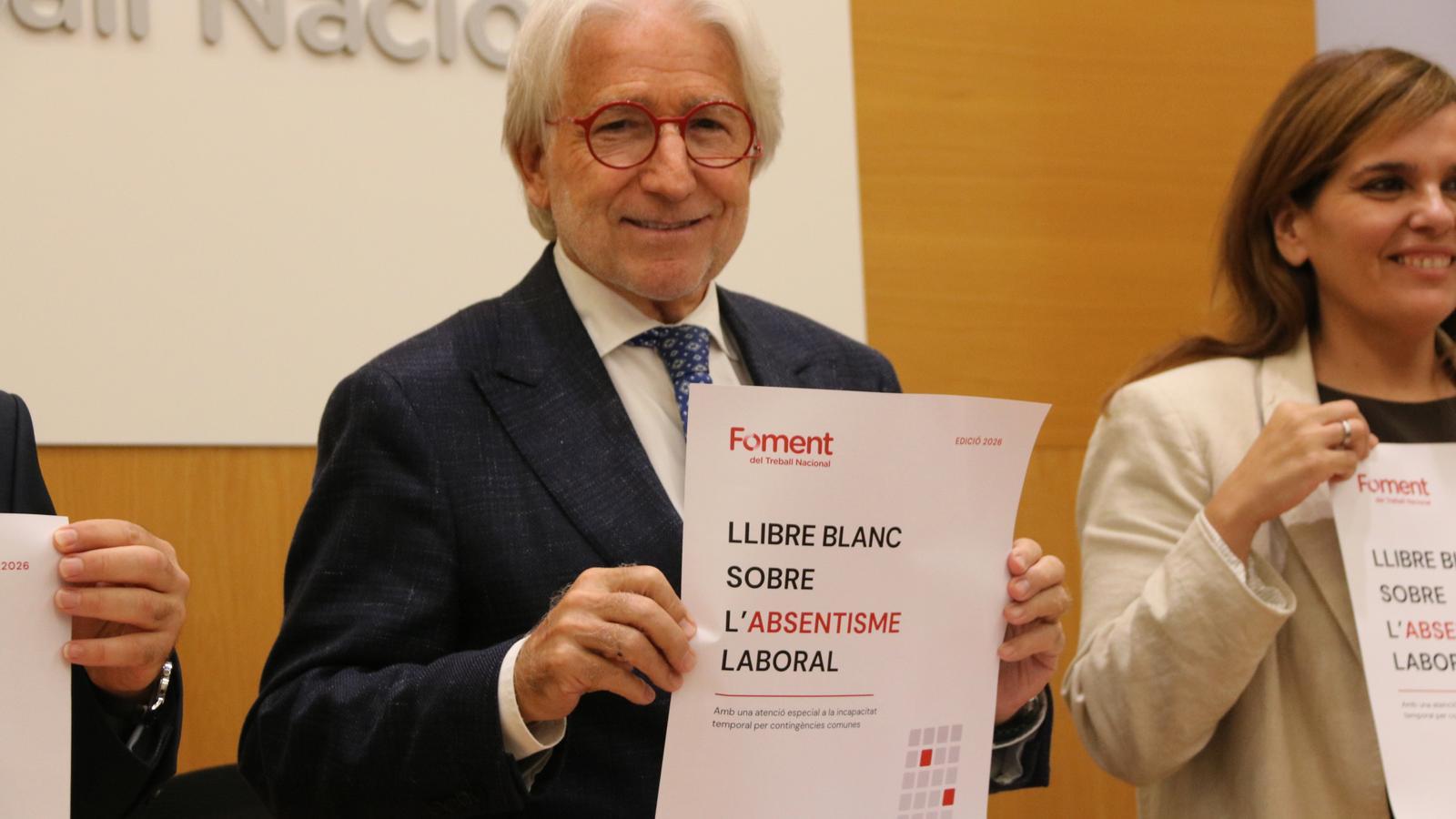
"Absenteeism is a global problem that is starting to become unmanageable," said the president of Foment, Josep Sánchez Llibre, this Tuesday at the presentation ceremony of the White Paper on Absenteeism, with which the business entity puts forward different measures to reverse the situation. Sánchez Llibre has once again demanded that this issue "occupy a priority place" on the political agenda.
Specifically, one of the main changes requested by the employers' association to combat absenteeism is the aforementioned return of objective dismissals. Foment asserts that they could be a "useful tool" for companies "in the event that the worker is absent from their workplace, regardless of the causes, on a certain number of occasions," excluding cases of disability. In other words, this would allow a company to fire an employee for accumulating several leaves due to health reasons or other justified motives. It should be remembered that the option of objectively terminating the employment relationship for reasons linked to the worker's justified absence was abolished by the 2020 labor reform.
Another tool proposed by the employers' association is for private health mutuals to take on a more prominent role in cases of common contingencies. Although they currently already play a main role in work accidents and occupational diseases, the entity believes they could help by assuming temporary disability processes for common contingencies.
Furthermore, they also point out that improvements are needed in primary care to reduce, among other things, waiting lists for diagnostic and medical tests. The White Paper also says that it must "ensure that doctors have sufficient technical competence for the corresponding analyses of the work capacities of workers on leave".
Among the proposals gathered in the publication—coordinated by the professor of labor and social security law at the University of Barcelona, Jordi García Viña—there is also a notable desire to eliminate the need for employee consent to conduct medical examinations, "whether at the initial moments of the relationship or during it, as well as to regulate the possibility of conducting mandatory medical examinations when there may be medical reasons to do so." Changes are also proposed regarding the company's control over temporary disabilities: "the employer must have a certain knowledge of the employee's health status when they are on leave."
This fact would currently clash with data protection law, which places significant obstacles on the access to citizens' medical information by companies, administrations, and third parties, including direct family members.
Cost sharing
As detailed in the report and explained by the director of Labor Relations and Social Affairs of the employers' association, Yésika Aguilar, the costs of sick leave are "very high." Specifically, according to Foment's data, for companies this situation represented 16,115.84 million euros; and the total cost was 33,280.39 million. During 2019, the moment that Sánchez Llibre has set as the target scenario for a return, the leaves meant a cost of 8,228.06 million for companies and 16,646.82 in total.
For this reason, the employers' association believes that the current system of direct payments by the company, which now runs from the fourth to the fifteenth day of leave, and that of delegated payment, which begins once the fifteenth day is exceeded, must be changed. "It is proposed that the employer stop assuming this cost and that this benefit be paid directly, whether by the managing entities or by the collaborating mutuals," the report asserts. Furthermore, as Sánchez Llibre has explained, it is also considered necessary to "eliminate the obligation for companies to contribute during the leave period."
Regarding collective bargaining, Foment notes a "special relationship" between the "high rates of absenteeism" and the "temporary disability supplements negotiated in collective agreements." For this reason, the employers' association considers that a "mechanism for the elimination of supplements" must be established. Other proposals from the employers' association to reverse the current situation are to "recover values related to effort, commitment to work, and responsibility in the execution of the provision of services" or to "establish programs for recovery and progressive return to work.

