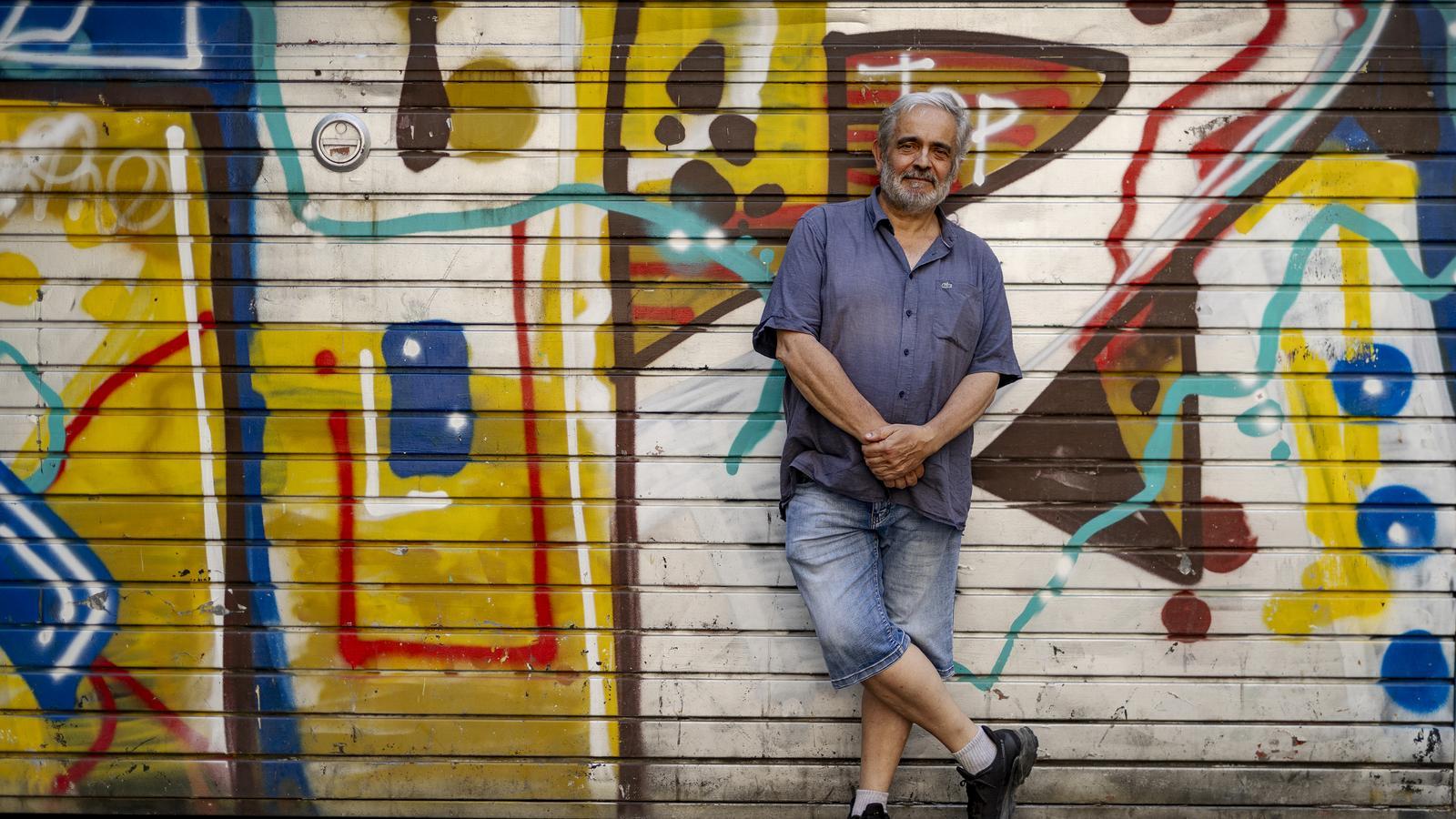
Joan Maria Minguet: "Can they exhibit against the Spanish monarchy again at the Macba?"
Art historian. Publishes the book 'Against Obedience. To End Art Consensus'

-
CAT -
CAST
BarcelonaThe art historian, critic, and exhibition curator Joan Maria Minguet Batllori (Cornellà de Llobregat, 1958), a retired professor from the UAB, is a restless and incisive mind. He assures that his new book "Contra l'obediència. Per acabar amb els consensos de l'art" (Raig Verd) is a summary of his career and how he began to rethink it about fifteen years ago. "I go very much against things that I myself had said," he states.
He warns that we are very submissive in the field of culture.
— We all have the idea that the world of culture is a field of freedom, a field in which creation awakens our consciousness, and I come to say that this is not the case. We are subjected to obediences that are imposed on us, but they are not imposed on us by anyone in particular, but by the times, by tastes, by consensuses, and it is very difficult to break with these consensuses.
"Art that is not understood as a tool of combat also becomes a privilege," he says.
— When I say this, I question myself, because there are many offices of power and the bourgeoisie where, for example, the works of Joan Miró are simply decorating the walls. It is one thing to use the work, but it is also true that Miró had a groundbreaking will, even when he makes paintings that he knows he will later sell to the big bourgeoisie. And when he makes posters and the ephemeral mural at the College of Architects of Catalonia in 1969, he is trying to break with this complacent, lazy system.
Warns against intellectual laziness and demands art that "hurts".
— I am very concerned that when we enter encyclopedic museums, it seems we perform an absolute genuflection. This doesn't happen in contemporary art museums, because there are people who show their discomfort or even dare to say that the works on display are not art, which doesn't happen in any other discipline. You read a bad book and don't say it's not literature, or when you hear terrible music, you don't say it's not music. Instead, with art, they do dare. When you enter an encyclopedic museum, you perform this genuflection, because you enter and see a Velázquez, who was certainly an extraordinary painter in a technical sense, but he was a court painter. So, sometimes I am accused of presentism, but I don't feel challenged because I believe we should always interpret from the values of the present, especially if they are values that have dignified the role of women, that have dignified the collective role. Therefore, I think it's good to point out that Velázquez was a court painter, and whether he was good or bad shouldn't be the most important thing nowadays because I believe technical ability is not very important.
Isn't much supposedly rebellious art found in contemporary art museums actually decorative?
— What really worries the system is violence, collective protests. Art has never worried it because it ends up phagocytosing any art that is combative or born with the intention of combat. The system phagocytoses everything that goes against the system. And Adorno is the first to detect this when, in the 50s, he begins to point out that the system has neutralized surrealism, which had really been a bomb.
Speaking of museums, we are investing a lot of resources in trying to redeem an institution that is historically exclusionary and steeped in violence, even though we currently talk about ideas like the social museum or the museum as a place of care. Do you think it is possible to achieve this?
— The museum has no solution. During the French Revolution there were voices that raised their voice questioning the creation of a museum to exalt the Ancien Régime, that is, the monarchy they had beheaded. But it went ahead and the Louvre was created, which is the example on which all museums were based. One of these consensuses is to make us believe that what was born from the instances of power, of bourgeois power, has now been democratized. But this is relatively true, because our societies can be democratic or imperfectly democratic, but museums continue to be governed by boards where what you see are people with a lot of money; from time to time they put some university professor there to make it seem like it's not so bad. Furthermore, the boards are an undemocratic system because they are created by co-optation, there is no competition, there is no evaluation of merits to be a trustee, you just have to have money. You just have to look at the boards of Macba and MNAC. In all the boards there is a series of people who have studied nothing about the subject, but they are there due to political influences or because they have money. What does this mean? That democratization is not true.
Heritage continues to be a critical issue. The renovation of the permanent collection of the Design Museum caused a stir.
— The uncritical defense of heritage bothers me a lot. The heritage that we now defend is a heritage that is what has reached us, but we have left aside a whole popular heritage, of art, which is not what the system likes, which we have already put aside. There is no art of the subaltern classes, there is no memory or history of the subaltern classes. And the problem is that there is also no provision that we can solve it now.
The artistic canon is increasingly questioned. Its exhibition on the Dalmau galleries continues at the Abelló Museum in Mollet del Vallès. Some of the artists exhibited were forgotten.
— In this exhibition I have managed to rescue a hundred works, among which there are some that were highly valued but have been left out of this canon. And what has remained within the canon? What Lluís Plandiura had bought. He was not interested in modernity at all. Then, when the Generalitat bought the Plandiura collection, what happened was a strange phenomenon: the tastes of a private collector became a public canon, because it passed to the Board of Museums and is now the MNAC. How is this corrected? By abolishing museums [smiles]. And if you can't abolish them, at least there should be a willingness to rethink them. But this willingness is not there, because in Catalonia the museum directors have enough to do to keep up with the day-to-day to think about other things. And some are radically against what I say. There are museum directors who see that this continues to be a select, elitist thing, with a desire to be minority, and that when people go there it is to make that genuflection we were talking about before. In general, this reevaluation does not happen, among other things, because the system already prevents the museum boards from allowing any extravagance, and when there are extravagances they are also within the system; even this book is also within the system. Even though I say so, we are immobilized.
He is very critical of Jaume Plensa and his servitude.
— I think Plensa is a very harmful artist, especially because he wants to make it seem like he is a Renaissance artist, and he doesn't realize that Renaissance artists were already what he is, the voice of power. When Raphael sold a Sacred Family to a Florentine prince, the prince next to him also wanted one. So Plensa is building himself based on this copy, on this imitation that power has always had since the Renaissance. He dresses this commercial operation with certain forms, which is irrelevant whether I like them or not. What bothers me most is when, in the midst of the covid pandemic, he made one of those repetitive sculptures for the Community of Madrid, inaugurated it in the presence of Isabel Díaz Ayuso, the king, and representatives of all powers, and he thought that was fine. The other moment is that of the Liceu doors, this barrier to make it clear that the Liceu belongs to power. The other moment is that of the Liceu doors, this barrier to make it clear that the Liceu belongs to power.
As can be interpreted from an institutional logic, Valentín Roma's return to the Macba after the debacle of the exhibition The Beast and the Sovereign?
— I believe journalists have a job to do: when there's a press conference, ask him, not Valentín, but the president of the Macba Foundation, Ainhoa Grandes, if from now on at Macba works against the Spanish monarchy can be exhibited. Will Valentín Roma, who has publicly stated he voted for the CUP, allow himself to be censored by this uncontainable power within the museum that is the Macba Foundation? I believe this is the big problem. For me, Valentín has done a great job at La Virreina, he has turned it into one of the best centers, and whoever comes after him will have a problem matching his coherence. And at Macba, the first big challenge is to revive the museum, as all directors have tried and failed.
A few days ago I delved into an article published in Vilaweb about the controversial appointment of Maribel López as director of the Fundació Joan Miró.
— Beyond the person, the appointment of Maribel López is an alarming symptom, which adds to others that have occurred recently at the Joan Miró Foundation, of the institution's economicist drift. The focus is only on economic survival and the original spirit of the Joan Miró Foundation is being set aside based on the artist's wishes: that it be a center for contemporary art, to build imaginaries for freedom, and not just for economic return.
