Dolors Miquel: "When you have been very ill it is difficult to reintegrate into the sect of the healthy"
Writer. Publishes 'The sleeping breast'

-
CAT -
CAST
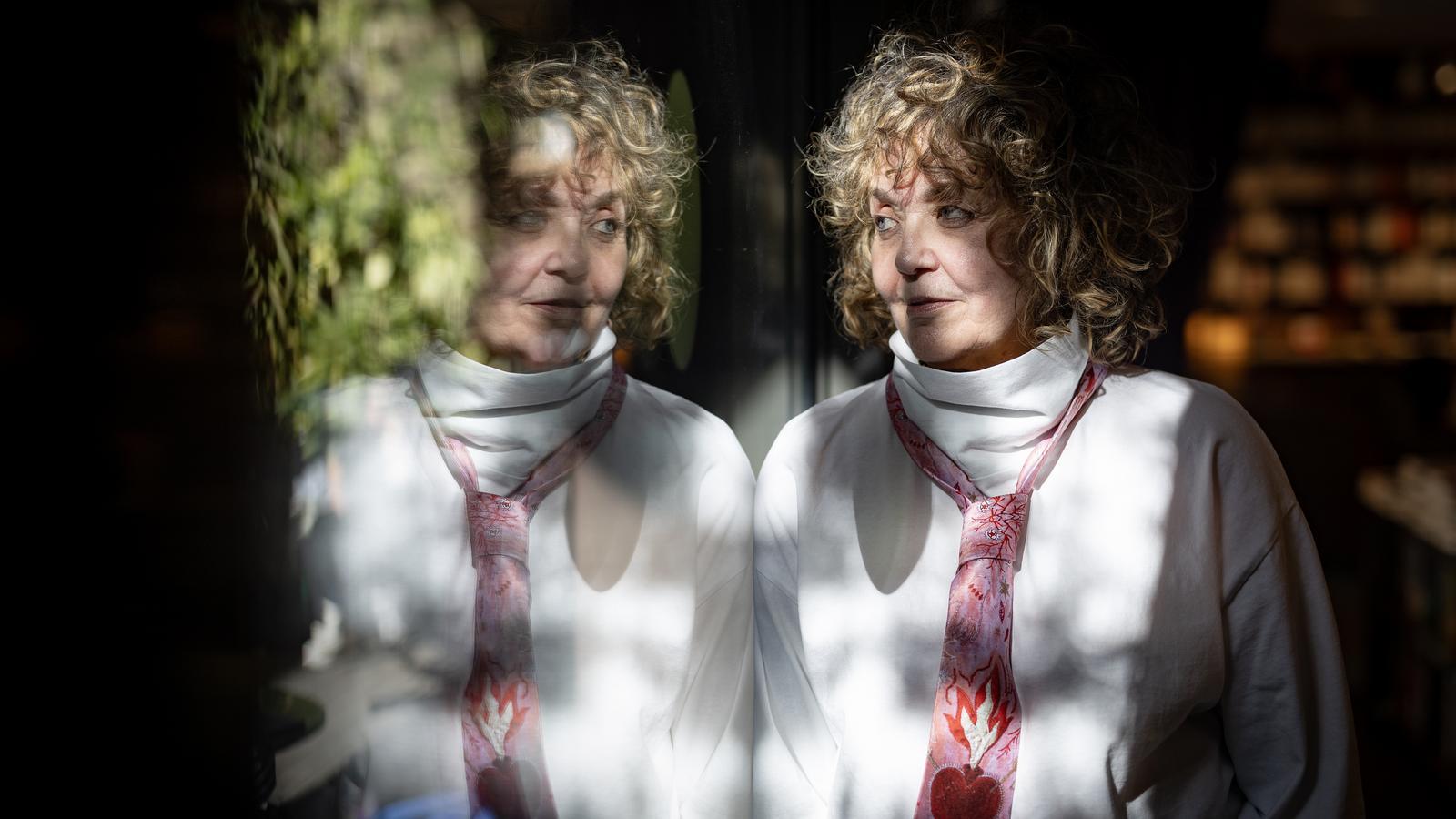
BarcelonaIn a slightly more just world, the jury of the award to which Dolors Miquel (Lleida, 1960) submitted El pit adormit at the end of 2024 would have proclaimed her book as the winner. It didn't happen that way, but the work has finally seen the light of day: in almost 500 pages of impressive intensity and ambition, the poet –author of some twenty volumes, including Haikús del camioner (Empúries, 1999) and El guant de plàstic rosa (Edicions 62, 2016)– combines various narrative threads, such as the detection and evolution of the cancer that was diagnosed five years ago, the chronicle of how Catalan poetry was reborn in the late nineties thanks to an alternative circuit of readings, reflections on misogyny – that of the past and that of the present – and fragments in which family memories intertwine with a passion for reading and writing.
We will try to pull a few threads about El pit adormit, but it will be impossible to cover them all. It is a book where there is a whole world: the most intimate, that of poetry, the family, the natural, that of hospitals...
— There are journalists who have asked me many questions about cancer.
The book begins during a medical examination you are undergoing to confirm or rule out breast cancer. You write: "Naked to the waist, neck turned, right armpit completely bare, arm outstretched in a gentle tension, cradling my head, all of me awake, except my breast which is lulled by a strange sleep." Was this the starting point?
— The starting point is that I need to write. What was given to me was the title and the theme, in this case, but from then on I looked for a way to structure everything I wanted to explain, and I found the answer by reading Bluets, by Maggie Nelson, a very free book that gave her a lot of room to do what she wanted. It was exactly what I needed: to make a tapestry with different narrative threads, because The Sleeping Breast is a book where many themes come up.
The diagnosis of the disease, the operation and the subsequent treatment is one of the main topics.
— Cancer was a gift from fate that came to me months after a car accident in which I broke my sternum.
I remember that this was just after publishing the anthology Sutura (Pagès, 2021), because we had to meet for an interview and you told me that at that time you couldn't leave home.
— I had been driving for over twenty years and had a horrible accident. The car was ruined. Luckily I was alone. During the accident, seconds stretched in an unusual way. It was a tough experience, but worse things awaited me. Misfortunes always come in bunches.
Your way of overcoming everything you lived and suffered was by writing The Sleeping Chest?
— I still can't believe how I managed to write it. I worked on it every day, from Monday to Sunday, and even during holidays. Most of the time I was lying in bed, because I didn't have the strength for anything. Now I don't know if I could write it again.
I would say you have made a conscious effort to distance yourself from the trauma narrative.
— Trauma doesn't interest me. I'm talking about the pain the body can cause, but also about how the body, as an artifact of life, is fascinating. It seems like a great mystery to me, something incredible. Imagine that they have to cut off a piece of flesh from you in the operating room and the body, without you intervening at all, creates it again and manages to restore its previous shape. It's mind-boggling. With illness you have this sensation. You don't know what's working inside you, who's giving the orders. You consider many things, because the body does what it wants.
In the book below appears the recital tour that you started in 1997 accompanied by poets such as Enric Casasses, Josep Pedrals, Gerard Horta, Pau Riba and Eduard Escoffet.
— Taking into account that I was in those circumstances, returning to the world of recitals was a refuge for me. The sleeping chest is the mental and imaginative procedure, of memory, of reflection and of suffering of the body that I lived through all these years. It makes sense that I took refuge in the past, doesn't it? The present was too hard. It also makes sense that I took refuge in intellectual thoughts. They helped me. For a time, my bedside book was The Magic Mountain, by Thomas Mann.
The magic mountain appears now and then, in The Sleeping Chest.
— Yes, it is an amazing novel because it talks to you in a, let's say, brilliant and masterful way about how the world of the sick is contrasted with that of the healthy. There comes a point where the sick person no longer wants to return to the world before.
It happens to Hans Castorp, the protagonist of the novel. His cousin Joachim Ziemssen, on the other hand, longs to return to normal life.
— I am more of a Castorp. When you have been very ill, it is difficult to reintegrate into the world of the healthy. Everything seems very strange to you. I understand perfectly that Castorp did not want to leave the sanatorium. His decision has nothing to do with that Russian girl he falls in love with, Madame Chauchat.
In one of the fragments of'The Magic Mountain you mention some words from Doctor Krokowski in Mann's novel. He says: "The absence of love reappears in the form of illness".
— To what extent do emotional states cause illnesses to appear? Perhaps they only predispose you to get sick, because there is a weakness in the body. Love and desire are the most powerful forces on Earth. Let's specify: on the mammalian Earth. I don't think rocks desire... Or perhaps they desire each other, I don't know.
Love is above desire, or is it the other way around?
— Desire is life itself. When desire takes hold of you, it is life that wishes to perpetuate itself through you. It is very strong. Love is already another stage, which has nothing to do with the perpetuation of life, and which is very interesting to experience. The sleeping chest is a book full of love.
It is one of the effects it has had on me. Even in moments when everything around you "smelled of hospital and of life in danger" you found something positive to hold onto, be it a book, a dream, or someone's memory.
— I think this also helped me to heal.
You also speak with great love of animals, of trees, of flowers... There is a pantheistic point that we could associate with Joan Maragall.
— I have always loved everything. What happens is that I have a rather strong character and I can have quite a bad temper. But since I was little, everything has seemed estimable to me, and that's why I have so much to do with nature, with animals and with things.
There are exciting pages about your parents and about a great-grandmother.
— All this has to do with sweetness and tenderness. They are a way of facing life. That's why I talk about a French philosopher, Anne Dufourmantelle, who said that sweetness is a tool for opposing war and social violence.
Dufourmantelle considered tenderness a subversive strength, rather than a weakness, right?
— It managed to convey a different way of seeing life. It seems like a very good idea to me. When in the book I talk about love or expose all these memories, I look for tenderness and love.
You may still miss your parents, even though they have been dead for years.
— Very much. I miss everyone who has died. I even remember a small kitten, the little birds I had, a dog I found and that later got lost. One time I tried to save a kestrel. Before going to school, I used to hunt ants for it in the tree in front of the house and give them to it. Then I would go to the field and throw it up so it would fly. But it couldn't. And it didn't make it. I still remember that kestrel that died in my hand, looking at me. It makes me sad.
It wasn't the intention. Perhaps it is time to turn to one of the other great themes of the book, which is poetry. Before tackling the 1997 recital tour that you describe in detail, you take a critical look at a major event like the Price of the poets, held in 1970 and filmed by Pere Portabella.
— When I watched Portabella's film again, I was gobsmacked. He filmed everyone who recited, except Rosa Leveroni, the only poet who went on stage, whom he barely mentions. These things weigh on me.
You write: "Ask for our forgiveness, all of you. Pere Portabella, kneel!"
— Yes. I also tell him to Joan Vinyoli later on.
But for another reason.
— When Orlando Guillén wanted to translate an anthology of Catalan poets into Spanish, he only recommended men. He didn't think of any women. The most mind-boggling thing about all this is that it didn't even occur to him that he could do so. Later, Guillén added women, but they were only present through poems; he never translated an entire book by any of them.
Denounce the sexism that has existed and persists in the world of Catalan culture.
— It is something that bothers me a lot, that it is not recognized that it is a patriarchy. I have also been trained in this mentality. Until something is recognized, it cannot be changed. It disgusts me when we pretend to be so feminist. My proposal is to get off the pedestal and look at things as they are.
In 1997, a few poets traveled up and down Catalonia reciting in unexpected venues and creating a new audience.
— My will returning to what happened at the end of last century was to take the narrative. There is a discourse about poetry and literature in general that has been imposed over the years. I wanted to explain my version, which ends up contravening many of the things that have been said.
You are the only woman in the group.
— Back then I didn't even realize it. Until then I had been in literary meetings that were very bourgeois. Instead of talking about literature, they commented on the cover, who had published it... I felt like an octopus trapped inside a vase. Then I met Enric [Casasses], Albert [Roig], Víctor [Nik] and many others, people who valued texts and who were moved by them. They lived the word in a very intense way.
You admit that you were suffering before going on stage.
— I really like to recite, but what I would like is to do it in a place all alone, without an audience. I'm a bit of a misanthrope, albeit in a, let's say, kind way. I like solitude, but it also costs me. The things that really matter to me I hardly ever say. In other words, I'm very closed off. Many of the things I say are to cover up the others. Maybe you see me laughing and inside I'm about to do like Anne Sexton [who committed suicide].
Those of us who saw you in those years have not forgotten the forcefulness of your interventions. I remember a recital in Reus with Enric Casasses and Jaume Sisa around 2003 or 2004...
— It was in a very dark place. I felt terrible there. It was a time when I was very angry with society. I gave a hard time to people who wanted to mess with me.
What was controversial was the content of your verses or your attitude?
— It was striking that I spoke so badly, and that I didn't hold back when criticizing men. A woman was expected to write love poems about men who had left her, and to cry while drinking coffee and watching the clouds go by. I, to be honest, neither saw the clouds go by nor drank coffee: I was super angry. Especially with the system. I had suddenly discovered how the ideological structures of society had manipulated me. I railed against men because they were the other part of this heterosexual couple story, but they, in a way, were also victims of this ideology.
Before you told me you loved everything. Have you managed to maintain your love for men?
— I continue to love men. I really like their energy. What I don't like is the patriarchy, because it reduces me.
