We celebrate Catalan cinema... with a critical spirit
Xavi Serra moderates an interesting conversation at the Filmoteca about the 25 best Catalan films of the 21st century
-
CAT -
CAST
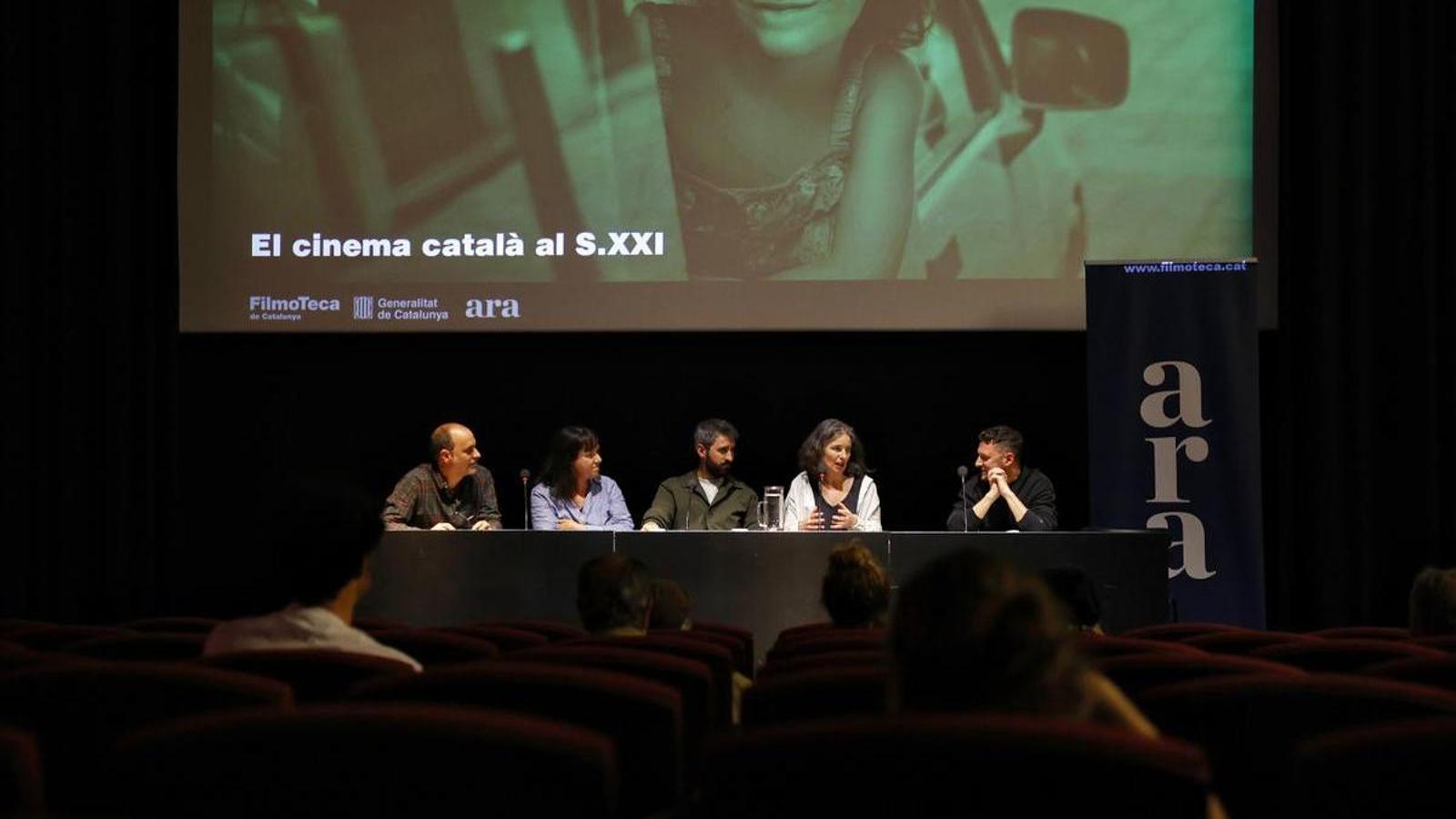
BarcelonaThe best antidote to the banality of some discussions is a debate with people who know what they are talking about. For example, four people whom the deputy director of Culture at ARA, Xavi Serra, convened on Tuesday in the Sala Laya of the Filmoteca to talk about the canon of 21st-century Catalan cinema, the list of 267 films published by the newspaper and which can be consulted in a magnificent and exemplary interactive. "An excellent dossier, an unprecedented initiative with a survey in which 200 experts have participated to make a possible canon," as Pablo La Parra, the director of the Filmoteca (where this Wednesday there will be a meeting with Carla Simón), said. The interactive, incidentally, also shows the 200 votes (each of 10 films). "It's a nice way to discover films, debate and talk about our cinema," celebrates Serra, who imagined Tuesday's meeting as "an extension of the survey" and an opportunity to specify some of the characteristics of Catalan cinema; such as the naturalism that connects with certain European auteur cinema and the fruitful relationship between the language of documentary and fiction.

At the table moderated by the deputy director of Culture, there were two critics from ARA, María Adell Carmona and Eulàlia Iglesias, both professors: one at the University of Barcelona and the other at the Rovira i Virgili University of Tarragona. Also present was Miquel Escudero, programmer for film festivals like IndieLisboa, and filmmaker Arnau Vilaró, screenwriter of Alcarràs alongside Carla Simón, the director who appears at number 1 on the list with the film Estiu 1993. The critical spirit of all of this immediately emerged, as soon as Serra, happily incorrigible, asked what they were missing from the list of the 25 best.
Adell Carmona, despite celebrating the fourth position of [REC], calls for more genre films from directors like J.A. Bayona (who has three films among the 65 most voted); that said, she highly values "the variety" shown by the titles ranging from position 26 to 104, although comedies are missing. "Catalan cinema is very serious," she concludes with a smile. Vilaró would have preferred Marc Recha to be present among these 25, especially because he is a good example of "the hybridization of documentary and fiction" (in the ranking there are four films by Recha, in positions 31, 39, 53, and 59).
For Eulàlia Iglesias, "there's a lack of surprise, of risk, of transgression, in the top 25," and that's why she highlights the 106 films that only have one vote, because she likes to find films she doesn't know or had forgotten; in any case, Iglesias believes that ARA's canon, which would not have been possible a few years ago, "normalizes Catalan cinema." Escudero likes the list, "it's representative," even though among the top positions he misses more heterodox cinema made "on the margins," more "outskirts and queer cinema," perhaps the canon of the future that will challenge the 2026 canon. Xavi Serra, moderator with the right to reply, pointed out what "heterodoxy" there is in a list with four films by Albert Serra and one by Pere Portabella among the top 25. "I don't know if in a canon of Spanish or British cinema there would be space for such heterodox cinema."
The debate gained momentum as the film model or models reflected in the list were delved into. Iglesias brought to the table different characteristics of a cinema that in the early 21st century generated "an industrial model linked to genre and fantasy" (Balagueró, Bayona), supported by the Sitges Festival and by production companies like Filmax, which has always had auteur references (Joaquim Jordà, José Luis Guerin) and which in recent years has seen the consolidation of a model that "goes beyond commercial industrial dynamics" and fosters collective and horizontal work (Elena Martín, Clara Roquet). A cinema, says Iglesias, that "by not having its own state" has managed to create from the margins to build "a uniqueness that makes cinema successful" at festivals (Carla Simón, Albert Serra, Isaki Lacuesta) and also among critics and audiences (Mar Coll and especially Carla Simón as a paradigmatic example).
Escudero has worked at various European festivals where initially "genuine visions of Catalan filmmakers" were identified, and later "a Catalan cinema" was recognized. A cinema, explains Vilaró, that finds aesthetic references in European cinema: "Guerin, Jordà and Portabella with a formal approach inspired by Godard", and "Carla Simón and Mar Coll in narrative references such as Éric Rohmer and Claire Denis, with formal exploration but seeking to empathize with the audience", as achieved by Estiu 1993. "Regarding the cinema of young female filmmakers, the uniqueness, the genuine vision, is the result of looking at European auteur cinema but to tell stories very much from here —says Adell Carmona—. Like Mar Coll, who looks at French cinema but no one portrays the bourgeoisie here like she does".
The conversation also addressed the linguistic diversity of the ARA canon, with films in Catalan (12 of the first 25), Spanish, French, English... "Diversity is positive as long as it does not mean the marginalization of a language," said Iglesias, tempering enthusiasm, although he celebrates the fact that "directors who do not have Catalan as their first language shoot in Catalan because there are public policies that promote it".
Aspects such as the prestige model with popular vocation and authorial gaze of Pa negre, by Agustí Villaronga; the possibility that, following Casa en flames, by Dani de la Orden, Emma Vilarasau is a kind of Catalan Isabelle Huppert, and the consistency of actors and actresses such as Enric Auquer, Nausicaa Bonnín, Bruna Cusí, Carlos Cuevas, Victoria Luengo, Laura Weissmahr and the brothers Álvaro and Ángela Cervantes, were not left out of the conversation. "We celebrate Catalan cinema", Xavi Serra had said at the beginning of the session. There are quite a few reasons to do so.
