"The worst thing a child can inherit is a father or a mother who has not lived the life they wanted"
Douglas Stuart closes the trilogy about the repression of homosexuality, now in the Scottish islands, with the novel 'John, John's son'

-
CAT -
CAST
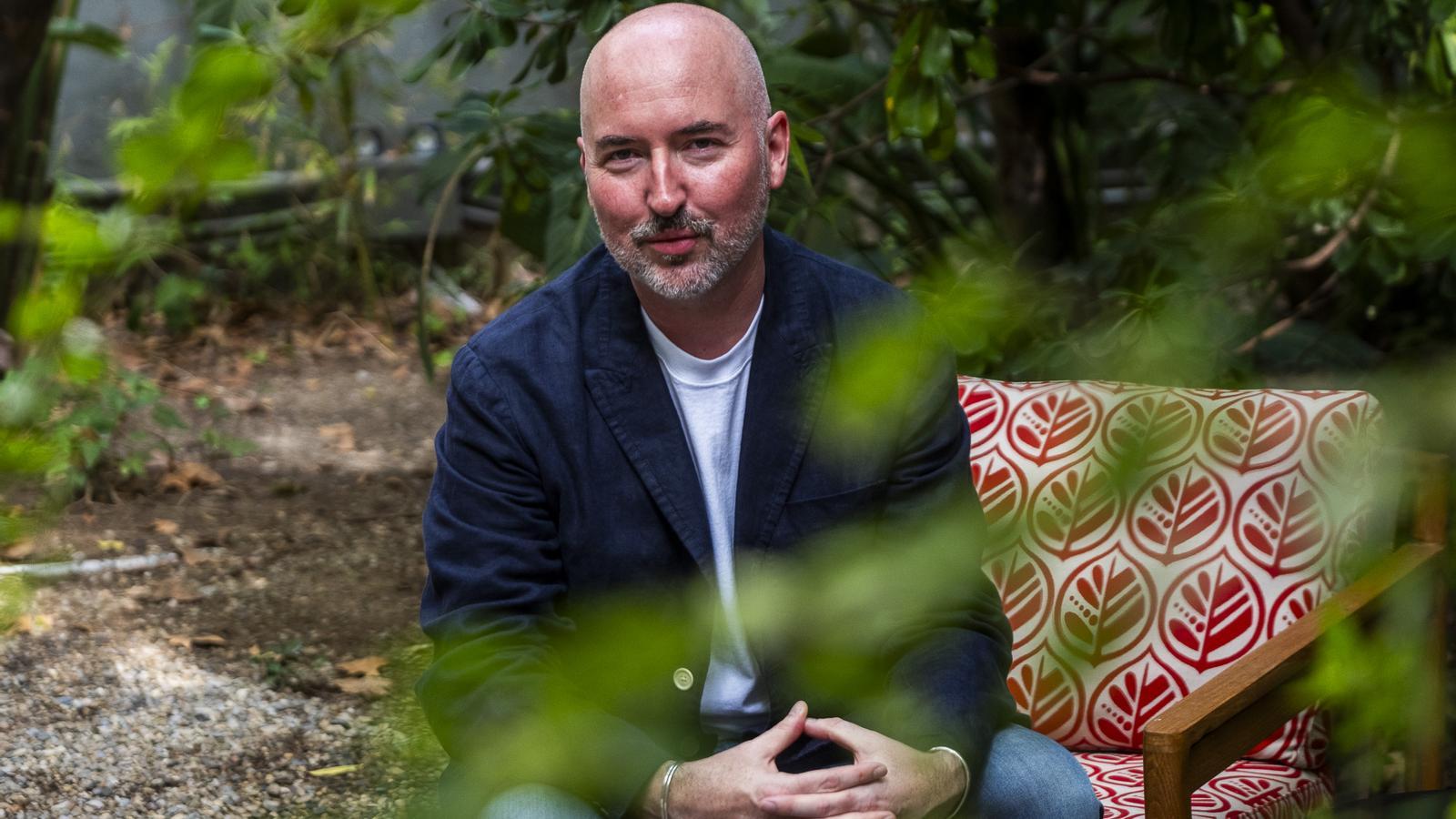
BarcelonaIf there is a crucial moment in the life of Douglas Stuart (Glasgow, 1976), we should place it in 2019. Until then, Stuart had had a complicated childhood as the son of a single, working-class mother who had died of alcoholism when he was 16, and, conversely, a liberating youth, because he had managed to graduate from university in London and move to New York to work in the sparkling world of fashion. "I had always thought that writing would be my passion and fashion my job," he recalls. Until 2019. That year he submitted the manuscript for Shuggie Bain, which would receive the 2020 Booker Prize and turn him into a world-famous writer.
In that same 2019, while waiting for the publication of his debut, he began working on what would be his third novel, Young Mungo, which now arrives in Catalan at Edicions de 1984 with the translation by Josefina Caball and at Random House in Spanish. The book closes the triptych about queer life in the Scottish working class, and it does so at the extreme northwestern edge of the country, in the Hebrides islands. The author lived there for four weeks that year in 2019 and interviewed dozens of people to understand what life is like in such an isolated, closed, and endogamous environment, a place that over the course of the century lost half its population, now very aged and impoverished.
In this rugged landscape, where Stanley Kubrick filmed 2001: A Space Odyssey, and which Stuart portrays with precision and humanity, there lies a story that explores "the difficulty of being yourself" when you know no alternative. "Homosexuality is so far removed from the Scriptures that it cannot even exist," he explains. On each island, moreover, everyone is the child of a well-known lineage, there are very few different surnames, and therefore "you are not just yourself, but you protect the reputation of your family." In this archipelago, Scottish Gaelic (spoken by 1% of Scots) survives, along with the cult of the Free Presbyterian Church, the strictest branch of Calvinism. In the English original—and it is understood perfectly well in the Catalan version—Stuart uses Scottish Gaelic, exploits the dramatic potential of bilingualism, and uses it to give character to his figures. "It was impossible for the Gàidhlig not to be in the novel. Language is how you see things: time, relationships, God..." he explains.
The return of the son
The protagonists of the novel are John and his son Cal, a 23-year-old kid who has to return to his father's isolated farm on the Isle of Harris to take care of his grandmother, whom he loves with devotion. "Care is the purest form of love," the writer opines. This is the underlying current that runs through his three novels. The father's call forces that young gay man, a fine arts graduate in Edinburgh, to seclude himself in the lonely and tedious prison that is his home, and dedicate himself to raising sheep, weaving wool to make tweed and going to mass. "I, who do not have a father, have always wondered about father-son love. From what I know of my father, he was very much a macho man, a product of his place and time, and I know, without a doubt, that I would never have been the son my father would have desired," the writer states.
In Young Mungo, he digs into the weight of inheritance, the effect of repression, and how one can feel, at the same time, rage and love for the same thing. Stuart, however, does not focus the tension on the boy who comes from outside but on those who have stayed on the island, especially the father and also his neighbors. "The worst inheritance is not receiving the farm. The worst thing a child can inherit is a father or mother who has not lived the life they wanted," the author states. "The father has let his life pass by to be able to preserve the land and the house for the son, and the son will lose his future because of the inheritance the father imposes on him. Sometimes families get stuck in a dead end," the Scotsman observes. The writer exploits the paradoxes of village life, such as the importance of discretion and, at the same time, the lack of privacy.
The third protagonist is the grandmother, who serves as a counterpoint to the surly and unsentimental male figures. "I could have talked about the silence of men, but I wanted to explain that this silence can never deceive women. Men have secrets and women know exactly what is happening to them... but they cannot explain it either," he states. According to him, gay grandsons have a special relationship with their grandmothers because they see in them an "example of survival and strength in a hostile world." Because even though Stuart believes that literature can move mountains, there is a rock that is hard to shatter: "The rift between the gay world and the Church is one I will not be able to close," he laments.
