The Vila Casas Foundation celebrates the legacy of Esther Boix with the most ambitious retrospective
'A World in Struggle' reviews all aspects of her career as an artist and educator

- Volart Spaces of the Vila Casas Foundation (Ausiàs Marc, 22; Barcelona).From April 10 to July 12.
Sometimes, life takes precedence over art. In a 1957 self-portrait, the Ampurdán painter and pedagogue Esther Boix (1927-2014), one of the most important of her generation, is a sad woman. Beside her is her husband, the poet Ricard Creus, equally contrite. Both have strangely elongated necks, as if Francoism were infiltrating their bodies and deforming them, as can be seen from this Friday at the exhibition that the Fundació Vila Casas dedicates to Esther Boix at the Espais Volart, titledEsther Boix. A World in Struggle. This is the most ambitious retrospective ever dedicated to her, and an unmissable exhibition.
Returning to the portrait, the couple travels to Milan with this heaviness within them, but this trip changed their lives: it was in the Italian city where they learned they were expecting their first and only child, Adrià. They returned because they wanted him to be born in Catalonia. And upon their return, despite Francoism, everything was different. While the self-portrait is made with brownish tones, one of the first portraits Boix paints of her son is all light and delicacy. "In the self-portrait they are like masks, self-absorbed characters. The trip to Milan had a dark beginning, but the end was luminous," states Bernat Puigdollers, the artistic director of the Fundació Vila Casas and curator of the exhibition. "Milan opened them up to new ways of living, allowed them to enter a circle of intellectuals, artists, illustrators, writers, and filmmakers, and allowed them to live in a different way," he adds.
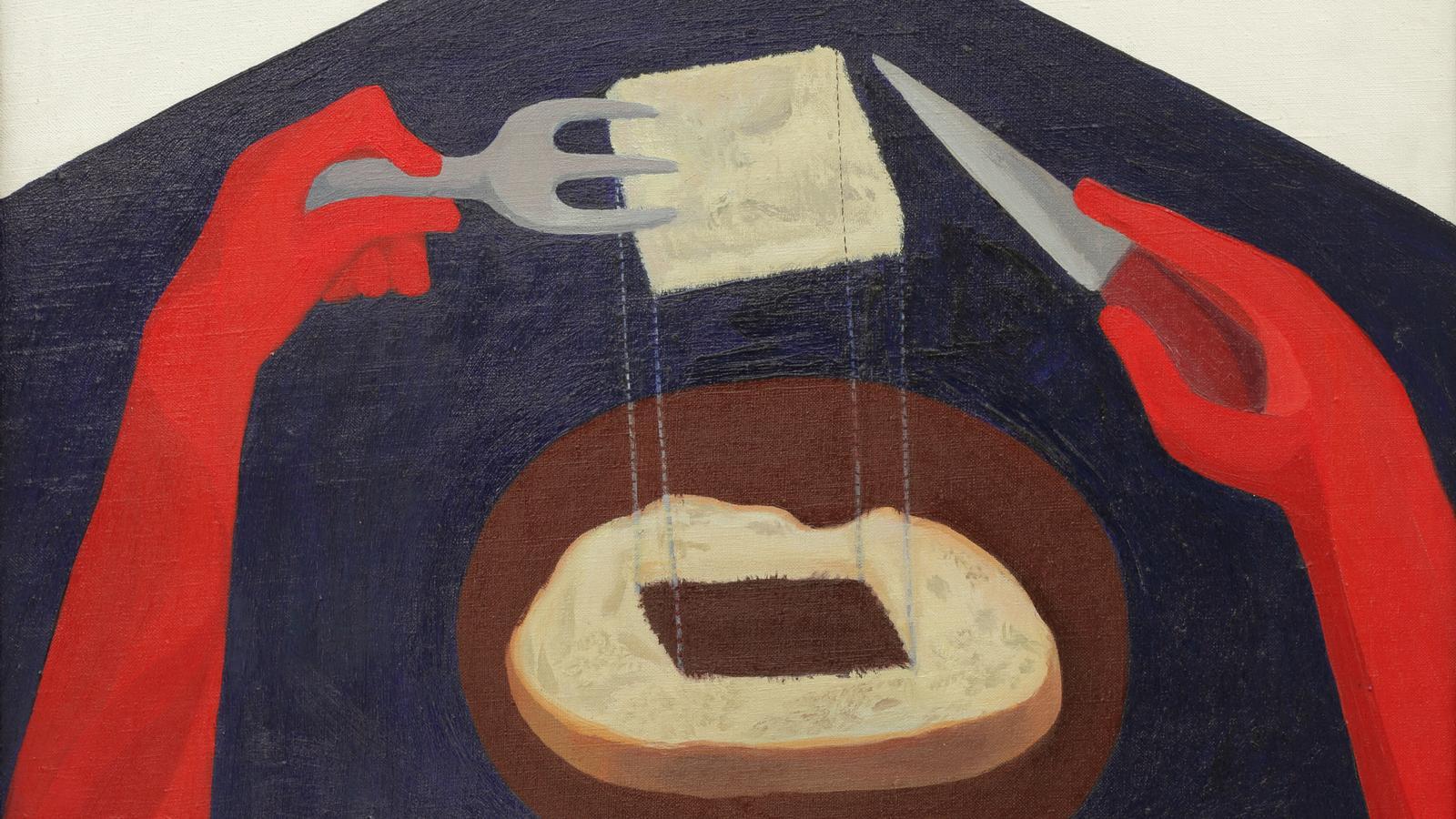
Furthermore, upon their return, Boix's painting acquired a more directly social character, both in terms of her commitment to working people and to feminism. And later, from the 1960s onwards, when she was one of the driving forces behind the Estampa Popular group, her criticism became frontal and open. The paintings are full of symbols with which she denounces the cruelty of the Francoist authorities. Among the most poignant paintings is One Day You Will Be Served (1972), featuring a dismembered body served on a platter.
From the blackness of Gutiérrez Solana to light
A life on the margins. Esther Boix grew up marked by polio, which she suffered at the age of two. "This means having a more introspective life, not being able to play with other children with the same freedom, and also opening the door to wanting to focus on the margins of society and also the pictorial and artistic ones," explains Puigdollers. As for her painting, initially influenced by the darkness of Gutiérrez Solana, it is characterized by being "rather dark, by a certain geometrization and simplification of forms, and also by the fact of highlighting the misery of the postwar period," as the curator says.
Later, the exhibition, which will be open until July 12, includes her time at Llotja, which was important not for the training she received, but for the small group she formed around her, which included Ricard Creus, who was then just a friend, the painter Mercè Vallverdú, and the sculptor Josep Maria Subirachs. The meetings took place in Esther Boix's father's apartment. "We must understand this group above all as a group of friendship: it had been born naturally and basically what they wanted was to exchange knowledge. They listened to music, organized poetry readings, and also went on small excursions to visit monuments throughout Catalonia. Highlights include those they made to visit Gaudí's work, at a time when almost no one spoke of him, because they began to be rediscovered in the 1950s," explains Puigdollers.
Another aspect of this relationship was the creation of the ephemeral group Postectura, as an opportunity to gain more visibility. "They advocated a return to the essence, a pictorial and sculptural essence that starts from real experience, but seeks the intimate structure of existence," says the curator, who has dedicated one of the rooms to the pedagogical work of Esther Boix and Ricard Creus at the Escola d’Expressió L’ARC.
Esther Boix herself defined the evolution of her career as the transition from "struggle" during Francoism to "song." That is, after the dictator's death, she embarked on new paths with other commitments. "The focus of her work changes, and it begins to lean towards the landscape," says Puigdollers. This evolution was marked by the move of her studio to an attic on Girona street in Barcelona, and later to El Perer, a farmhouse in the municipality of Les Preses (Garrotxa). "In addition to political awareness, she also shows ecological awareness and talks about pollution. And a process begins in which the human figure starts to disappear and the landscape begins a process of dissolution until it almost reaches white," says Puigdollers. "She ends up having an almost pantheistic view of the world, that is, the world has a life of its own and we are a small thing in the midst of the universe, the environment, the landscape. There is a process of calm, of communion with the environment, and I don't know if the word is disenchantment, but rather a relativization of human existence," concludes the curator.
