The moment that changed Kae Tempest's life
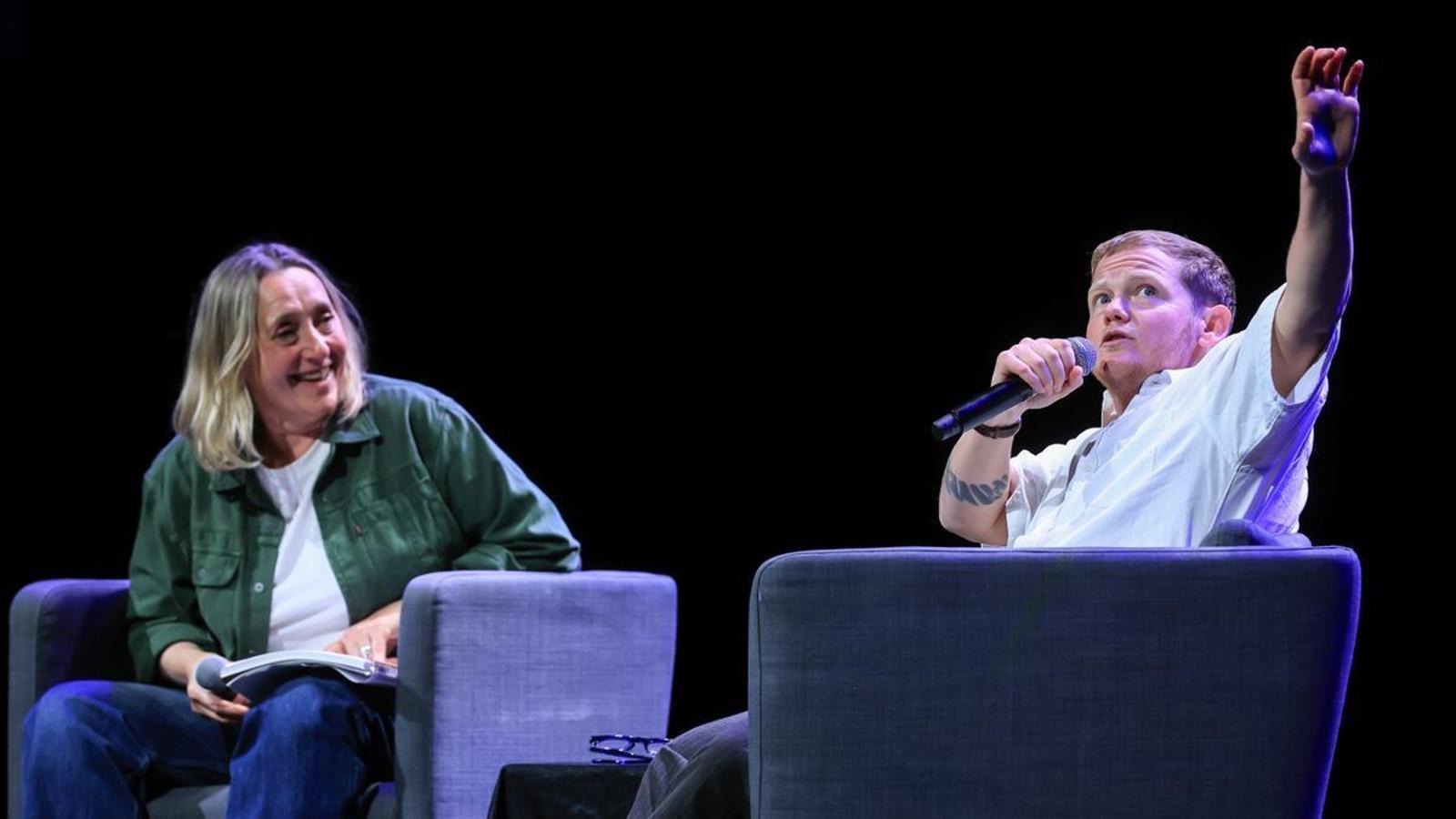
The writer presents the novel 'All my life searching' at Paral·lel 62 with Virginie Despentes

-
CAT -
CAST
BarcelonaPair of literary stars at Paral·lel 62, which is becoming a new venue for major publishing events —this Wednesday even at a modest price of 6 euros—. Kae Tempest (London, 1985) presents Tota la vida buscant (Random House / L’Altra, translated by Maria-Arboç Terrades), which returns her to the novel almost ten years after Cuando la vida te da un martillo (Sexto Piso). And she does so at the hand of another institution of dissident literature, Virginie Despentes (Nancy, 1969). Books by both are sold at the entrance.
Barcelona has followed the unstoppable rise of this artist who has received awards as a poet, playwright, and musician. Tempest confesses "a romantic feeling" for the city, its festivals, and the public that follows her. She also twice thanks her stay at the "isolated paradise of the world" that is the Finestres Residence in Cala Sanià, "the best gift you can give a writer". Tota la vida buscant is set precisely in an imaginary coastal town, Edgecliff, a place that combines "extreme claustrophobia, because you are on the threshold of the ends of the earth and there is a feeling of loneliness, loss, alcoholism, and drug problems" with "the beauty of the ocean and people who have a great time". This is where her protagonist, Rothko Taylor, returns after fifteen years locked up in prison. And this is where Kae Tempest grew up, making music in a heterosexual and male environment, without access to the queer community. "That isolated me from myself, I felt suffocated," she recalls.
Shame and creativity are two themes about which he elaborates because one is the response to the other. Tempest experiences creation as a path to love and to understand, also as an escape from pain: "It is when I have the sensation of leaving the body behind and going to a different place. Shame is very alienating, it doesn't let you live, you just want to die. Most of the artists I know have shame. It is a force that goes against you and you have to face it with an equally strong force: the only thing that can stand up to it is creativity, an act of love and of life –he states–. I knew I wanted to write about the wound, a place I hadn't been before".
, he repeats. "These words, so small that they seem to mean nothing, are like the limestone caves under England, which became great underground cathedrals".
While writing the novel, Tempest had a motto written on the wall: "Write what you are unable to admit". That is why, when Despentes asks him what he would say to his young self (an exercise he does in the novel), the author tells him the same thing he tells trans teenagers and their parents when they approach him: "Keep going, please. Always forward! Stay alive long enough, please, keep living because in the end things happen. Things happen. We all live inconceivable things but we have come this far. We are here. Keep going". Keep going, he repeats. "These words, so small that they seem to mean nothing, are like the limestone caves under England, which became great underground cathedrals".
