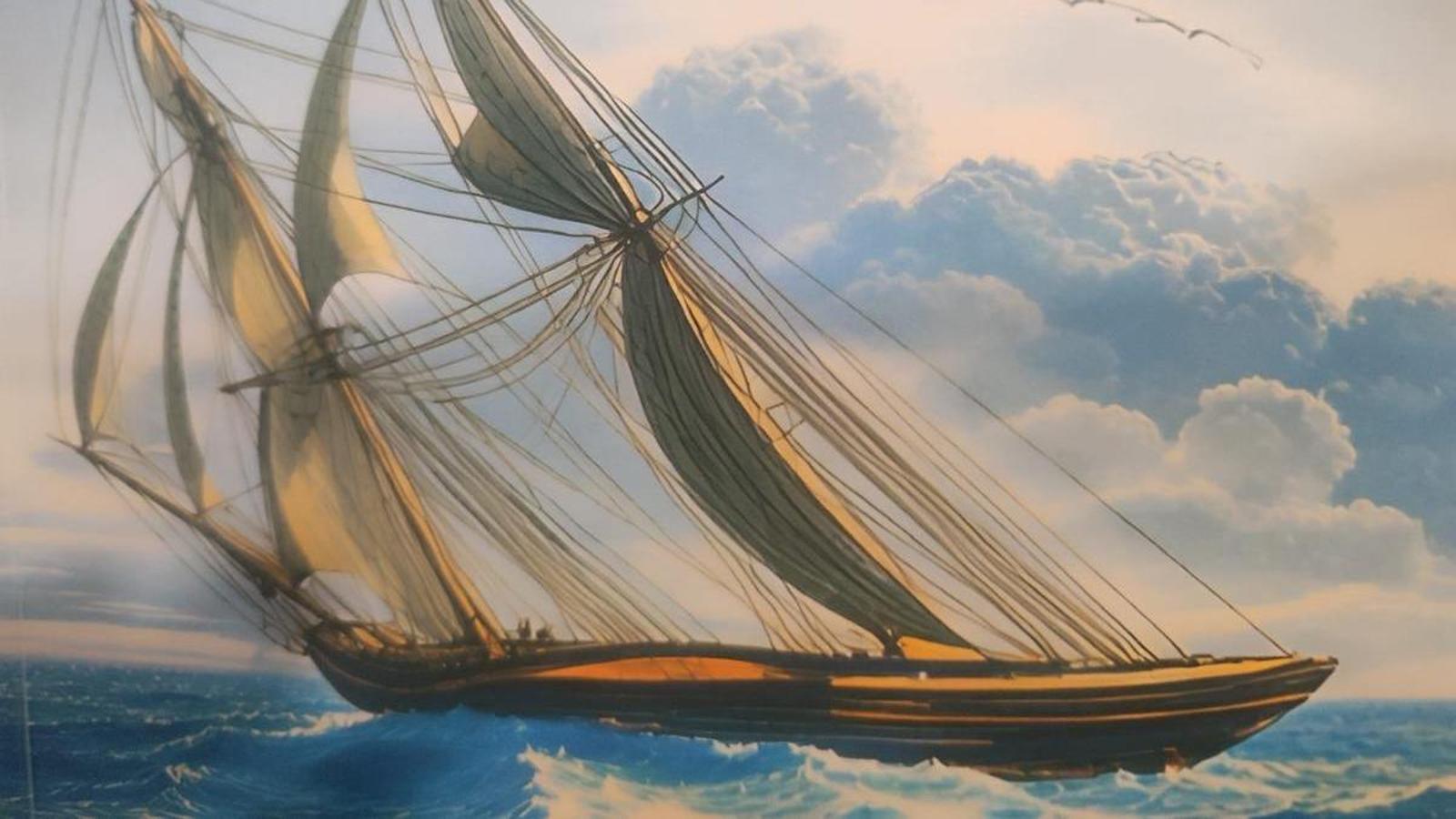

Linked to the slave trade, Pere Gibert, born in Altafulla, was the last Catalan pirate. In 1832 he attacked the American merchant ship Mexican, which had departed from the town of Salem – the one from the witch hunts of 1692 – in Massachusetts, and stole the 20,000 dollars in silver it was carrying. Jordi Maluquer de Motes, emeritus professor of economic history at the UAB, has reconstructed the true events in the novel El darrer viatge de la goleta Panda (Editorial Base). The main events narrated are real and documented.
Pere Gibert can be considered not only the last Catalan pirate, but the last in the West. Tried in Boston, this merchant marine captain was found guilty and publicly executed on June 11, 1835. The press of the time gave ample coverage. He was not a barbaric criminal with an eye patch and a hook for a hand; he was a man in his forties with remarkable education and culture, who, if at the beginning of the trial he stirred up popular anger, in the end he ended up awakening admiration and compassion due to his dignified serenity and the doubts about the judicial proceedings to which he was subjected, described in great detail by Maluquer.
The war between Spain and the former continental American colonies had led to privateering for years as a weapon of one against the other. When committing the attack, Gibert raised the Colombian flag. With the intention of leaving no trace, he ordered all the crew members of the Mexican to be killed and for it to be set on fire so that it would sink without a trace. But his orders were not obeyed: the attackers locked the people from the Mexican in the holds, but did not kill them. And the Americans managed to get out of the hold, extinguish the fires, and, despite the damage, set course back to Salem. The news soon reached all corners of the country.
Gibert, once aware of the situation, decided to change the appearance of the schooner in a discreet port of the Matanzas abbey –the hull was painted another color and the figurehead was changed–, loaded provisions and set course for Africa, to increase the loot in the Gulf of Guinea with the slave trade, which he would acquire from African kings in exchange for weapons, brandy, and clothing, and which he would later sell to other ships for transport to America. The price had risen as the British and Americans, great slave traders for centuries, had abandoned the trade due to the prohibition in their countries. Gibert's objective was for time to erase the matter of the Mexican and to take advantage of the wait to get richer and retire. He had a wife and two sons in Altafulla who barely knew him and were waiting for him.
Pere Gibert had studied at the pilot school in Barcelona and dreamed of making a fortune in America, like an uncle of his. He ended up opening a business in Havana, but his main activity continued to be that of a sailor transporting sugar, molasses, rum, tobacco, and wines to the USA. He had also participated in some slave expedition. In exchange for maintaining tolerance with the slave trade and slavery, increasingly prohibited throughout the world, Cuba had not participated in the Bolivarian struggle for emancipation.
The only problem –not a minor one– of Gibert's plan was the British war squadron, very active against the slave trade. In the book, the relationship with the African peoples is very interesting, as is the pursuit by the British, with both sides playing cat and mouse at sea. The duel between the Catalan merchant sailor Gibert and the Scottish aristocrat Henry D. Trotter becomes obsessive. The counterpoint is found in the king of the Orungu, Bango, and his three hundred or so wives with whom he had fathered more than six hundred children. Bango offers Gibert a daughter to help whiten his race. They strike up a mutually beneficial friendship, of course.
The Gibert, Bango, and Trotter triangle ends in an unpredictable way. The fact is that, after a few months, Gibert and part of his crew are taken prisoner first to England and then to the USA, where they will be judged with the outcome that Maluquer has already announced from the beginning and which does not detract from the emotion of a dramatic adventure, not only for the protagonist, but for everything it shows of colonialism and the slave trade.
A separate chapter is deserved by the trial, which ends up becoming a farce. Despite the weak evidence against Gibert and his men and the procedural deficiencies, the verdict is predetermined, and high politics plays no minor role. Here again, Maluquer's hand is noticeable in the analysis and contextualization of the facts. Paradoxically, the defense lawyer for the Catalan captain is the lawyer David L. Child, a young anti-slavery lawyer who, however, out of professional duty, fights to the utmost for his client to have a fair trial. Through his wife, the poetess Lydia Maria Child, he reaches the president of the USA, Andrew Jackson, so that he may grant Gibert a pardon. Despite the president's conviction that the trial has not had the necessary guarantees, the reason of state against piracy and slavery ultimately prevails. And Gibert dies on the gallows. The last Catalan pirate.
